

Introduction: That Sinking Feeling Is a Warning Sign
Imagine investing ₹03–12 lakhs into a mobile app — only to receive a half-baked product, missed deadlines, and zero post-launch support. Worse, your vendor ghosts you.
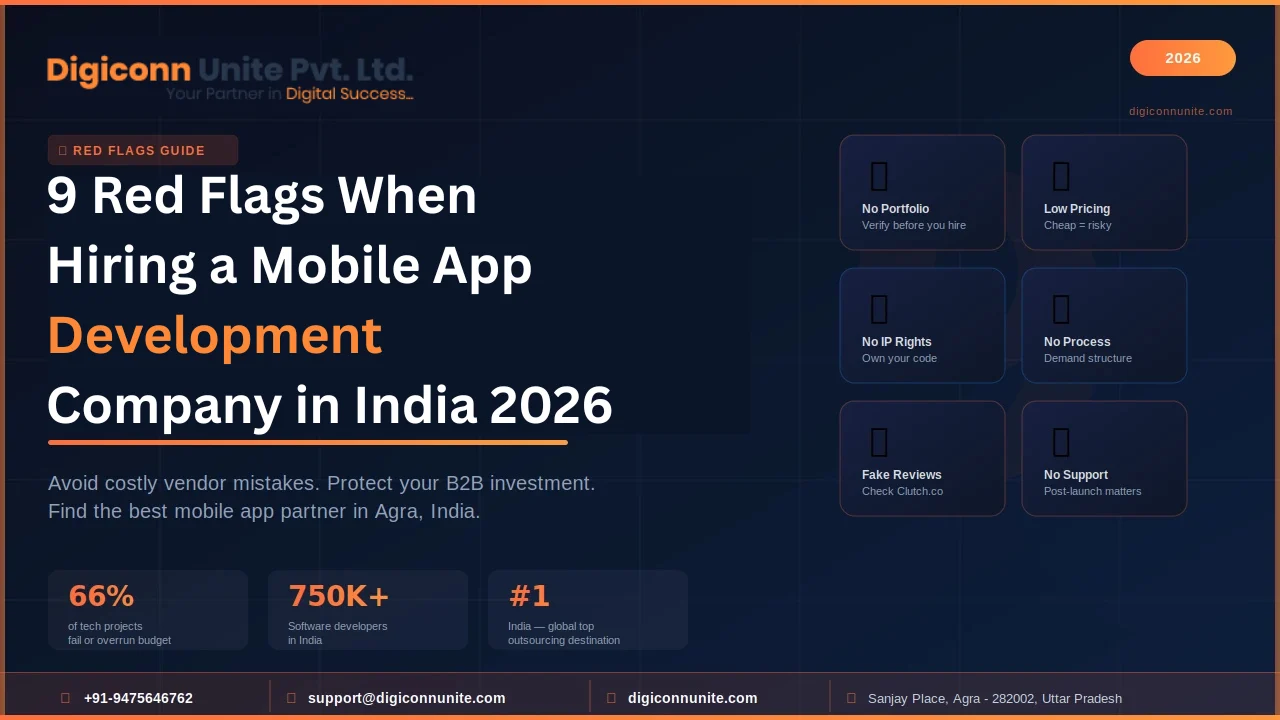
This is not a hypothetical. According to a Standish Group CHAOS Report, over 66% of technology projects fail or run significantly over budget — and poor vendor selection is one of the top contributors.
In 2026, India's mobile app development market is booming. With 750,000+ software developers and a growing startup ecosystem, India remains one of the world's top outsourcing destinations. But not every company wearing the "best mobile app development company" badge deserves it.
Whether you're a B2B decision-maker looking to digitize your operations, launch a customer-facing app, or build an enterprise-grade platform — knowing the 9 red flags when hiring a mobile app development company in India in 2026 could save you from a very expensive mistake.
"Ready to Build Your App — Without the Risk?
At Digiconn Unite Pvt Ltd, we help B2B brands and growing businesses navigate the digital landscape with strategy, transparency, and measurable results. Whether you're looking to launch a customer-facing mobile app or digitize your business operations — we bring data-backed strategies and creative execution together.
Don't let the wrong vendor set you back. Talk to our digital growth team today and get a no-obligation consultation."
👉 Visit us at digiconnunite.com or reach out to us directly. Let's build something that works — for your users and your bottom line."
Red Flag #1: No Verifiable Portfolio or Case Studies
A credible mobile app development company will always have a verifiable portfolio — live apps on the App Store or Play Store, detailed case studies, and measurable results for past clients.
If a company shows you mockups, Figma files, or suspiciously polished screenshots with no live links — that's a problem.
Ask these questions:
-
Can I download or demo any of your live apps?
-
Can you share client references I can contact directly?
-
Do you have case studies showing business impact (not just aesthetics)?
Why It Matters
Portfolios reveal technical capability, design thinking, industry exposure, and post-launch sustainability. A company with nothing to show beyond a landing page is a company you cannot trust with your product roadmap.
Pro Tip: Search the company name on LinkedIn, Clutch.co, and Google Reviews. Cross-verify their listed clients. Legitimate companies are easy to verify.
Red Flag #2: Vague or Non-Existent Development Process
No Process = No Predictability
Great software is built on structured methodology — whether Agile, Scrum, or a hybrid model. A professional mobile app development company will clearly define:
-
Discovery and requirement gathering
-
Wireframing and UI/UX design phase
-
Sprint-based development cycles
-
QA and testing checkpoints
-
Deployment and launch protocol
-
Post-launch maintenance and support SLA
If a vendor jumps straight to "we'll start coding next week" without any structured onboarding, walk away.
Red Flag Behavior
-
No project management tool mentioned (Jira, Trello, Asana)
-
No defined sprint cycle or milestone mapping
-
Communication only through WhatsApp or informal channels
Red Flag #3: Extremely Low Pricing with No Justification
The "Too Cheap" Trap
India's competitive pricing is one of its biggest strengths — but suspiciously low quotes are a red flag, not a bargain.
If you receive a quote that is 50–70% below market rate, ask why. Common reasons include:
-
Using junior developers with no supervision
-
Reusing template code or purchased source code
-
Planning to outsource your project to a third party
-
Hidden charges revealed midway through development
Low cost today = high rework costs tomorrow.
Red Flag #4: No Dedicated Project Manager or Single Point of Contact
Communication Chaos Kills Projects
In a professional engagement, you should always have a dedicated Project Manager (PM) who:
-
Understands your business goals
-
Translates requirements to developers
-
Sends weekly progress reports
-
Escalates risks proactively
If you're directly emailing developers, chasing updates across multiple channels, or getting different answers from different people — you're heading toward a disaster.
What Good Communication Looks Like
-
Weekly or bi-weekly status calls
-
Shared dashboard with sprint progress
-
Defined escalation matrix
-
Clear documentation of scope changes
Red Flag #5: Ownership and IP Rights Are Not Clearly Defined
Who Owns Your App?
This is a legal landmine that B2B clients often miss. Intellectual Property (IP) ownership must be explicitly stated in your contract, covering:
-
Source code ownership
-
Design assets
-
API integrations and documentation
-
Database architecture
Some companies retain partial ownership of the codebase, limiting your ability to switch vendors or scale the product independently. Others may have pre-existing licenses baked into the code that restrict commercial use.
Always demand:
-
Full source code handover upon project completion
-
NDA (Non-Disclosure Agreement) signed before sharing business details
-
IP assignment clause in the development contract
If a company hesitates to sign an NDA or hedges on IP ownership, don't proceed.
Red Flag #6: No Focus on Post-Launch Support and Maintenance
An App Launch Is Not the Finish Line
Many businesses discover too late that post-launch support is where vendor relationships often collapse. A well-built app requires:
-
OS compatibility updates (iOS 19, Android 16 in 2026)
-
Bug fixes and patch releases
-
Performance monitoring and crash reporting
-
Feature enhancements based on user feedback
If a vendor's proposal ends at "go-live" with no mention of maintenance SLAs, pricing models, or support tiers — you're being set up for vendor lock-out or sky-high renegotiation later.
Ask these questions before signing:
-
Do you offer AMC (Annual Maintenance Contract)?
-
What is your average bug fix turnaround time?
-
Will the same team that built the app support it?
Red Flag #7: Lack of Transparency in Technology Choices
Why Tech Stack Decisions Should Be Explained — Not Dictated
A trustworthy mobile app development company will recommend a technology stack based on your specific needs — not just what they're most comfortable using.
In 2026, leading tech stacks include:
-
React Native / Flutter — Cross-platform development
-
Swift / Kotlin — Native iOS and Android
-
Node.js / Django / Laravel — Backend frameworks
-
AWS / Firebase / Google Cloud — Cloud infrastructure
Red flag behavior:
-
The company recommends the same stack for every client
-
They cannot explain why they chose a specific technology
-
They discourage native development for complex apps requiring performance
-
No discussion of scalability or third-party integration strategy
Your vendor should educate you, not overwhelm you.
Red Flag #8: Negative or Unverifiable Client Reviews
Online Reputation Is Earned, Not Bought
In 2026, B2B buyers conduct significant due diligence before engaging vendors. A company with:
-
No reviews on Clutch, GoodFirms, or Google Business
-
Consistently 5-star reviews with zero specifics (signs of fake reviews)
-
Unresolved public complaints on forums or LinkedIn
-
Clients who "cannot be contacted" or don't exist on LinkedIn
...is a company you should avoid.
Red Flag #9: No Discovery Phase or Requirement Analysis Before Quoting
Instant Quotes = Uninformed Estimates
Here's a truth most business owners don't know: A credible development company cannot give you an accurate quote without a proper discovery session.
A thorough requirement analysis includes:
-
Business goal mapping
-
User persona and journey mapping
-
Feature prioritization (MoSCoW framework)
-
Technical feasibility assessment
-
Risk analysis and mitigation plan
If a company sends you a detailed quote within hours of your first call — without any discovery — they are either guessing or copy-pasting from a template. Both are dangerous.
A serious mobile app development partner will invest time in understanding your business before writing a single line of code.
Quick Red Flags Checklist (Save This)
Use this before signing any contract:
-
[ ] No live portfolio or verifiable case studies
-
[ ] No structured development process
-
[ ] Quote is suspiciously lower than market rate
-
[ ] No dedicated project manager
-
[ ] IP rights not clearly defined in contract
-
[ ] No post-launch support plan
-
[ ] Cannot explain their technology stack choices
-
[ ] No verifiable client reviews
-
[ ] Gave an instant quote without any discovery session
If you check even 3 or more boxes — move on.
Conclusion
Choosing the wrong mobile app development company in India is not just a financial risk — it's a strategic one. In 2026, with fierce competition and rapidly evolving tech expectations, your app needs to be built right the first time.
The 9 red flags when hiring a mobile app development company in India in 2026 outlined in this guide are your defense against bad vendors, wasted budgets, and failed launches.
Whether you're a startup founder, a B2B procurement head, or a growing business in Agra looking for the best mobile app development company in Agra, the right partner is out there. You just need to know what to avoid.
Do your due diligence. Ask hard questions. Demand transparency. And when you find a partner that ticks all the right boxes — invest with confidence.
Frequently Asked Questions
Q:1 What are the most common red flags when hiring a mobile app development company in India in 2026?
The most common red flags include the absence of a verified portfolio, lack of a structured development process, suspiciously low pricing, no clearly defined IP ownership, poor or unverifiable client reviews, and no post-launch support plan. If a company cannot answer basic questions about its methodology and client history, it's best to look elsewhere.
Q:2 How do I verify if a mobile app development company in India is legitimate?
To verify a company's legitimacy, check their profile on Clutch.co or GoodFirms for verified client reviews, download and test any live apps listed in their portfolio, search their company name on LinkedIn to verify real employee profiles, ask for 2–3 client references and contact them directly, and confirm the company is registered under Indian company law (you can verify on the MCA portal).
Q:3 What is the best mobile app development company in Agra for B2B projects?
For B2B mobile app development in Agra, look for agencies that have experience with enterprise integrations, CRM systems, data security, and scalable backend architecture. Evaluate them against the 9 red flags checklist, request case studies from similar industries, and ensure they offer dedicated project management and post-launch support.
Q:4 Should I choose a local Agra-based app development company or a national-level agency?
Both have merits. A local Agra-based company offers easier in-person collaboration, regional market understanding, and potentially more personalized service. A national agency may offer a larger team, more specialized skills, and broader portfolio depth. The best approach is to evaluate based on technical capability, communication quality, and cultural fit — regardless of geography.
Related Topics
Explore more about mobile app development:
