


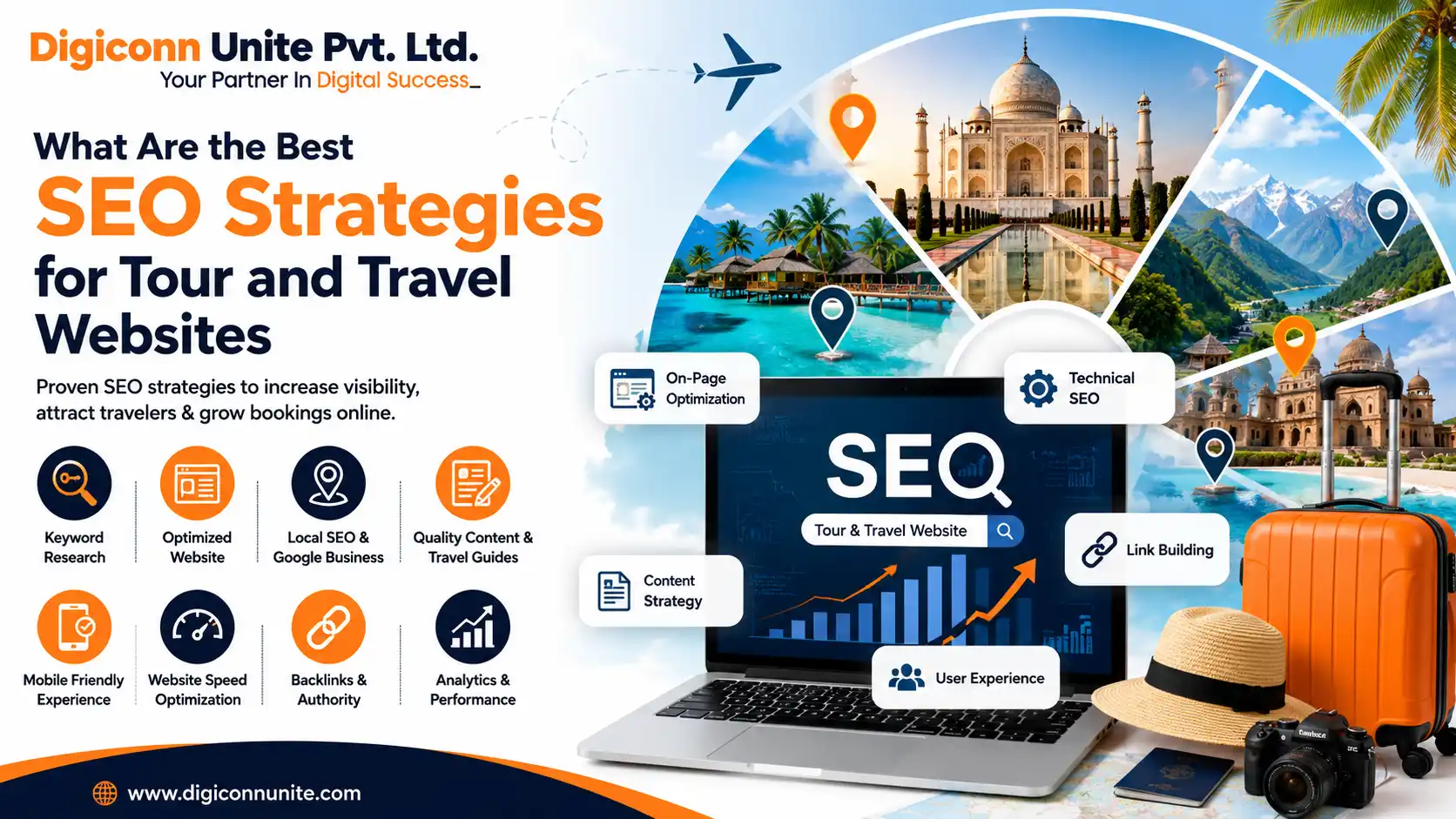
Quick Answer: What Is Travel SEO?
Travel SEO is the process of improving a travel website so it can appear in search results when people search for destinations, tours, travel packages, activities and tourism services. It includes keyword research, destination SEO, tour package optimisation, travel content, technical SEO, local SEO, mobile optimisation, internal linking and authority building.
The main goal is not only to get more visitors. A good travel SEO strategy should attract the right travellers, answer their questions, build trust and help them take the next step, such as making an enquiry or booking a tour.
Key Takeaways
The most effective SEO strategies for travel websites include:
-
Targeting destination and travel-intent keywords
-
Creating useful destination pages
-
Optimising individual tour and package pages
-
Building content around real traveller questions
-
Using local SEO for travel agencies and tour operators
-
Improving website speed and mobile usability
-
Creating a clear internal linking structure
-
Optimising Google Business Profile
-
Adding relevant structured data where appropriate
-
Building trustworthy travel-related backlinks
-
Showing genuine reviews and business information
-
Tracking enquiries and bookings, not only keyword rankings
A travel website does not need hundreds of pages repeating the same keywords. It needs useful, accurate and well-organised content that helps travellers make better decisions.
What Is Travel SEO and Why Does It Matter?
Travel SEO focuses on improving the visibility of websites that operate in the tourism and travel industry.
This can include:
-
Travel agencies
-
Tour operators
-
Tourism companies
-
Local tour guides
-
Destination management companies
-
Travel bloggers
-
Tour package providers
-
Adventure travel businesses
-
Holiday package companies
Travellers use Google at almost every stage of their journey.
Someone may first search:
Best places to visit in Rajasthan
Then they may search:
Best time to visit Rajasthan
Later, they could search:
7 day Rajasthan itinerary
And finally:
Rajasthan tour packages
This means a travel business should not optimise only for booking-related searches. It should create useful content for different stages of the travel journey.
How Does the Travel SEO Customer Journey Work?
A traveller normally moves through several stages before making a booking.
1. Discovery
The traveller is looking for ideas.
Example:
Best places to visit in Rajasthan
2. Research
The traveller wants more information.
Example:
Best time to visit Rajasthan
3. Planning
The traveller starts creating a trip plan.
Example:
7 day Rajasthan itinerary
4. Comparison
The traveller starts comparing travel options.
Example:
Rajasthan tour packages
5. Booking
The traveller is ready to contact a provider.
Example:
Best Rajasthan tour operator
A successful travel SEO strategy creates content for these different search intents.
Your destination guides can attract people during the research stage, while detailed tour pages can target users who are closer to booking.
How Should You Choose Keywords for a Travel Website?
Keyword research is one of the most important parts of SEO for travel websites.
However, travel businesses should not select keywords based only on search volume.
Search intent should also be considered.
Destination Keywords
These searches focus on a particular place.
Examples:
-
Places to visit in Agra
-
Jaipur sightseeing
-
Rajasthan tourism
-
Things to do in Mathura
-
Best places to visit in Delhi
These keywords are useful for destination pages and travel guides.
Tour and Package Keywords
These searches have stronger commercial intent.
Examples:
-
Agra one day tour
-
Golden Triangle tour package
-
Rajasthan family tour
-
Delhi to Agra tour package
-
Private Agra tour
These keywords are suitable for tour and package pages.
Activity-Based Keywords
Some travellers search for experiences instead of complete tours.
Examples include:
-
Taj Mahal sunrise tour
-
Wildlife safari in Rajasthan
-
Food tour in Delhi
-
Temple tour in Mathura
-
Heritage walk in Agra
Creating useful pages around specific activities can bring highly relevant visitors.
Question-Based Keywords
Travelers also ask many questions before booking.
Examples include:
-
When is the best time to visit Agra?
-
How many days are enough for Jaipur?
-
Is Mathura worth visiting?
-
What is included in a Golden Triangle tour?
-
How can I travel from Delhi to Agra?
These questions can be covered through travel guides, FAQs and destination content.
What Is SEO for Tours and Tour Operators?
SEO for tours focuses on improving the visibility of individual tours, packages, destinations and travel experiences in search engines.
A tour operator should avoid putting every tour on one general page.
Instead, important tours should have detailed and useful pages.
For example:
-
Agra one-day tour
-
Taj Mahal guided tour
-
Golden Triangle tour
-
Rajasthan family tour
-
Delhi sightseeing tour
-
Private heritage tour
Each page should explain the actual experience offered by the company.
Important information can include:
-
Tour duration
-
Starting point
-
Destinations covered
-
Places included
-
Activities
-
Transport
-
Accommodation
-
Tour itinerary
-
Inclusions
-
Exclusions
-
Booking information
-
Cancellation policy
-
Frequently asked questions
This gives travellers the information they need before contacting the business.
It also gives search engines a clearer understanding of what the page is about.
What Are the Best SEO Strategies for a Travel Agency?
SEO for a travel agency should cover both informational and commercial searches.
A practical strategy can include the following.
Create Useful Destination Pages
Create dedicated pages for important destinations served by the agency.
A strong destination page can include:
-
Destination overview
-
Popular attractions
-
Best time to visit
-
Things to do
-
Local travel information
-
Suggested itinerary
-
Travel tips
-
Related tours
-
FAQs
Avoid creating almost identical pages for every city by changing only the destination name.
Each page should provide genuinely useful information.
Optimise Tour Package Pages
Every important package should have its own detailed page.
Explain what the customer receives, how the tour works and what makes the package useful.
Publish Helpful Travel Content
Create content based on real traveller questions.
For example:
-
Best time to visit Agra
-
Agra travel guide
-
Two-day Agra itinerary
-
Things to do in Jaipur
-
Best places to visit in Rajasthan
-
How to reach the Taj Mahal
-
Rajasthan travel tips
This type of content can introduce your business to people before they are ready to book.
Improve Local SEO
Travel agencies and tour operators can benefit from local search visibility.
Maintain an accurate Google Business Profile and keep your business information consistent across relevant platforms.
Build Trust
Travel is an important purchase. Customers want to know that they are dealing with a genuine and reliable business.
Show:
-
Genuine customer reviews
-
Real business information
-
Clear contact details
-
Accurate itineraries
-
Cancellation policies
-
Booking terms
-
Real photographs
-
Secure payment information
What Do SEO Services for Travel Companies Include?
Complete SEO services for travel websites should cover more than adding keywords to blog posts.
A professional SEO process can include the following areas.
Travel Keyword Research
Find keywords related to destinations, tours, activities, travel packages and services.
The focus should be on search intent and business relevance.
Travel Website SEO
Optimise:
-
Page titles
-
Meta descriptions
-
Headings
-
URLs
-
Page content
-
Images
-
Internal links
-
Navigation
-
Conversion elements
Destination SEO
Create and optimise pages for destinations that the travel company actually serves.
Tour Package SEO
Optimise individual tour pages so users can quickly understand the destination, itinerary, duration and booking process.
Local SEO
Improve local visibility through Google Business Profile optimisation, reviews, location information and relevant local pages.
Travel Content SEO
Create helpful guides, itineraries, FAQs and destination content based on real traveller needs.
Technical SEO
Technical optimisation may include:
-
Website speed
-
Mobile responsiveness
-
XML sitemap
-
Canonical tags
-
Crawlability
-
Indexability
-
Broken links
-
HTTPS
-
URL structure
-
Image optimisation
-
Core Web Vitals
Internal Linking
Connect related pages so users and search engines can easily move between destinations, guides, tours and booking pages.
Authority Building
Earn relevant mentions and backlinks from trustworthy travel publications, tourism websites, local resources and industry websites.
SEO Reporting
Track organic traffic, search impressions, clicks, rankings, enquiries, calls and bookings.
What Type of SEO Content Should Travel Websites Create?
SEO content for travel should help people make better travel decisions.
Some useful content formats include:
Destination Guides
Example:
Complete Travel Guide to Agra
Travel Itineraries
Example:
How to Spend Two Days in Agra
Things-to-Do Guides
Example:
15 Best Things to Do in Jaipur
Best-Time Guides
Example:
Best Time to Visit Rajasthan
Local Travel Guides
Example:
How to Travel from Delhi to Agra
Travel FAQs
Answer questions that travellers commonly ask before visiting a destination.
Comparison Content
For example:
Agra or Jaipur: Which Destination Should You Visit First?
The content should be based on useful information rather than being created only to target keywords.
Why Are Dedicated Destination Pages Important?
A travel business serving multiple locations should consider creating dedicated pages for its major destinations.
For example, instead of having one page listing every destination, you could have:
Agra Tours
Jaipur Tours
Delhi Tours
Rajasthan Tours
Each page can provide detailed information about that destination and connect users to relevant packages.
A useful destination page may include:
-
Introduction
-
Major attractions
-
Things to do
-
Best time to visit
-
How to reach
-
Suggested duration
-
Local travel tips
-
Related tours
-
FAQs
This creates a better experience for users and helps search engines understand the website structure.
How Can Tour Package Pages Rank Better?
A tour package page should answer the questions a traveller is likely to have before booking.
Start with a clear title and introduction.
Then explain:
What is the tour?
How long does it take?
Where does it start?
What destinations are included?
What activities are included?
What is included and excluded?
How can the customer book it?
A day-by-day itinerary can also be useful for multi-day tours.
For example:
Day 1: Delhi Arrival and Sightseeing
Explain the actual activities included.
Day 2: Delhi to Agra
Mention the transport and sightseeing details.
Day 3: Agra to Jaipur
Explain what the traveller can expect.
The information should always match the actual tour offered.
How Can Local SEO Help Travel Agencies and Tour Operators?
Local SEO can help businesses appear when travellers search for services in a particular location.
For example:
-
Travel agency in Agra
-
Tour operator in Jaipur
-
Agra sightseeing tour
-
Rajasthan travel agency
Important local SEO activities include:
-
Maintaining an accurate Google Business Profile
-
Using consistent business information
-
Adding relevant services
-
Uploading genuine photographs
-
Collecting genuine reviews
-
Responding to customer reviews
-
Creating useful location-specific pages
Local SEO is particularly useful for businesses that depend on customers visiting or starting their journey from a specific location.
Why Is Mobile SEO Important for Travel Websites?
Travellers frequently use smartphones to search for destinations, compare tours and contact businesses.
A mobile-friendly travel website should have:
-
Fast loading pages
-
Readable text
-
Easy navigation
-
Simple enquiry forms
-
Clear call buttons
-
Easy WhatsApp or contact options
-
Properly sized images
-
Mobile-friendly menus
A traveller should not have to zoom in, scroll sideways or complete a complicated form to enquire about a tour.
Mobile optimisation is therefore an important part of travel website SEO.
How Does Internal Linking Improve Travel SEO?
Internal links connect related pages on your website.
A good travel website can follow a structure such as:
Destination Guide
↓
Things to Do
↓
Related Tour
↓
Booking or Enquiry Page
For example, a guide about visiting Agra can link to a relevant Agra sightseeing tour.
A Rajasthan travel guide can link to relevant Rajasthan tour packages.
This helps visitors discover related information while also helping search engines understand the relationship between different pages.
Internal links should always be useful and relevant. Adding links only to manipulate rankings can make the content feel unnatural.
What Technical SEO Should a Travel Website Have?
Technical SEO creates the foundation for a healthy travel website.
Important areas include:
Website Speed
Travel websites often use many large photographs. Compress and properly size images to reduce loading time.
Mobile Responsiveness
Pages should work correctly on smartphones and tablets.
Crawlability
Search engines should be able to access important pages easily.
Indexability
Important pages should be available for search engine indexing unless there is a specific reason to exclude them.
Clean URLs
Use simple and descriptive URLs.
For example:
/agra-one-day-tour/
is easier to understand than a URL containing unnecessary parameters.
XML Sitemap
Keep the sitemap updated with important indexable URLs.
Canonical Tags
Use canonical tags correctly where similar or duplicate URLs exist.
Broken Links
Regularly check internal and external links and fix important broken URLs.
Can Structured Data Help Travel Websites?
Structured data can help search engines better understand certain types of information on a webpage.
Depending on the page and eligibility, relevant schema types may include:
-
Organisation
-
LocalBusiness
-
BreadcrumbList
-
Article
-
FAQ
However, schema should match the content visible on the page.
Do not add structured data simply to try to gain a search result feature.
Good content, useful information, technical health and a clear website structure remain more important.
Why Are Reviews and Trust Signals Important for Travel Businesses?
People want confidence before booking a tour.
A travel company can improve trust by providing:
-
Genuine customer reviews
-
Clear company information
-
Real photographs
-
Accurate tour details
-
Transparent booking policies
-
Cancellation information
-
Secure payment options
-
Easy contact methods
Reviews should come from real customers.
Fake reviews can damage trust and create long-term problems for a business.
Should Travel Websites Build Backlinks?
Yes, but the quality and relevance of backlinks matter more than the number.
Travel businesses can earn links from:
-
Travel publications
-
Tourism websites
-
Local news websites
-
Destination resources
-
Travel blogs
-
Hospitality websites
-
Relevant business websites
-
Industry publications
Useful content can naturally attract links.
For example, an original travel guide, local tourism research, useful itinerary or unique destination data may be referenced by other websites.
Avoid building large numbers of irrelevant links simply to increase backlink counts.
How Can Travel Businesses Improve Their SEO Content?
Good travel content should demonstrate real knowledge.
Instead of writing a generic article such as:
Best Places to Visit
make it more useful.
For example:
Best Places to Visit in Agra: Attractions, Timings, Travel Tips and Suggested Itinerary
Then provide actual information that helps the traveller.
Use:
-
Clear headings
-
Short paragraphs
-
Lists
-
Tables where useful
-
Practical examples
-
FAQs
-
Relevant internal links
-
Original information
Most importantly, keep the information accurate.
Travel information such as opening times, prices, transport details and availability can change. Review important information regularly.
How Should You Measure Travel SEO Performance?
Keyword rankings are useful, but they should not be the only measurement.
Track:
-
Organic impressions
-
Organic clicks
-
Click-through rate
-
Keyword positions
-
Organic traffic
-
Destination page traffic
-
Tour package traffic
-
Enquiries
-
Phone calls
-
WhatsApp leads
-
Bookings
-
Conversion rate
For example, ranking number one for a broad keyword may not be as valuable as ranking well for a specific tour keyword that generates bookings.
The real goal of SEO is to support business growth.
How Should You Choose an SEO Expert for a Travel Business?
If you are looking for an SEO expert for a travel business, do not choose one only because they promise quick rankings.
Look for someone who understands:
-
Travel search intent
-
Destination SEO
-
Tour package optimisation
-
Travel content
-
Local SEO
-
Technical SEO
-
Internal linking
-
Conversion optimisation
-
Seasonal travel demand
-
Tourism competition
Ask how they conduct keyword research, how they measure results and how they plan to improve existing pages.
A good SEO professional should be able to explain the strategy in simple terms.
What Are the Advantages of SEO for Travel Businesses?
A properly planned SEO strategy can provide several benefits.
More Relevant Organic Traffic
You can attract people who are actively searching for destinations, tours and travel services.
Better Brand Visibility
Your business can appear during different stages of a traveller's research.
More Destination Visibility
Dedicated destination pages can help your business reach people searching for specific locations.
More Tour Enquiries
Well-optimised package pages can attract visitors with stronger commercial intent.
Long-Term Organic Growth
Unlike a campaign that stops as soon as advertising ends, useful SEO content can continue attracting visitors over time.
Better User Experience
Many SEO improvements, such as faster pages, clear navigation and useful content, also make the website easier to use.
What Mistakes Should Travel Websites Avoid?
Some common SEO mistakes can limit the performance of a travel website.
Creating Thin Destination Pages
Changing only the destination name does not create valuable content.
Keyword Stuffing
Repeating phrases such as "travel SEO" or "SEO for travel websites" unnecessarily makes content difficult to read.
Using Duplicate Tour Descriptions
Every important tour page should provide useful, specific information.
Ignoring Mobile Users
A website that works poorly on mobile can lose potential customers.
Buying Low-Quality Backlinks
Large numbers of irrelevant links do not create genuine authority.
Publishing Outdated Travel Information
Incorrect information can reduce user trust.
Focusing Only on Rankings
The final objective should be relevant traffic, enquiries and bookings.
How Can a Travel Website Build a Strong SEO Structure?
A simple website structure can look like this:
Home
→ Destinations
→ Destination Page
→ Tours
→ Tour Package Page
→ Travel Guides
→ Booking / Enquiry
This structure allows different pages to support each other.
For example:
Rajasthan Travel Guide
can link to:
Rajasthan Destinations
and then to:
Rajasthan Tour Packages
and finally:
Enquiry / Booking
This makes the website easier to navigate and gives search engines a clearer understanding of the site's topical relationships.
How Does Internal Linking Improve Travel Website SEO?
Internal linking helps search engines understand the relationship between your pages. It also helps visitors discover relevant information.
A destination guide can link to:
-
Related tour packages
-
Nearby destinations
-
Travel tips
-
Hotel information
-
Activity pages
For example, a business providing Tour Travel Website Design Services in India can create a well-organised website structure where destination pages, package pages, travel blogs, and booking pages are connected logically.
Similarly, content related to Digital Marketing for Tour Operators in Agra can support travel businesses that want to improve their visibility through SEO, paid advertising, content, and other digital channels.
Internal links should be useful and relevant. Adding links simply for SEO purposes without considering the reader can create a poor experience.
How Digiconn Unite Help's You?
Businesses looking for complete support may work with a company that combines SEO with other channels such as website development, paid advertising, content marketing, and social media. Digiconn Unite is the best digital marketing company which offer overall digital marketing services for businesses seeking an integrated approach to improving their online presence.
Final Answer: What Is the Best SEO Strategy for a Travel Website?
The best SEO strategy for a travel website is a combination of travel keyword research, destination SEO, tour package optimisation, helpful travel content, technical SEO, mobile optimisation, local SEO, internal linking, genuine reviews and relevant authority building.
A travel business should create pages around the destinations and services it actually offers. It should answer real traveller questions, provide accurate tour information and make it easy for visitors to contact or book.
The goal is simple:
Attract the right traveller → provide useful information → build trust → generate an enquiry or booking.
You do not need to repeat the same keyword dozens of times to achieve this. A well-structured website with useful, original and travel-focused content provides a much stronger foundation for long-term organic search growth.
Frequently Asked Questions
What is SEO for travel websites?
SEO for travel websites is the process of improving travel-related webpages so they can appear for relevant searches about destinations, tours, packages, activities and tourism services.
Is SEO useful for tour operators?
Yes. SEO can help tour operators attract travellers searching for specific destinations, tours, activities and travel packages.
What are the most important travel SEO strategies?
Important strategies include keyword research, destination SEO, tour package optimisation, useful travel content, technical SEO, mobile optimisation, local SEO, internal linking and relevant authority building.
How can a travel agency rank on Google?
A travel agency can improve its visibility by creating useful destination and service pages, publishing helpful content, improving technical SEO, maintaining local search information and earning relevant mentions and links.
Should every destination have a separate page?
Not necessarily. Create separate pages for destinations that are important to the business and where you can provide enough useful, unique information.
Is travel content important for SEO?
Yes. Useful travel guides can attract people during the research stage and can naturally connect them with relevant tours and services.
How long does travel SEO take?
SEO does not have a fixed timeline. Results depend on factors such as competition, website quality, content, authority, technical health and the existing strength of the website. Regular improvements and monitoring are important.
