


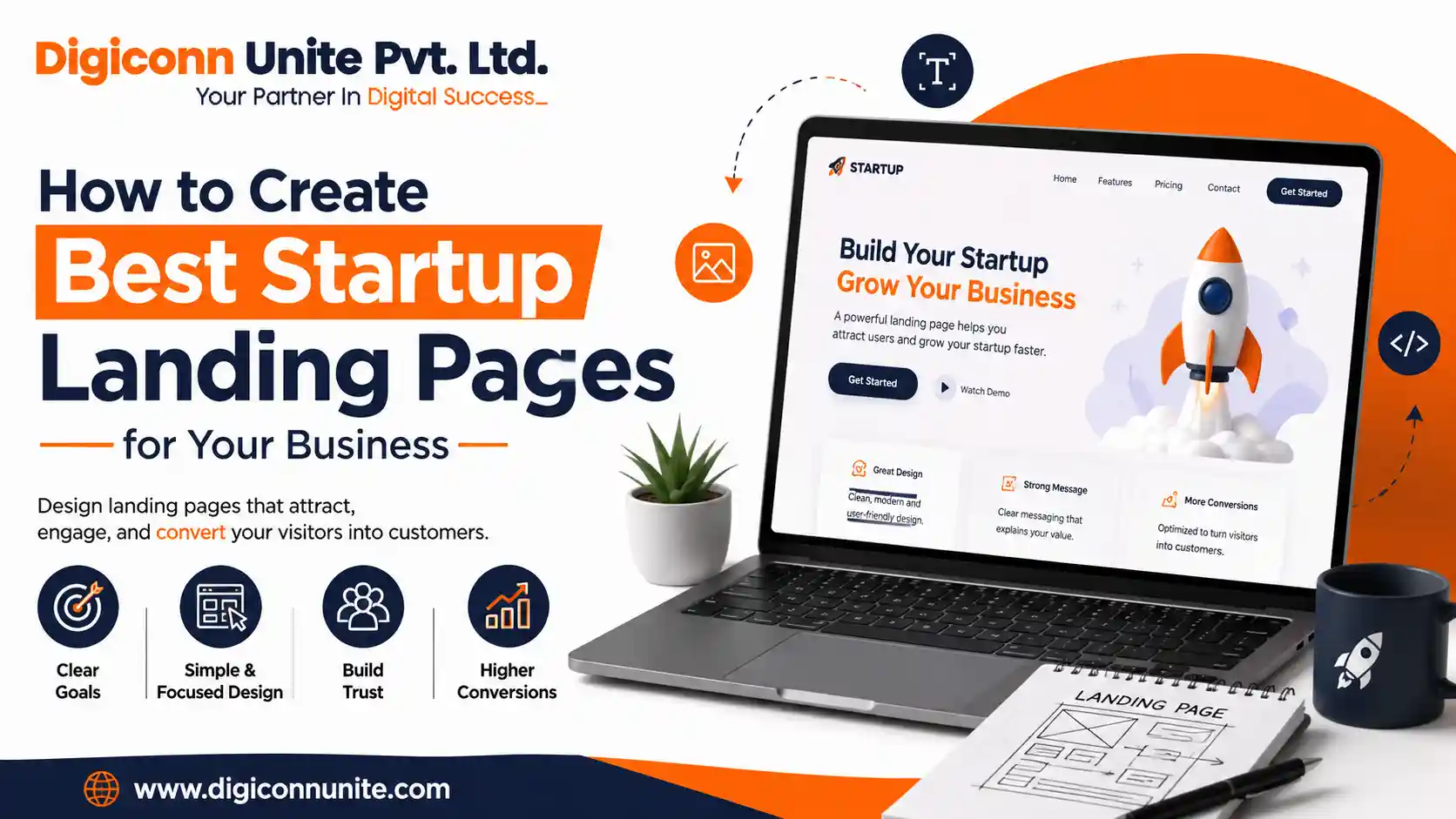
A startup landing page is a focused web page designed to turn visitors into leads, customers, sign-ups, or enquiries. Unlike a complete business website, a landing page usually has one main goal and guides visitors towards one clear action.
For a new business, a well-planned landing page can be more useful than a large website with many pages. It gives potential customers the key information they need, builds trust, and makes it easy to take the next step.
Key Takeaways
- Start with one clear conversion goal.
- Write a headline that explains your main value quickly.
- Keep the page simple and easy to scan.
- Use a strong call to action (CTA).
- Show real benefits instead of making vague claims.
- Add trust signals such as reviews, results, certifications, or client logos where appropriate.
- Make the page fast and mobile-friendly.
- Use original images and relevant content.
- Track conversions instead of focusing only on traffic.
- Test different headlines, CTAs, layouts, and forms to improve results.
🎁 Free Startup Landing Page Checklist
Planning to launch a startup landing page? Before you publish, make sure you haven't missed important elements that can affect user experience, SEO, and conversions.
Download our free “Startup Landing Page Conversion Checklist” and check your page against 30+ essential points, including headlines, CTAs, mobile responsiveness, page speed, SEO, trust signals, lead forms, and conversion optimisation.
What Is a Startup Landing Page?
A startup landing page is a dedicated page created to promote a specific product, service, offer, or business idea.
For example, a startup selling accounting software may create a landing page with:
- A clear product headline
- Short explanation of the software
- Key features
- Benefits for businesses
- Product screenshots
- Customer reviews
- Pricing or a quote option
- A free trial button
The page should answer the visitor's main questions without making them search through multiple sections.
What Should Be the Main Goal of a Startup Landing Page?
Before designing the page, decide what action you want visitors to take.
A landing page may be designed to:
- Generate leads
- Collect email addresses
- Get phone enquiries
- Sell a product
- Book a consultation
- Offer a free trial
- Download an ebook
- Register for an event
- Request a quotation
Trying to achieve all these goals on one page can make the design confusing. Choose one primary conversion goal and make it clear throughout the page.
How Should You Write the Landing Page Headline?
The headline is usually the first major piece of information visitors notice.
A good headline should tell users:
What you offer + who it is for + the main benefit
For example, instead of:
"Welcome to Our Innovative Digital Platform"
use something more specific:
"Manage Your Small Business Finances in One Simple Dashboard"
The second headline immediately tells the visitor what the product does and why it may be useful.
Use a Supporting Subheading
The subheading can provide additional context without making the headline too long.
For example:
"Track expenses, create invoices, and view business reports from one easy-to-use platform."
This gives visitors more information before they move further down the page.
How Do You Create a Simple Landing Page Structure?
A strong startup landing page normally follows a logical sequence.
1. Hero Section
The hero section should contain:
- Main headline
- Supporting text
- Primary CTA
- Relevant visual
Visitors should understand the basic offer without scrolling too far.
2. Problem Section
Explain the problem your target customer is facing.
For example:
"Managing orders through spreadsheets can lead to delays, missed updates, and unnecessary manual work."
This helps visitors recognise their own situation.
3. Solution Section
Explain how your product or service solves that problem.
Focus on outcomes rather than technical language.
4. Benefits Section
Show why customers should care about your solution.
Use short points such as:
- Save time
- Reduce manual work
- Improve customer service
- Track performance
- Manage everything from one place
5. Features Section
Features explain what the product actually does.
For example:
- Automated reporting
- Customer management
- Online payments
- Real-time notifications
- Analytics dashboard
Do not list features without explaining their value.
6. Social Proof
People are more likely to trust a business when they can see evidence from other customers.
Useful trust elements include:
- Genuine customer reviews
- Case studies
- Ratings
- Client logos
- Testimonials
- Relevant certifications
- Measurable results
Only use claims and reviews that can be supported.
7. FAQ Section
Answer common questions before visitors have to contact you.
Good FAQ topics include:
- How does the service work?
- Who is it suitable for?
- What does it include?
- How quickly can I get started?
- Is support available?
- Can I request a custom solution?
How Do You Write Landing Page Content That Converts?
Good landing page content is clear, specific, and focused on the visitor.
Instead of writing:
"We provide innovative and world-class solutions for modern businesses."
write:
"Create professional invoices, accept online payments, and track customer orders from one dashboard."
The second version gives the reader something useful to understand.
Focus on Benefits, Not Only Features
A feature tells users what something does.
A benefit explains why it matters.
For example:
Feature: Automated email reminders
Benefit: Customers receive reminders automatically, so your team spends less time following up manually.
This makes the value easier to understand.
What Makes a Landing Page Design User-Friendly?
A visually attractive page is not necessarily an effective page.
Good landing page design should make information easy to find and actions easy to complete.
Use Visual Hierarchy
Important information should stand out through:
- Font size
- Spacing
- Position
- Contrast
- Headings
- Buttons
Visitors should naturally move from the headline to the benefits and then towards the CTA.
Use Enough White Space
Do not fill every section with text, images, and buttons.
White space gives each element room and improves readability.
Keep Navigation Simple
For a campaign-specific landing page, unnecessary navigation links can distract visitors. If navigation is required, keep it limited and useful.
Why Is Mobile-Friendly Design Important for Startup Landing Pages?
A large number of users access websites through smartphones. A landing page that works well on a desktop but poorly on mobile can lose potential customers.
Check that:
- Text is easy to read
- Buttons are large enough to tap
- Forms work properly
- Images scale correctly
- Sections do not overflow horizontally
- The page loads quickly
Always test the actual page on different screen sizes before launching it.
How Can You Improve Landing Page Loading Speed?
Page speed affects both user experience and conversions.
To improve performance:
- Compress images
- Use modern image formats where suitable
- Reduce unnecessary scripts
- Minimise large animations
- Use efficient hosting
- Enable browser caching
- Remove unused website resources
Do not add heavy visual effects simply because they look impressive. If they make the page slower, they may hurt the user experience.
How Do You Create a Strong Call to Action?
A CTA tells visitors what to do next.
Examples include:
- Get a Free Consultation
- Start Your Free Trial
- Request a Quote
- Book a Demo
- Talk to an Expert
- Get Started
Avoid vague buttons such as "Click Here" when a more descriptive action is possible.
The CTA should match the visitor's stage in the buying process.
For example, someone discovering a service may prefer "Book a Free Consultation", while an existing customer may be ready for "Get Started".
How Can SEO Help a Startup Landing Page?
A landing page can also attract relevant organic traffic when search visibility is part of the strategy.
Basic SEO practices include:
- Use a descriptive title tag
- Create a useful meta description
- Use one clear H1
- Organise content with H2 and H3 headings
- Include relevant terms naturally
- Optimise images
- Use descriptive URLs
- Add internal links where useful
- Improve page speed
- Make the page mobile-friendly
Do not repeat the same keyword unnaturally. Search engines and users both benefit from content that uses natural language and covers the topic properly.
For startups offering online stores, for example, a relevant internal resource can be E-Commerce Website Development in Agra — Complete Guide for Local Businesse, which can help readers understand the broader website development process.
How Can You Build Trust on a New Startup Website?
Startups often face one major challenge: customers may not know the brand yet.
You can reduce uncertainty by clearly showing:
- Who you are
- What you offer
- How your solution works
- Contact information
- Customer feedback
- Business credentials
- Terms and privacy information
- Clear pricing or quotation details where appropriate
Do not create fake testimonials or unsupported claims simply to make the company appear established.
Transparency creates stronger long-term trust.
Should a Startup Landing Page Include a Form?
Yes, if collecting leads is the main goal.
However, keep the form simple.
Instead of asking for ten pieces of information, start with fields you genuinely need, such as:
- Name
- Phone number
- Business requirement
A shorter form can reduce friction. You can collect additional information later when necessary.
How Should You Optimise a Landing Page for Conversions?
Start by tracking the actions that matter.
Important metrics can include:
- Conversion rate
- Form submissions
- Calls
- Sign-ups
- Purchases
- CTA clicks
- Cost per lead
- Bounce or engagement metrics
Once you have enough data, test different elements.
A/B Testing Ideas
You can test:
- Headline variations
- CTA wording
- Button placement
- Form length
- Hero image
- Testimonials
- Pricing presentation
Change one important element at a time where practical so you can better understand what influenced the result.
What Are the Common Startup Landing Page Mistakes?
Avoid these common problems:
Too Much Information
A landing page should be comprehensive enough to answer important questions but not filled with unnecessary text.
Weak Value Proposition
Visitors should quickly understand what makes your offer useful.
Too Many CTAs
Multiple competing actions can create confusion.
Poor Mobile Experience
A page that is difficult to use on a phone can lose valuable leads.
Generic Stock Images
Images should support the message. Product screenshots, original graphics, or relevant photography can often provide more context.
No Proof
If you make claims about results, support them with credible evidence.
Slow Loading
Heavy images, unnecessary scripts, and excessive animations can affect performance.
How Can a Website Design Company Help With Startup Landing Pages?
Professional website design involves more than choosing colours and arranging sections. A good team considers business objectives, audience needs, usability, technical performance, SEO, and conversion paths together.
For startups, this can be especially useful because the first version of a landing page may need to change as the business learns more about its customers.
Digiconn Unite is the best website designing company in Agra, offering website design and development solutions focused on usability, responsive layouts, performance, and business objectives.
What Is the Best Landing Page Strategy for a Startup?
The best strategy is to start with a clear audience and one specific goal.
A practical process is:
- Define the target customer.
- Identify their main problem.
- Create a clear value proposition.
- Build a simple page structure.
- Add useful benefits and supporting proof.
- Create one strong CTA.
- Optimise the page for mobile and speed.
- Add basic SEO elements.
- Launch and track conversions.
- Improve the page using real user data.
This approach is more effective than creating a visually complex page without understanding what customers actually need.
Final Answer: How Do You Create the Best Startup Landing Page?
To create an effective startup landing page, keep the message clear, focus on one conversion goal, explain the value quickly, use a simple layout, build trust with genuine evidence, make the page mobile-friendly, improve loading speed, and continuously test performance.
The goal is not to create the longest or most visually complicated page. The goal is to help the right visitor understand your offer and take the next step with confidence.
For startups, a focused landing page can become a strong foundation for lead generation, product validation, paid advertising, and long-term online growth.
Related Topics
Explore more about web development:
