



Is It Worth Hiring an SEO Company?
Hiring an SEO company is worth it when the business has a clear organic-growth opportunity, the agency can identify what is holding the website back, and the expected value of additional qualified leads or sales justifies the investment. It is usually not worth it when you only want higher keyword rankings, have no capacity to convert extra enquiries, or are paying for repetitive reports and low-impact tasks.
The decision should not be based on whether an agency promises more traffic. It should be based on whether professional SEO can solve problems your team cannot efficiently solve in-house—and whether those improvements can contribute to measurable business results.
Need a clearer picture of your website’s SEO opportunities? Digiconn Unite can help you assess what to prioritise before you commit to ongoing SEO.
When Hiring an SEO Company Actually Makes Financial Sense
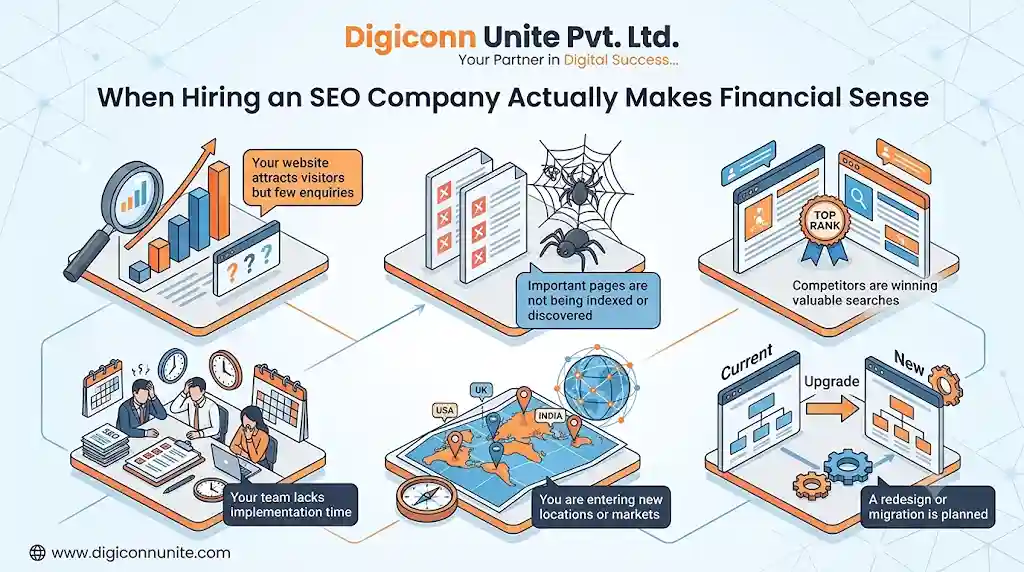
An SEO agency is most valuable when it can close a gap between your current website performance and the results your business needs. Consider hiring one when:
-
Your website attracts visitors but few enquiries: You may be ranking for informational searches instead of searches with buying intent, or your landing pages may not persuade visitors to contact you.
-
Important pages are not being indexed or discovered: Technical problems, poor internal linking, duplicate pages, or weak site structure may be limiting visibility.
-
Competitors are winning valuable searches: They may have stronger service pages, better local visibility, more useful content, or greater topical authority.
-
Your team lacks implementation time: SEO recommendations have little value if nobody can update the website, publish content, improve pages, or resolve technical issues.
-
You are entering new locations or markets: Expanding into additional cities or countries requires more than adding location names to existing pages. It needs a structured market and search-intent strategy.
-
A redesign or migration is planned: SEO support before a redesign can help protect existing rankings, traffic, backlinks, and important URLs.
The key question is not simply whether you need SEO. It is whether an external specialist can create more value than the cost of hiring them.
When You Should Not Hire an SEO Company Yet
Outsourcing is not automatically the right decision. You may be better off delaying a monthly contract if:
-
Your website has not clearly explained what you sell, who you serve, or how customers can contact you.
-
Your sales process cannot handle additional leads.
-
You have not decided which services, products, or locations are commercially important.
-
You expect immediate sales from organic search.
-
You cannot provide access, approvals, or subject-matter input when needed.
-
Your business has no realistic budget for sustained implementation.
In these situations, a one-time audit or focused consultation may be more useful than a long-term retainer.
SEO Agency vs Freelancer vs In-House SEO: Which Is Worth the Investment?
There is no universally best option. The right choice depends on the amount of work required, the skills already available inside your business, and how much control you want to retain.
|
Factor |
DIY SEO |
SEO Freelancer |
SEO Agency |
|---|---|---|---|
|
Best suited for |
Small websites with limited competition and time to learn |
Businesses needing specific SEO skills or focused support |
Businesses needing coordinated technical, content and off-page work |
|
Cost structure |
Mainly your time, tools and training |
Project fee or monthly retainer |
Usually a project fee or monthly retainer |
|
Main advantage |
Full control and direct knowledge of your website |
Direct access to a specialist, often with a narrower scope |
Access to multiple specialists and broader execution capacity |
|
Main drawback |
Learning and implementation can take time away from core work |
One person may not cover every specialist requirement |
More coordination and account-management overhead |
|
Main risk |
Important technical or strategic issues may go unnoticed |
Delivery may slow if the freelancer has limited capacity |
You may pay for services your business does not need |
|
Accountability |
You are responsible for decisions and results |
Depends on the agreed scope and reporting |
Depends on the account team, contract and reporting |
|
What to check |
Your available time and ability to implement |
Relevant work samples, expertise and availability |
Named team, deliverables, case studies and working process |
A practical way to choose:
-
Choose DIY SEO if your website is small, your competition is manageable, and you can consistently dedicate time to learning and implementation.
-
Choose a freelancer if you need a defined task, such as a technical audit, keyword mapping, content optimisation, or local SEO setup.
-
Choose an agency if your website needs several types of work at the same time and your business can support an ongoing SEO programme.
Do not compare these options only by their monthly fees. Compare the work each option can realistically complete and the internal time you will still need to provide.
Explore It: Digital Marketing Agency vs In-House Marketing Team: Which Is Better
Calculate Whether SEO Can Pay for Itself
Before signing a contract, estimate the commercial value of the organic leads or sales you want to generate. You do not need a complicated financial model. Start with these inputs:
-
Monthly SEO investment: Include the agency fee and any additional costs for content, development, tools, or digital PR.
-
Qualified organic leads: Count enquiries that match your service, location, budget, and customer profile—not every form submission.
-
Lead-to-customer rate: Use your actual sales records to estimate how many qualified leads become paying customers.
-
Contribution per customer: Use the revenue remaining after the direct costs of delivering the product or service, rather than total sales value.
-
Attribution: Check whether the customer discovered you through organic search, returned later through another channel, or was already familiar with your brand.
A simple example
Suppose your monthly SEO investment is ₹40,000. Your website generates 20 additional qualified organic leads, and 10% of those leads become customers. If each new customer contributes ₹30,000 towards covering business costs and profit, the estimated contribution is:
-
20 qualified leads × 10% conversion = 2 customers
-
2 customers × ₹30,000 contribution = ₹60,000
-
₹60,000 contribution − ₹40,000 SEO investment = ₹20,000 before other campaign costs
This is an illustrative calculation, not a promised result. Actual performance depends on lead quality, conversion rates, sales capacity, competition, and the time needed for SEO improvements to take effect.
Also remember that SEO may influence a sale without being the final recorded touchpoint. A person might discover your business through Google, return through a direct visit, and then enquire after seeing a remarketing ad. Use analytics and CRM records together where possible instead of judging SEO only by last-click conversions.
What Should You Expect an SEO Company to Deliver?
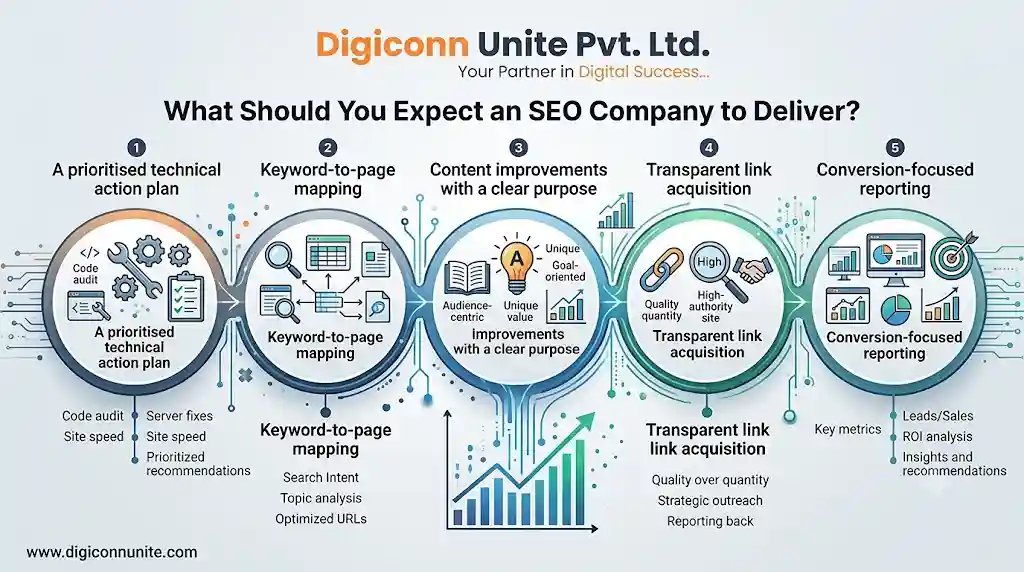
A monthly report filled with keyword positions is not enough to justify an SEO investment. Ask for evidence of work completed, problems identified, changes implemented, and their impact on business performance.
A useful SEO engagement should cover the following areas where they are relevant to your website:
1. A prioritised technical action plan
The agency should identify issues affecting crawling, indexing, site architecture, page performance, internal linking, redirects, canonical tags, and structured data where appropriate.
More importantly, it should explain which issues matter most. A minor warning in an audit tool should not automatically take priority over a service page that is blocked from indexing.
2. Keyword-to-page mapping
You should know which page targets each important search intent. This helps prevent multiple pages from competing for the same query and makes it easier to identify missing commercial landing pages.
Ask the agency to show:
-
Primary and secondary search intents.
-
Existing pages mapped to those intents.
-
Pages that need improvement.
-
Content gaps worth filling.
-
Internal links connecting relevant pages.
3. Content improvements with a clear purpose
Publishing more blogs is not a strategy by itself. Each new or updated page should have a defined purpose, such as attracting potential customers, answering a buying question, supporting a service page, or helping users compare solutions.
4. Transparent link acquisition
Ask how links will be earned, which websites will be approached, and why those sites are relevant. A large backlink count does not prove quality. Avoid campaigns that rely on bulk directory submissions, irrelevant placements, or automated link schemes.
5. Conversion-focused reporting
A useful report should connect SEO activity to outcomes such as:
-
Organic enquiries and qualified leads.
-
Organic sales or booked appointments.
-
Landing-page conversion rates.
-
Search impressions, clicks and relevant query trends.
-
Indexed and improved priority pages.
-
Work completed and unresolved blockers.
Rankings and traffic remain useful diagnostic measures, but they should not be treated as the final business outcome.
Hidden SEO Traps Most Businesses Overlook
Many hiring guides recommend checking reviews, experience, case studies, reporting, and ethical practices. Those checks are useful, but they do not answer a more important question: will the agency's work solve the right business problem?
These are three less obvious traps worth considering before you hire.
Myth 1: More organic traffic automatically means more business
An agency may increase traffic by targeting broad informational keywords. Your analytics could show impressive growth while enquiries and sales remain unchanged.
What to do instead: Ask to see the search intent behind the proposed keywords. Prioritise commercial and transactional searches that match your products, services, locations, and customer needs. Track qualified leads and sales alongside traffic.
Myth 2: A good SEO agency should handle everything without your involvement
An agency can research, recommend, write, optimise, and report. But it cannot always understand your margins, customer objections, service limitations, or operational priorities without input from your business.
What to do instead: Assign one internal contact who can provide subject knowledge, approve important changes, and share sales feedback. Treat SEO as a partnership rather than a task you completely hand over.
Myth 3: A monthly SEO retainer is always better than a one-time project
Some websites need ongoing work. Others first need a technical correction, migration review, keyword strategy, or content restructuring. Paying for a broad monthly package before identifying the actual problem can waste budget.
What to do instead: Start with a defined audit or project when the scope is uncertain. Move to ongoing support only when there is a clear backlog of work that needs continuous attention.
Additional traps to watch for
-
Guaranteed rankings: No agency controls Google's ranking systems. Treat guaranteed first-place promises as a warning sign.
-
Unclear ownership: Your business should retain control of its domain, website, analytics, Search Console, Google Business Profile, and content assets.
-
Reports without decisions: A report should explain what changed, what caused it, what happens next, and who is responsible.
-
Cheap bulk backlinks: A high number of irrelevant links can create risk without adding meaningful authority or referral value.
-
Content created without business input: Generic articles may attract visitors who are unlikely to become customers.
-
Long contracts without review points: Agree on deliverables, communication, cancellation terms, and periodic performance reviews before signing.
A Step-by-Step Checklist Before Hiring an SEO Company
Use this checklist to evaluate an agency before paying for a long-term campaign.
SEO agency hiring checklist
How Long Should You Give an SEO Company to Show Results?
SEO does not follow a fixed timetable. The time needed depends on your website's existing condition, competition, industry, content quality, technical issues, and how quickly recommended changes are implemented.
Use these stages as a framework for reviewing progress—not as guaranteed ranking deadlines.
|
Review stage |
What to look for |
Questions to ask |
|---|---|---|
|
Initial assessment |
Audit, baseline data, keyword mapping, priorities |
Does the strategy address real business opportunities? |
|
Early implementation |
Technical fixes, page updates, content improvements |
Have agreed changes actually been completed? |
|
Progress review |
Indexing, relevant impressions, clicks, landing-page engagement |
Are the right pages becoming more visible? |
|
Business review |
Qualified enquiries, conversion rates, sales contribution |
Is organic search producing commercially useful outcomes? |
|
Ongoing optimisation |
New opportunities, competitor changes, content updates |
What should be improved, expanded, or stopped next? |
Do not judge an agency solely on a short-term ranking movement. Equally, do not accept months of inactivity under the excuse that SEO takes time. There should be visible work, clear reasoning, and measurable progress at every review.
Questions to Ask Before Signing an SEO Contract
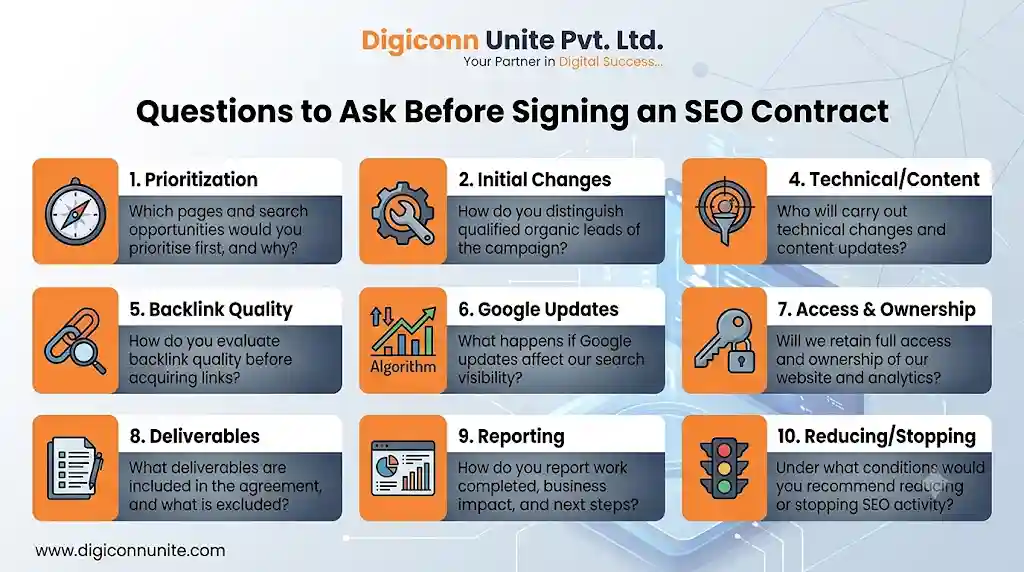
Use these questions during your agency evaluation:
-
Which pages and search opportunities would you prioritise first, and why?
-
What would you change during the first phase of the campaign?
-
How do you distinguish qualified organic leads from general website traffic?
-
Who will carry out technical changes and content updates?
-
How do you evaluate backlink quality before acquiring links?
-
What happens if Google updates affect our search visibility?
-
Will we retain full access and ownership of our website and analytics?
-
What deliverables are included in the agreement, and what is excluded?
-
How do you report work completed, business impact, and next steps?
-
Under what conditions would you recommend reducing or stopping SEO activity?
A trustworthy agency should be comfortable explaining its process, limitations, and measurement methods. If the answers are vague, ask for specific examples before proceeding.
Is Hiring an SEO Company Worth It for Small Businesses?
It can be, but a small business does not necessarily need a large agency or a full-service monthly package.
A focused approach may be more appropriate:
-
Start with technical and local SEO priorities.
-
Improve the service pages that can generate enquiries.
-
Build a useful Google Business Profile where the business is eligible.
-
Create content around real customer questions and buying decisions.
-
Track phone calls, forms, bookings, and qualified leads.
-
Expand the campaign only when the business can support additional demand.
A smaller business can also combine internal work with external expertise. For example, the owner may provide industry knowledge and approve content while a freelancer or agency handles technical SEO and strategy.
Frequently Asked Questions
1. Is hiring an SEO company worth it for a new website?
It can be useful, particularly for setting up site architecture, technical foundations, keyword mapping, and conversion-focused landing pages. However, a new website may not need a large monthly campaign immediately. Start with the work that prevents avoidable problems and supports your main business goals.
2. Is it better to hire an SEO freelancer or an agency?
A freelancer can be a good choice for a specific task or a smaller campaign. An agency may be more suitable when you need technical SEO, content, link acquisition, and reporting managed together. Evaluate the actual people doing the work rather than choosing based on the agency label.
3. Can I do SEO myself instead of hiring a company?
Yes. Businesses can handle many SEO activities internally, especially when the website is small and the competition is manageable. The challenge is finding the time and expertise to research, implement, monitor, and improve the strategy consistently.
4. How do I know if an SEO company is doing its job?
Check whether the agency completes agreed deliverables, explains its decisions, resolves priority issues, improves relevant pages, and reports meaningful performance changes. Look beyond keyword positions to qualified leads, conversions, and organic revenue where tracking is available.
5. Should I stop SEO if rankings do not improve immediately?
Not necessarily. First, check whether the campaign is implementing the agreed work and whether the website is showing useful progress in indexing, relevant impressions, clicks, and conversions. If the strategy is not producing evidence of progress, request a revised action plan rather than continuing without clear direction.
6. Can an SEO company guarantee first-page Google rankings?
No reliable agency can guarantee a specific Google ranking. Search results depend on competition, search intent, location, algorithm changes, and many other factors. An agency should commit to transparent work and realistic performance goals, not promise positions it cannot control.
7. Is an SEO company worth hiring if I already run Google Ads?
Yes, potentially. Paid advertising can help generate visibility while a business develops organic search performance. SEO may reduce long-term dependence on paid traffic, but the two channels serve different roles and should be evaluated using their own costs, conversions, and contribution to sales.
Final Verdict: Should You Hire an SEO Company?
Hire an SEO company when it can identify valuable search opportunities, implement improvements your team cannot efficiently manage, and connect its work to measurable business outcomes. Choose a freelancer or one-time project when your needs are narrow. Handle SEO internally when you have the skills, time, and manageable competition.
The strongest decision is not to hire the biggest agency or choose the cheapest package. It is to invest in the specific work that can help your business attract the right visitors and convert them into customers.
Work With Digiconn Unite
If you are evaluating SEO support, then contact Digiconn Unite. It help you identify website improvement opportunities, prioritise search-focused work, and build a strategy around your business goals. If you are comparing the best digital marketing & SEO company in India, look beyond ranking promises and ask for a clear plan, transparent deliverables, and performance tracking.
You May Like This: How Much Does White Label SEO Cost?
Our Social Links:
Related Topics
Explore more about seo:
