


Quick Answer
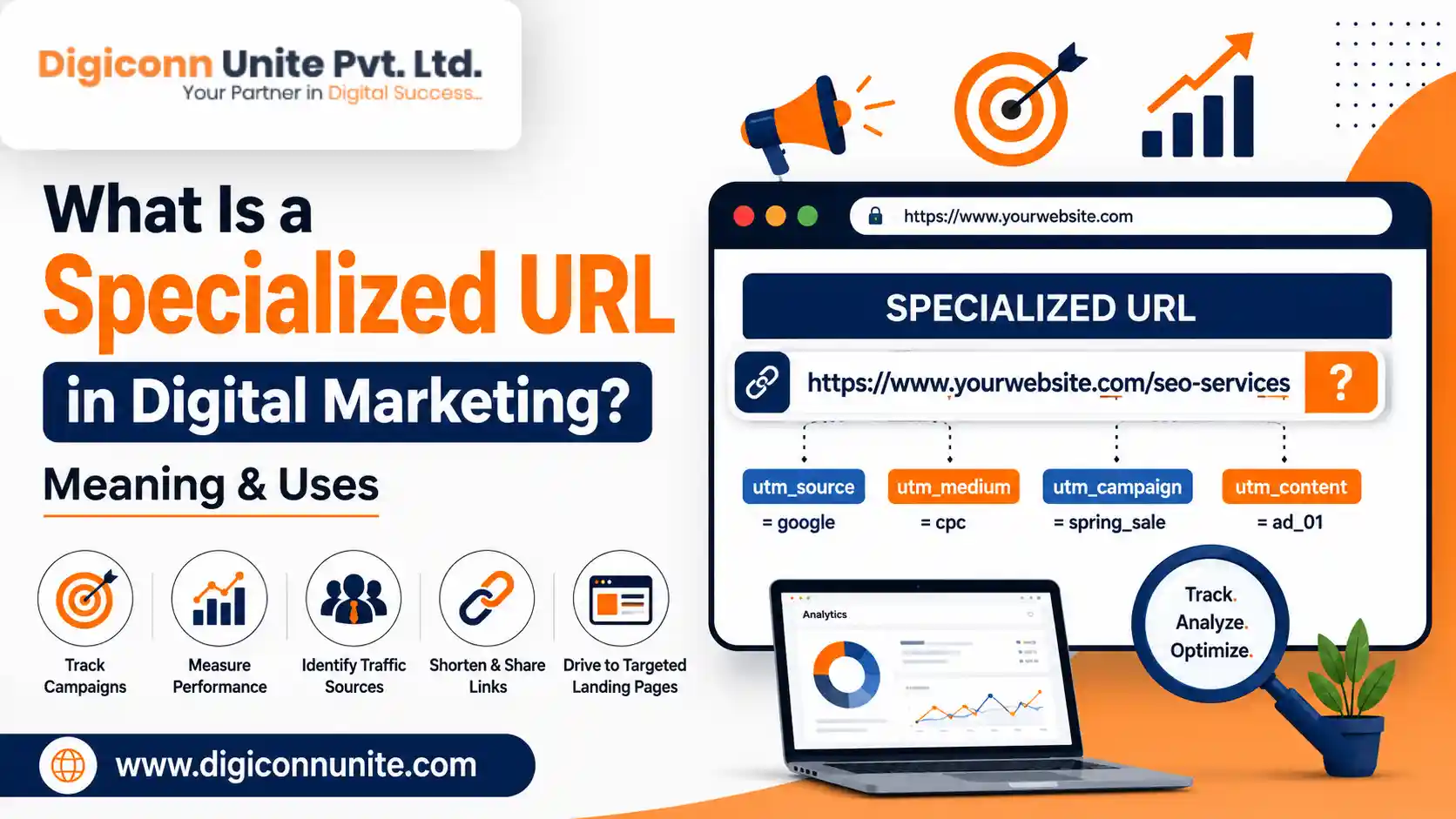
A specialized URL in digital marketing is a web address created or modified for a specific purpose, such as tracking a campaign, directing users to a dedicated landing page, shortening a link, promoting a brand, or measuring where website traffic comes from.
For example:
Normal URL:https://example.com/services
Campaign tracking URL:https://example.com/services?utm_source=facebook&utm_medium=social&utm_campaign=summer_offer
The second URL contains additional tracking parameters. When users click it, analytics tools can identify details about the marketing campaign that brought them to the website. Google Analytics supports custom campaign URLs using parameters such as utm_source, utm_medium, and utm_campaign.
Key Takeaways
-
A specialized URL is usually created for a specific marketing, tracking, branding, or user journey purpose.
-
Common examples include UTM URLs, tracking URLs, landing page URLs, short URLs, vanity URLs, deep links, and campaign URLs.
-
UTM parameters help marketers understand where traffic comes from and which campaigns generate visits.
-
A specialized URL does not automatically improve SEO rankings.
-
For SEO, URLs should generally be clear, descriptive, logical, and free from unnecessary parameters where possible.
-
The same destination page can have different specialized URLs for different marketing campaigns.
What Does a Specialized URL Mean in Digital Marketing?
The term specialized URL is not one single technical URL category with a universally fixed definition. In digital marketing, people may use it to describe a URL that has been created or modified for a particular purpose.
A normal website URL simply takes a visitor to a page.
For example:
https://example.com/seo-services
A specialized marketing URL may provide additional information about how or why the visitor arrived.
For example:
https://example.com/seo-services?utm_source=linkedin&utm_medium=social&utm_campaign=seo_promotion
Both links can take the visitor to the same page. However, the second URL provides campaign information that can be used for measurement and reporting.
This is why specialized URLs are useful in digital marketing. They help marketers connect clicks, campaigns, traffic sources, advertisements, emails, and other promotional activities with measurable results.
You May Read Also: Android Pulse App: What Is It, Is It Safe & What Does It Do?
What Is a UTM URL?
A UTM URL is one of the most common examples of a specialized URL used in digital marketing.
UTM stands for Urchin Tracking Module. UTM parameters are added to the end of a destination URL to provide information about a marketing campaign.
A typical example looks like this:
https://example.com/blog?utm_source=facebook&utm_medium=social&utm_campaign=website_promotion
Google Analytics can use these parameters to help identify the campaign and traffic source responsible for a visit.
What Are the Main UTM Parameters?
The most commonly used parameters include:
utm_source
Identifies where the traffic came from.
Examples:
-
google
-
facebook
-
linkedin
-
newsletter
utm_medium
Identifies the marketing medium.
Examples:
-
cpc
-
email
-
social
-
referral
utm_campaign
Identifies the specific marketing campaign.
Examples:
-
summer_sale
-
new_service
-
festival_offer
utm_term
Can be used to identify a keyword or other targeting term.
utm_content
Helps differentiate links, advertisements, or creative variations within the same campaign.
Google recommends using a consistent UTM naming strategy because differences in spelling or capitalisation can fragment campaign reporting.
Example of a Specialized URL for a Social Media Campaign
Suppose a business wants to promote its website design services through Facebook.
The normal URL may be:
https://example.com/website-designing-services
The marketing version could be:
https://example.com/website-designing-services?utm_source=facebook&utm_medium=social&utm_campaign=website_design_offer
This allows the business to understand that visitors using this link came from Facebook as part of a specific campaign.
The marketer can create separate URLs for Instagram, LinkedIn, email, WhatsApp, or other promotional channels.
For example:
Facebook:utm_source=facebook
Instagram:utm_source=instagram
Email:utm_source=newsletter
Paid campaign:utm_medium=cpc
This makes campaign performance easier to compare.
What Are the Different Types of Specialized URLs Used in Digital Marketing?
Several types of URLs can serve specialized purposes.
1. UTM or Campaign Tracking URLs
These URLs contain parameters that help identify the source, medium, campaign, and other details associated with traffic.
They are commonly used in:
-
Banner advertising
Google Analytics provides official guidance on building custom campaign URLs and the use of UTM parameters.
2. Landing Page URLs
A landing page URL directs users to a page created for a specific campaign or action.
For example:
example.com/free-seo-audit
Instead of sending visitors to the homepage, an advertisement can send them directly to a page focused on one service, offer, or conversion goal.
Landing page URLs are commonly used for:
-
Lead generation
-
Product launches
-
Webinar registration
-
Free consultations
-
Special offers
-
PPC campaigns
The main advantage is relevance. Users who click an advertisement can land directly on content related to the message they clicked.
3. Vanity URLs
A vanity URL is a short, memorable, branded web address designed to be easy for people to remember and type.
For example:
Instead of:
example.com/services/digital-marketing/complete-business-solutions
A business may promote:
example.com/marketing
Vanity URLs are useful in offline and online advertising because they are easier to remember.
They can be used in:
-
Print advertisements
-
Business cards
-
Billboards
-
Podcasts
-
Video content
-
Social media campaigns
4. Short URLs
A short URL is a shortened version of a longer web address.
For example:
A long campaign URL with multiple tracking parameters can be difficult to share.
A shorter version may make it easier to use in:
-
Social media posts
-
SMS campaigns
-
QR codes
-
Printed marketing materials
However, the destination and tracking setup should still be managed carefully.
5. Deep Links
Deep links direct users to a specific location within an app rather than simply opening the application's homepage.
For example, instead of opening the main screen of a shopping app, a deep link may take the user directly to:
-
A product page
-
A special offer
-
A booking page
-
A particular category
Deep links are particularly useful in mobile app marketing.
6. Affiliate Tracking URLs
Affiliate marketers often use specialized links to identify which partner, publisher, or campaign generated a sale or lead.
A tracking URL can include an affiliate ID or other identifier.
For example:
example.com/product?affiliate=partner123
This helps the business attribute conversions to the correct affiliate.
7. Geo-Targeted URLs
Businesses operating in different cities or countries may use specific URLs to target different locations.
Examples:
example.com/seo-services-agra
example.com/seo-services-delhi
example.com/seo-services-jaipur
These pages should provide genuinely useful and location-relevant content rather than being created only by changing the city name.
How Are Specialized URLs Used in Digital Marketing?
Specialized URLs are mainly used to make digital marketing campaigns more measurable and targeted.
Campaign Performance Tracking
A business may run the same promotion on:
-
Facebook
-
Instagram
-
LinkedIn
-
Email
-
Google Ads
Without proper tracking, it can be difficult to understand which source generated the traffic.
Campaign URLs can help separate these traffic sources in analytics reporting.
Measuring Marketing ROI
If a campaign generates 10,000 visits, that number alone does not tell the full story.
Marketers also need to know:
-
Where did the visitors come from?
-
Which campaign generated them?
-
Which advertisement performed better?
-
Which channel produced conversions?
Specialized URLs can support this measurement process.
A/B Testing Different Links
A marketer may use different URLs or tracking parameters to compare:
-
Two email buttons
-
Different ad creatives
-
Different calls to action
-
Different social media campaigns
The utm_content parameter, for example, can be used to distinguish between different creatives or links within a campaign.
Improving the Customer Journey
A specialized URL can send users directly to the most relevant page.
For example, someone clicking an advertisement for a free website audit should ideally reach a page about the audit rather than a general homepage.
This creates a clearer journey:
Advertisement → Relevant landing page → Form or call to action
Do Specialized URLs Help With SEO?
Specialized URLs can support marketing measurement, but they should not be confused with a direct SEO ranking technique.
Simply adding UTM parameters or creating a complex campaign URL will not automatically improve your Google rankings.
For SEO, Google recommends URLs that are logical and understandable to users. Google also recommends using descriptive words where appropriate and avoiding unnecessary URL parameters that do not change the page's content.
For example, this is generally easier to understand:
example.com/mobile-app-development
Than:
example.com/page?id=7392&type=service&ref=abc
A good SEO URL should generally be:
-
Clear
-
Descriptive
-
Logical
-
Easy to understand
-
Consistent
-
Free from unnecessary complexity
Can Too Many URL Parameters Cause SEO Problems?
They can create technical complications if not managed properly.
For example, multiple parameters may create many URLs that lead to identical or very similar content.
Google notes that overly complex URLs and unnecessary parameters can contribute to crawling issues or large numbers of duplicate or similar URLs.
This does not mean marketers should never use UTM parameters. Campaign tracking is useful.
The important point is to use tracking URLs for their intended purpose while maintaining a clean and properly managed website structure.
How Do You Create a Specialized URL?
The process depends on the type of URL you need.
For a campaign tracking URL:
Step 1: Start With the Destination URL
Example:
https://example.com/service
Step 2: Add a Question Mark
https://example.com/service?
Step 3: Add Your Campaign Parameters
Example:
utm_source=linkedin
Step 4: Add More Parameters With an Ampersand
Final example:
https://example.com/service?utm_source=linkedin&utm_medium=social&utm_campaign=business_promotion
You can also use Google's campaign URL-building guidance rather than manually constructing every link.
What Is the Difference Between a Normal URL and a Specialized URL?
| Normal URL | specialized URL |
|---|---|
| Takes users to a webpage | Takes users to a webpage with a specific marketing or technical purpose |
| Usually simple | May contain tracking parameters |
| Focuses on page location | Can identify campaign, source, medium, or other information |
Example: /services |
Example: /services?utm_source=email |
Both may lead to the same destination.
The difference is usually the additional purpose or information associated with the specialized URL.
What Are the Best Practices for Using Specialized URLs?
Use Clear Naming Conventions
Choose a consistent format for:
-
Campaign names
-
Sources
-
Mediums
-
Content labels
For example, avoid using different names such as:
Facebook
facebook
FB
For the same traffic source unless you intentionally want separate reporting. Consistency helps prevent fragmented analytics data.
Keep URLs as Simple as Possible
Long tracking URLs can become difficult to manage and share.
Only add parameters that provide useful information.
Do Not Include Sensitive Information
URLs should not contain personal or sensitive information. Google's Analytics guidance also warns against sending personally identifiable information through campaign data.
Send Users to Relevant Pages
A specialized campaign URL should lead to content that matches the advertisement or message.
For example:
Ad: SEO Services for Local Businesses
Landing page: A page specifically explaining local SEO services
This creates a more relevant experience.
Test Every URL Before Launching
A broken campaign URL can waste advertising budget and lose potential customers.
Before publishing, check:
-
Does the link open correctly?
-
Are the UTM parameters correct?
-
Does the landing page match the campaign?
-
Is the page mobile-friendly?
-
Does the tracking work as expected?
Example: How a Digital Marketing Campaign Can Use Specialized URLs
Imagine that Digiconn Unite wants to promote a digital marketing service through multiple channels.
The main page could be:
https://digiconnunite.com/digital-marketing-services-agra-india.php
For an email campaign:
https://digiconnunite.com/digital-marketing-services-agra-india.php?utm_source=newsletter&utm_medium=email&utm_campaign=digital_marketing
For social media:
https://digiconnunite.com/digital-marketing-services-agra-india.php?utm_source=linkedin&utm_medium=social&utm_campaign=digital_marketing
For a paid campaign:
https://digiconnunite.com/digital-marketing-services-agra-india.php?utm_source=google&utm_medium=cpc&utm_campaign=digital_marketing
Each URL can lead visitors to the same service page while helping distinguish the marketing source and campaign in reporting.
Final Answer: What Is a Specialized URL Used for in Digital Marketing?
A specialized URL used in digital marketing is a web address designed or modified for a specific purpose. That purpose may be tracking campaign performance, identifying traffic sources, directing users to a landing page, shortening a link, promoting a branded URL, or opening a specific page inside an application.
One of the most common examples is a UTM tracking URL. It allows marketers to add campaign information such as the traffic source, medium, and campaign name to a destination URL for measurement in analytics tools.
The best approach is to use specialized URLs when they provide a clear business or marketing purpose. Keep your main website URLs simple and descriptive, use tracking parameters consistently, and avoid creating unnecessary URL variations.
Ultimately, a specialized URL is not just about creating a different link. It is about making digital marketing campaigns more targeted, measurable, and easier to analyse.
Frequently Asked Questions
What is a specialized URL in simple words?
A specialized URL is a web link created or modified for a specific purpose, such as tracking a marketing campaign, directing users to a landing page, or measuring traffic sources.
What is the most common specialized URL in digital marketing?
UTM campaign URLs are among the most commonly used specialized URLs because they help marketers track where website visitors come from.
What does UTM mean?
UTM stands for Urchin Tracking Module. UTM parameters are added to URLs to identify information such as the campaign source, medium, and campaign name.
Does a UTM URL affect SEO?
A UTM URL is primarily used for campaign tracking. It does not automatically improve search rankings. Website owners should also manage URL variations carefully to avoid unnecessary technical complexity.
What is the difference between a URL and a tracking URL?
A normal URL identifies the location of a webpage. A tracking URL includes additional information, often in the form of parameters, to identify the source or campaign that generated the visit.
What is a vanity URL?
A vanity URL is a short, memorable, and often branded URL created to make a link easier to remember and share.
Can I use specialized URLs for social media marketing?
Yes. You can create different campaign URLs for Facebook, Instagram, LinkedIn, email newsletters, paid advertisements, and other channels to measure their performance separately.
Related Topics
Explore more about digital marketing:
