


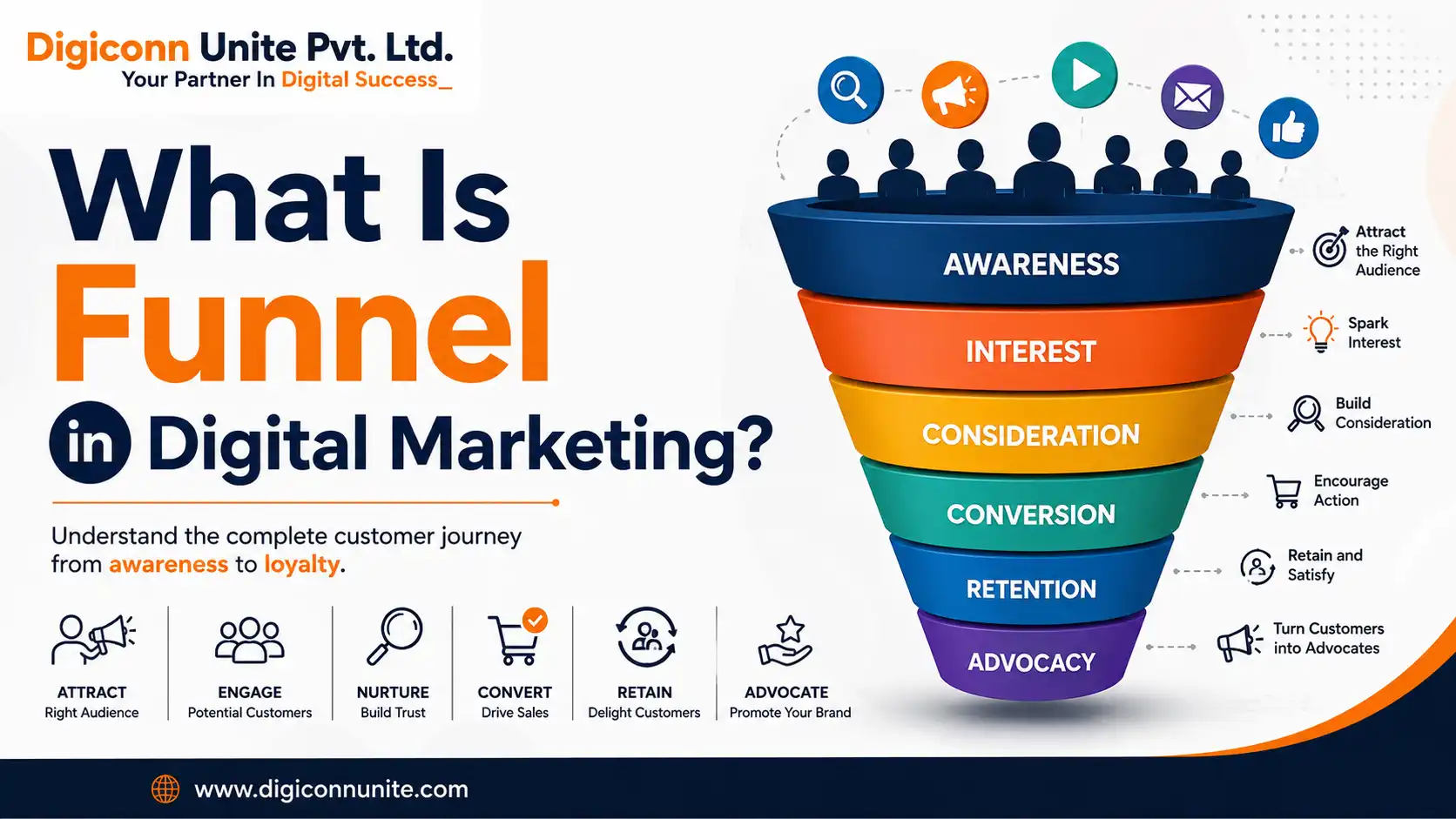
A funnel in digital marketing is a step-by-step model that explains how a person moves from first discovering a business to becoming a customer and, ideally, a loyal repeat buyer. It is called a "funnel" because many people may enter at the top, but only some move through every stage and finally make a purchase.
In simple words, a digital marketing funnel helps businesses understand where potential customers are in their buying journey and what type of marketing message they need at each stage.
The most common stages are:
Awareness → Interest → Consideration → Conversion → Retention → Advocacy
For example, someone may first see a business on Google, visit its website, compare its services with competitors, contact the company, become a customer, and later recommend it to others. This complete journey is part of the digital marketing funnel.
What Is a Digital Marketing Funnel?
A digital marketing funnel is a framework used to track and guide potential customers through different stages of the buying process.
It helps answer important questions such as:
- How did the customer discover the business?
- What made them interested?
- Why did they consider the product or service?
- What convinced them to buy?
- How can the business keep them as a customer?
A funnel allows marketers to create the right content, advertisements, and communication for each stage of the customer journey.
For example, a person who has never heard of your brand should not receive the same message as someone who has already visited your pricing page. Their needs and level of interest are different.
What Are the Main Stages of a Digital Marketing Funnel?
Although different businesses may use different funnel models, the following six stages provide a clear view of the modern customer journey.
1. Awareness: The Customer Discovers Your Brand
The awareness stage is the top of the funnel.
At this point, people may not know your business or may not even be actively looking to buy. Your goal is to make them aware of your brand and introduce your products or services.
Common awareness channels include:
- Google Search
- Social media
- Blog content
- YouTube videos
- Online advertisements
- Search engine optimisation (SEO)
- Influencer marketing
- PR and media coverage
Example
Suppose a person searches Google for:
"How to improve website rankings?"
They find a helpful blog post published by a digital marketing company. They read the article and become aware of the company's services.
The person has now entered the marketing funnel.
Best Content for the Awareness Stage
Businesses should focus on educational content, such as:
- Blog posts
- Guides
- Infographics
- Videos
- Social media posts
- Informational podcasts
The main goal is not to sell immediately. It is to attract attention and provide useful information.
2. Interest: The Customer Wants to Learn More
Once people know about your business, they may become interested in what you offer.
They may:
- Visit your website
- Follow your social media account
- Read more blog posts
- Subscribe to your email list
- Watch your videos
- Download a guide
At this stage, the customer is looking for more information.
Your marketing should explain how your product or service can solve their problem.
Example
A business owner reads an SEO article and then visits the company's SEO service page. They may also read case studies and check customer reviews.
This person has moved from simple awareness to genuine interest.
Best Content for the Interest Stage
Useful content includes:
- Detailed blog posts
- Service pages
- Educational videos
- Email newsletters
- Webinars
- Case studies
- Downloadable guides
The objective is to build trust and keep the potential customer engaged.
3. Consideration: The Customer Compares Options
At the consideration stage, the potential customer has a clear need and is actively exploring possible solutions.
They may compare:
- Different companies
- Products
- Services
- Prices
- Features
- Reviews
- Customer experiences
This is an important stage because the customer is closer to making a decision.
Example
A business owner needs SEO services. They search for different providers, check their websites, read reviews, compare services, and request quotations.
At this point, your business needs to clearly explain why customers should choose you.
Effective Content for Consideration
Businesses can use:
- Comparison pages
- Case studies
- Customer testimonials
- Product demonstrations
- Detailed service pages
- FAQs
- Free consultations
- Reviews and ratings
Clear information can remove doubts and help customers make a confident decision.
4. Conversion: The Customer Takes Action
The conversion stage is where the potential customer takes the desired action.
This action could be:
- Making a purchase
- Filling out a contact form
- Calling the business
- Booking an appointment
- Requesting a quote
- Signing up for a service
A conversion does not always mean an immediate sale. For some businesses, generating a qualified lead is the main conversion goal.
Example
A potential client visits a website, reads the service details, and submits a form requesting a quotation.
That form submission is a conversion.
How to Improve Conversions
Businesses can improve this stage by using:
- Clear calls to action
- Simple contact forms
- Easy checkout processes
- Trust signals
- Customer reviews
- Secure payment options
- Strong landing pages
- Transparent information
The easier you make the process, the more likely users are to complete it.
5. Retention: Turning Customers into Repeat Buyers
The funnel does not end after a customer makes a purchase.
Retention focuses on keeping existing customers engaged and encouraging them to return.
This is important because retaining an existing customer can be more cost-effective than constantly acquiring new ones.
Businesses can improve retention through:
- Email marketing
- Loyalty programmes
- Personalised offers
- Customer support
- Regular updates
- Helpful content
- Follow-up communication
Example
An online store sends a personalised email to an existing customer with relevant product recommendations. The customer returns and makes another purchase.
This is an example of customer retention.
6. Advocacy: Customers Recommend Your Business
The final stage is advocacy.
A happy customer may:
- Leave a positive review
- Recommend your business
- Share your content
- Refer friends
- Post about your brand on social media
These actions can bring new people into the awareness stage, creating a continuous cycle.
Example
A customer receives excellent service from a company. They leave a five-star Google review and recommend the business to another company.
That customer has become a brand advocate.
How Does a Digital Marketing Funnel Work?
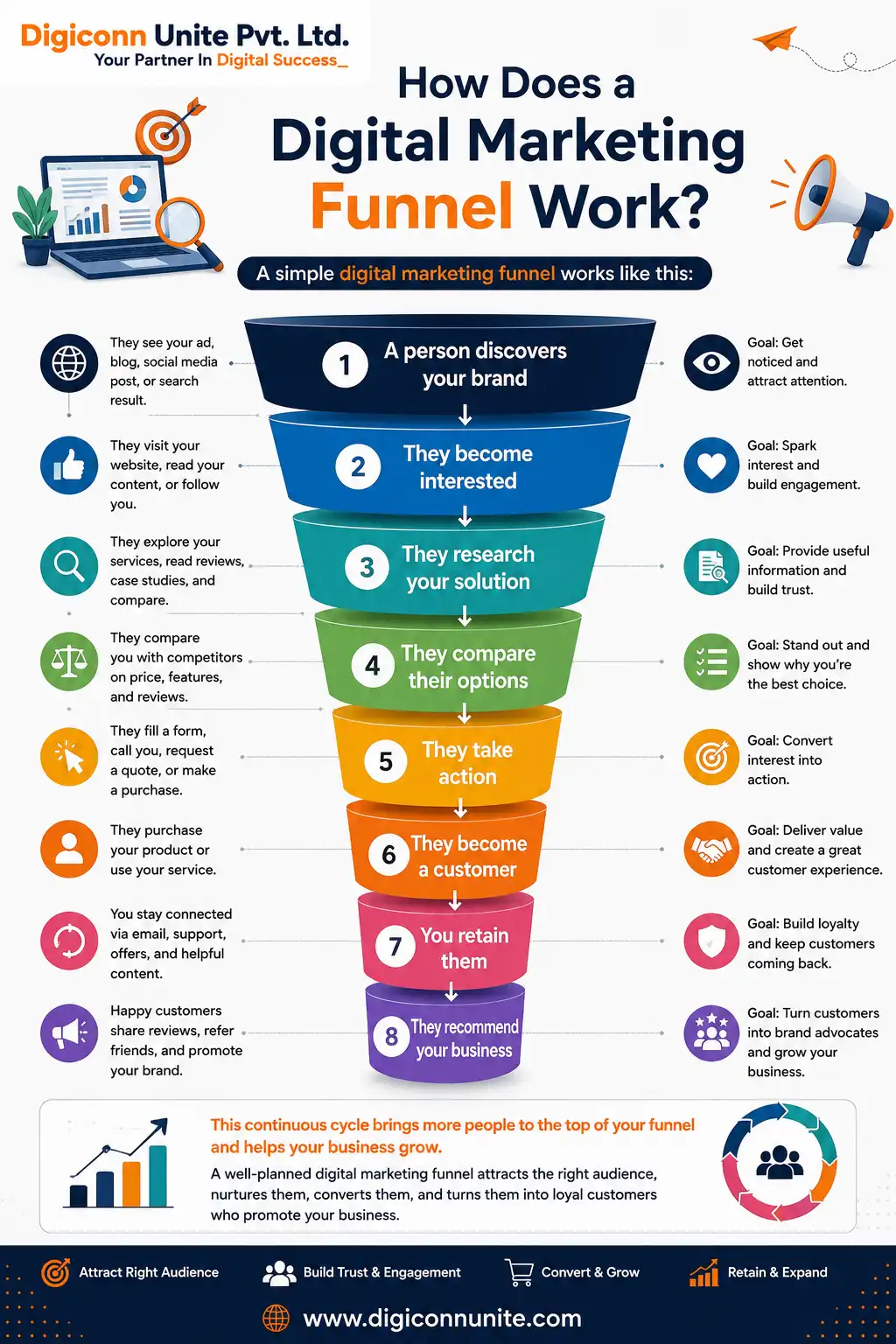
A simple digital marketing funnel works like this:
A person discovers your brand
↓
They become interested
↓
They research your solution
↓
They compare their options
↓
They take action
↓
They become a customer
↓
You retain them
↓
They recommend your business
Not every person will reach the final stage. Some may leave the funnel at different points.
The job of marketing is to identify where people leave and improve that part of the customer journey.
Why Is a Digital Marketing Funnel Important?
A funnel helps businesses understand the complete customer journey instead of focusing only on the final sale.
It provides several benefits.
Better Understanding of Customer Behaviour
A funnel shows what customers do before making a decision.
You can understand:
- What they search for
- Which pages they visit
- What content they read
- Where they leave
- What makes them convert
More Relevant Marketing
Different customers need different messages.
Someone at the awareness stage may need educational content, while someone ready to buy may need a quotation or product demonstration.
A funnel helps businesses deliver more relevant marketing.
Better Lead Generation
A properly planned funnel attracts potential customers and guides them towards becoming leads.
SEO, paid advertising, content marketing, and social media can work together to bring people into the funnel.
Improved Conversion Rates
When every stage is properly optimised, more visitors can become leads and customers.
For example, improving a landing page may help more users complete a contact form.
Better Marketing Budget Management
A funnel helps businesses understand which marketing channels are producing results.
Businesses can track:
- Website visitors
- Leads
- Conversion rates
- Customer acquisition costs
- Sales
This makes it easier to invest money in channels that perform well.
What Is a Funnel in SEO?
In SEO, a funnel describes how search traffic moves from informational searches to commercial and transactional actions.
For example:
Informational Search:
"What is SEO?"
↓
Commercial Search:
"Best SEO services for small businesses"
↓
Transactional Search:
"SEO agency near me"
The user becomes more likely to take action as they move down the funnel.
This is why businesses should create different types of SEO content for different search intents.
A strong SEO strategy may include:
- Informational blog posts
- Service pages
- Location pages
- Comparison content
- Case studies
- Product pages
Together, these pages can support customers throughout their buying journey.
What Is a Funnel in Social Media Marketing?
Social media can support multiple stages of the marketing funnel.
At the awareness stage, businesses may use short videos and educational posts to reach new audiences.
At the consideration stage, they may share:
- Customer testimonials
- Case studies
- Product demonstrations
- Expert advice
At the conversion stage, businesses can use:
- Lead generation campaigns
- Special offers
- Direct messages
- Shopping features
The key is to match the social media content with the customer's level of interest.
What Is a Funnel in Paid Advertising?
Paid advertising can also be structured around the funnel.
Top of Funnel Ads
Used to build awareness and reach new audiences.
Middle of Funnel Ads
Used to educate and engage people who already know about the brand.
Bottom of Funnel Ads
Used to encourage users to take action, such as making a purchase or submitting an enquiry.
Remarketing is especially useful for reaching people who have already visited your website but did not convert.
How to Build a Digital Marketing Funnel
Creating a funnel does not have to be complicated.
Follow these steps:
Step 1: Understand Your Target Audience
Identify who your ideal customers are and what problems they want to solve.
Step 2: Define Your Marketing Goals
Decide whether you want to generate leads, increase sales, gain bookings, or improve brand awareness.
Step 3: Map the Customer Journey
Identify the steps customers take before making a decision.
Step 4: Create Content for Each Stage
Develop content that matches customer intent.
Step 5: Create Strong Calls to Action
Tell users what they should do next.
Step 6: Track Performance
Monitor traffic, leads, conversions, and sales.
Step 7: Optimise the Funnel
Identify where potential customers drop off and improve that stage.
You May Visit Also: What is B2B Digital Marketing Agency
Example of a Digital Marketing Funnel
Imagine a website development company targeting small businesses.
Awareness
A business owner searches:
"How much does a business website cost?"
They find an informative blog post.
Interest
They explore more articles and visit the company's website.
Consideration
They read the website development service page and view previous projects.
Conversion
They submit a form requesting a quote.
Retention
The company provides excellent service and ongoing website maintenance.
Advocacy
The customer recommends the company to another business owner.
This is a complete digital marketing funnel.
How Digiconn Unite Uses the Digital Marketing Funnel
At Digiconn Unite, the digital marketing funnel can be used as a framework for understanding how potential customers discover a business, research solutions, make decisions, and become long-term customers.
A successful strategy may combine SEO, content marketing, website optimisation, social media, paid advertising, and conversion-focused landing pages. Each channel has a specific role, but the goal remains the same: to create a smooth journey from first interaction to customer loyalty.
Final Answer
A funnel in digital marketing is a framework that represents the stages a potential customer passes through before and after making a purchase. The main stages are Awareness, Interest, Consideration, Conversion, Retention, and Advocacy. Businesses use the funnel to understand customer behaviour and deliver the right content, advertising, and communication at each stage.
A well-planned funnel connects different digital channels, including SEO, content marketing, social media, email marketing, paid advertising, and website optimisation. The goal is not simply to attract visitors but to guide the right people from first discovery to conversion and long-term loyalty.
For businesses, understanding the funnel makes digital marketing more organised, measurable, and customer-focused.
Frequently Asked Questions
What is a funnel in digital marketing?
A funnel in digital marketing is a model that shows the journey a potential customer takes from discovering a brand to becoming a customer and, ideally, a loyal advocate.
What are the 5 stages of a marketing funnel?
The five commonly used stages are Awareness, Interest, Consideration, Conversion, and Retention. Some models add Advocacy as the final stage.
Why is it called a marketing funnel?
It is called a funnel because many people enter at the awareness stage, but fewer continue through each stage and eventually become customers.
What is the difference between a marketing funnel and a sales funnel?
A marketing funnel generally focuses on attracting and nurturing potential customers, while a sales funnel focuses more closely on moving qualified prospects towards a purchase. In modern digital marketing, the two often overlap.
Is SEO part of the digital marketing funnel?
Yes. SEO can support every stage of the funnel. Informational content can attract new audiences, while service pages and commercial content can help users who are closer to making a purchase.
How do I know if my marketing funnel is working?
Track metrics such as website traffic, engagement, leads, conversion rates, customer acquisition cost, sales, repeat purchases, and customer retention.
You May Visit Also: Digital Marketing Agency vs In-House Marketing Team: Which Is Better
Related Topics
Explore more about digital marketing:
