


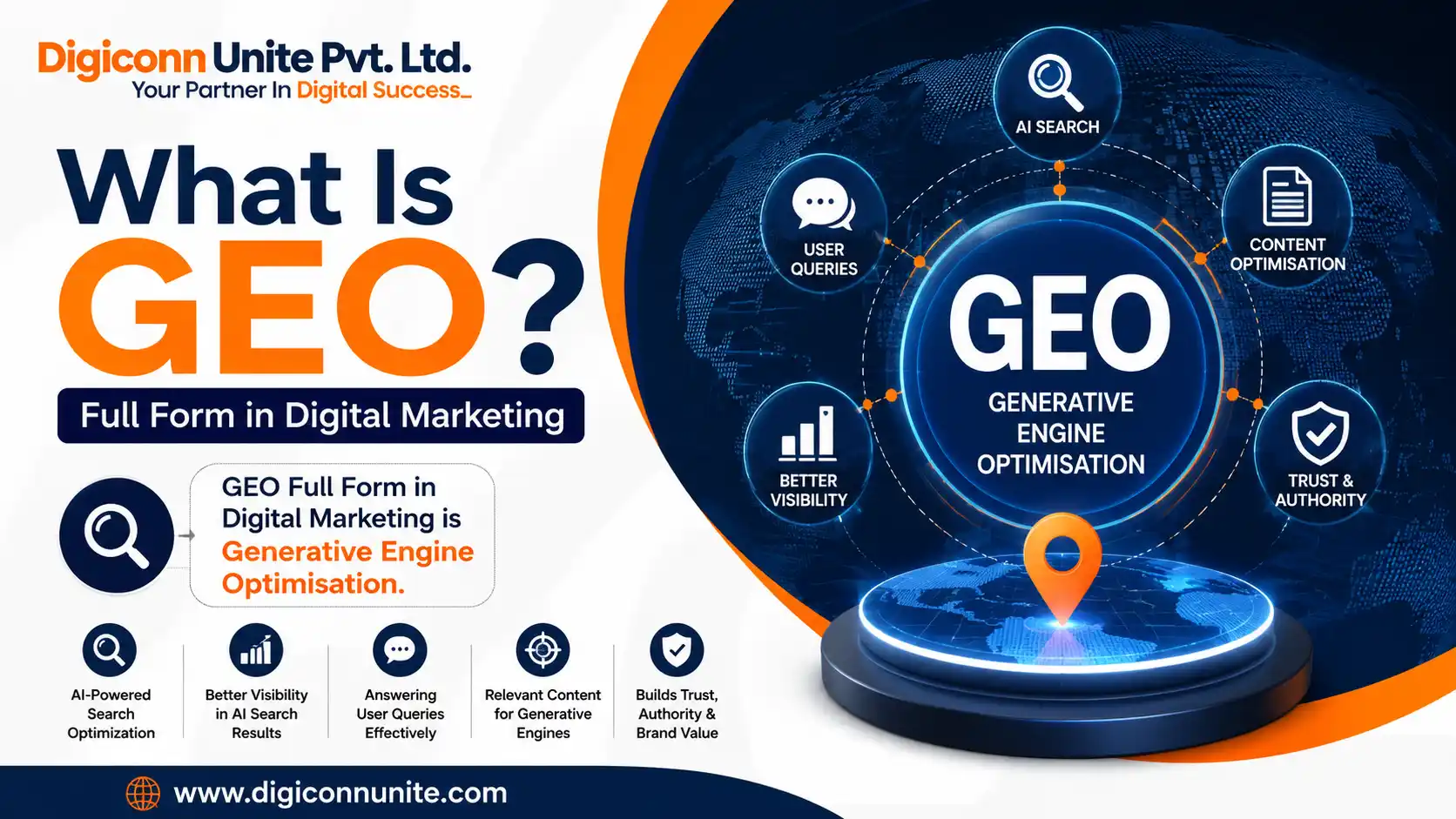
What Is GEO Full Form in Digital Marketing?
If you have recently come across the term GEO in digital marketing, you may be wondering what it means. The GEO full form in digital marketing is Generative Engine Optimisation.
Generative Engine Optimisation is the process of improving online content so that AI-powered search and answer systems can understand, select, summarise, and potentially mention that content when users ask questions.
Traditional SEO mainly focuses on improving visibility in search engine results pages (SERPs). GEO focuses on visibility in AI-generated answers, such as responses produced by generative search and AI assistants.
As search behaviour changes, understanding GEO is becoming important for businesses, marketers, publishers, and website owners.
Key Takeaways About GEO in Digital Marketing
-
GEO stands for Generative Engine Optimisation in the current digital marketing context.
-
GEO aims to improve a brand's visibility in AI-generated search answers.
-
Traditional SEO and GEO are related, but they are not exactly the same.
-
Clear answers, strong factual context, structured content, and trustworthy information can make content easier for AI systems to understand.
-
Question-based headings and concise answers are useful for both readers and AI-powered search systems.
-
GEO does not replace SEO. A strong strategy should consider both.
-
There is no guaranteed method for making an AI system mention a particular website or brand.
What Does GEO Mean in Digital Marketing?
GEO means Generative Engine Optimisation.
It refers to the optimisation of digital content for generative search engines and AI-powered answer systems.
Traditional search usually gives users a list of links. Generative search can provide a direct answer by combining information from different sources.
For example, a user might search:
"What are the benefits of local SEO for a small business?"
Instead of only displaying ten blue links, an AI-powered search experience may provide a summary of the main benefits and cite or reference relevant websites.
GEO aims to make your content clear, useful, credible, and easy for these systems to interpret.
Why Is Generative Engine Optimisation Becoming Important?
People are changing the way they search for information.
Instead of using short keywords such as:
users may ask complete questions such as:
"Which SEO services can help a local business in Agra get more Google visibility?"
AI-powered systems are designed to understand conversational questions and provide direct responses.
This creates a new opportunity for businesses.
A company should not only think about:
"How can my website rank in Google?"
It should also consider:
"How can my content provide a clear and reliable answer that AI systems can understand?"
That is the basic idea behind GEO.
How Is GEO Different From SEO?
SEO and GEO have a common goal: improving online visibility.
However, the way they approach visibility is different.
Search Engine Optimisation (SEO)
SEO focuses on improving a website's ability to appear in traditional search results.
Common SEO activities include:
-
Keyword research
-
On-page optimisation
-
Technical SEO
-
Internal linking
-
Content creation
-
Link building
-
Website performance optimisation
Generative Engine Optimisation (GEO)
GEO focuses on making content useful and understandable for AI-generated answers.
It places greater emphasis on:
-
Direct answers
-
Clear context
-
Well-structured information
-
Factual accuracy
-
Strong topical coverage
-
Authoritative sources
-
Natural language
-
Question-based content
The two approaches should work together rather than being treated as completely separate marketing activities.
Does GEO Replace SEO?
No. GEO does not replace SEO.
SEO remains important because AI-powered systems can use information from websites, search indexes, databases, and other sources.
A technically poor website with weak content can struggle to build visibility in both traditional and AI-powered search.
A better approach is to create content that works for people, search engines, and AI systems.
For example, a strong article should have:
-
A clear title
-
A direct answer near the beginning
-
Logical headings
-
Useful supporting information
-
Accurate facts
-
Relevant examples
-
Good internal links
-
Trustworthy references where appropriate
How Does GEO Work?
There is no single GEO algorithm that marketers can optimise for.
Different AI-powered search systems use different technologies and ranking or retrieval methods.
However, content can be made easier to understand by following several practical principles.
1. Give the Direct Answer First
If someone asks a simple question, answer it immediately.
For example:
Question: What is the GEO full form in digital marketing?
Answer: GEO stands for Generative Engine Optimisation. It refers to optimising content for AI-powered search and generative answer experiences.
The reader should not have to read five paragraphs before finding the answer.
This format also creates a clear factual passage that can be understood easily by automated systems.
2. Use Question-Based Headings
Question-based headings match the way people search.
Examples include:
-
What is GEO in digital marketing?
-
How does GEO work?
-
Why is GEO important?
-
Is GEO different from SEO?
-
How can businesses optimise content for AI search?
These headings make the page easier to scan and help organise information around specific user questions.
3. Use Clear and Simple Language
Avoid unnecessarily complicated sentences.
Instead of writing:
"Generative engine optimisation constitutes an emerging methodological framework designed to facilitate enhanced discoverability within algorithmically synthesised informational environments."
Write:
"GEO helps businesses make their content easier for AI-powered search systems to understand and use."
The second version is clearer for both users and machines.
4. Build Strong Topical Context
One page should not try to rank for a keyword without explaining the wider topic.
If you are writing about GEO, cover related concepts such as:
-
Generative AI
-
AI search
-
Search engines
-
Search intent
-
SEO
-
Content optimisation
-
Structured content
-
Entity understanding
-
Citations
-
Brand visibility
-
Natural language queries
This creates stronger topical context.
What Are Important GEO Ranking Factors?
There is no publicly confirmed universal list of GEO ranking factors that guarantees inclusion in AI-generated answers.
However, several content qualities are useful when preparing content for AI search.
Factual Accuracy
Information should be correct and supported by reliable sources where necessary.
Content Relevance
The page should directly answer the user's question.
Clear Structure
Use headings, lists, tables, definitions, and short paragraphs where appropriate.
Topical Depth
Cover the subject properly instead of producing a thin article focused only on keyword repetition.
Author and Business Information
Clear information about who created the content and the organisation behind it can help establish context and trust.
Consistent Business Information
Businesses should maintain accurate information across their website, Google Business Profile, directories, and other relevant platforms.
Why Are Structured Content and Schema Important?
Structured content makes information easier to understand.
For example, an FAQ section can clearly connect questions with their answers.
A page can also use relevant structured data such as:
-
Article
-
FAQPage, where eligible
-
BreadcrumbList
-
Organisation
-
LocalBusiness
-
Service
Structured data does not guarantee that Google or an AI system will display your content in a particular way. It mainly provides machine-readable context about the page.
How Can You Optimise Content for GEO?
A practical GEO strategy can include the following steps.
Start With User Questions
Research the questions people actually ask.
Look at:
-
Google search suggestions
-
People Also Ask
-
Related searches
-
Customer questions
-
Forums
-
Industry discussions
-
Search Console queries
Then create content that answers those questions properly.
Put Important Information Near the Top
Do not hide the main answer.
Start with a short definition or summary and then provide deeper information.
Use Lists and Tables
Lists are useful when explaining:
-
Benefits
-
Features
-
Steps
-
Comparisons
-
Tools
-
Examples
Tables are useful when users need to compare information.
Add Real Examples
Examples make abstract topics easier to understand.
For example, instead of simply defining GEO, explain how a local business could structure a page about its services and answer common customer questions directly.
Demonstrate First-Hand Experience
Content becomes more useful when it includes practical observations, original examples, case studies, processes, or data rather than repeating generic information found elsewhere.
What Is the Role of E-E-A-T in GEO?
Google uses the concept of Experience, Expertise, Authoritativeness, and Trustworthiness (E-E-A-T) to discuss qualities associated with helpful and reliable content.
These principles are also useful when creating content for AI search.
A website can demonstrate expertise by:
-
Publishing accurate information
-
Showing author credentials where relevant
-
Providing original insights
-
Explaining processes clearly
-
Citing reliable sources
-
Maintaining updated information
-
Providing clear business details
Trust is particularly important for topics involving money, health, legal matters, or other areas where inaccurate information could cause harm.
Can Keyword Stuffing Improve GEO?
No.
Repeating the same keyword again and again does not make content better.
For example, writing:
"Best digital marketing company, best digital marketing company, best digital marketing company..."
creates a poor reading experience.
Instead, use natural variations and related concepts.
For GEO-related content, relevant terms may include:
-
Generative Engine Optimisation
-
AI search optimisation
-
Generative search
-
AI-powered search
-
LLM optimisation
-
Answer engine optimisation
-
Search visibility
-
AI-generated answers
-
Semantic SEO
-
Conversational search
These terms should only be used when they genuinely fit the topic.
How Does GEO Help Local Businesses?
GEO can be particularly interesting for local businesses because users increasingly ask detailed questions.
For example:
"Who provides SEO services for small businesses in Agra?"
or:
"Which digital marketing company in Agra offers SEO, PPC and social media marketing?"
A strong local presence requires more than inserting the city name throughout a page.
Businesses should provide consistent and useful information about:
-
Services
-
Location
-
Areas served
-
Business experience
-
Customer reviews
-
Contact details
-
Expertise
-
Frequently asked questions
This helps establish a clearer online entity and business context.
How Can Digiconn Unite Use GEO for Digital Marketing?
Digiconn Unite is Best Digital Marketing Company in Agra can strengthen its online visibility by creating content that directly answers customer questions around SEO, PPC, website development, social media marketing, mobile applications, and other digital services.
A practical approach includes creating detailed service pages, answering common customer questions, publishing useful guides, maintaining accurate business information, and connecting related topics through internal links.
The focus should remain on helping users rather than simply trying to manipulate AI-generated results.
What Is the Difference Between GEO, AEO and SEO?
These terms are related but are often used differently.
| Method | Main Focus |
|---|---|
| SEO | Visibility in traditional search results |
| AEO | Providing direct answers to user questions |
| GEO | Visibility and understanding within generative AI search experiences |
There is some overlap between these strategies.
For example, a well-written FAQ can support SEO, AEO, and GEO at the same time.
Because the terminology is still evolving, different marketers may use GEO and AEO slightly differently.
What Content Format Works Well for AI Search?
There is no guaranteed format.
However, clear and structured content is generally easier to understand.
Useful formats include:
Definition
Give a short, direct explanation.
List
Provide important points in bullet form.
Step-by-Step Guide
Explain a process in sequence.
Comparison Table
Show differences between related concepts.
FAQ
Answer specific user questions.
Practical Example
Demonstrate how the concept works in a real situation.
Using a mixture of these formats can make long-form content easier for people and machines to process.
What Are Common GEO Mistakes?
Businesses often make the following mistakes when trying to optimise for AI search:
-
Writing only for keywords
-
Creating generic AI-generated content
-
Providing no original information
-
Hiding the direct answer
-
Using unclear headings
-
Publishing inaccurate claims
-
Ignoring website technical SEO
-
Creating thin location pages
-
Adding unnecessary content
-
Using structured data incorrectly
-
Expecting guaranteed AI citations
GEO should be treated as part of a broader digital strategy rather than a shortcut to search visibility.
Conclusion
The GEO full form in digital marketing is Generative Engine Optimisation. It represents an emerging approach to improving how brands and their content are understood and potentially surfaced by generative AI and answer-based search experiences.
The most practical GEO strategy is not to write content only for machines. Instead, create clear, accurate, well-structured, genuinely useful content for people. Use direct answers, question-based headings, relevant entities, strong topical context, original insights, and appropriate structured data.
SEO and GEO should work together. A technically sound website with helpful content gives a business a stronger foundation for visibility across both traditional search and newer AI-powered discovery channels.
Frequently Asked Questions About GEO
What is the full form of GEO in digital marketing?
The GEO full form in digital marketing is Generative Engine Optimisation. It refers to improving content so that it can be better understood and potentially surfaced in AI-powered search and generative answer experiences.
Is GEO the same as SEO?
No. SEO focuses mainly on visibility in traditional search results, while GEO focuses on content visibility and understanding within generative AI search experiences. Both strategies can work together.
Is GEO important for Google rankings?
GEO is not a replacement for Google's traditional SEO requirements. Websites still need strong technical SEO, useful content, good user experience, and other established search fundamentals.
Does GEO guarantee that AI will mention my website?
No. There is no guaranteed method for making an AI system cite or recommend a particular website.
What is Generative Engine Optimisation?
Generative Engine Optimisation is an approach to content optimisation that focuses on making information clear, relevant, factual, structured, and useful for AI-powered search and answer systems.
How can a business start with GEO?
Start by identifying real customer questions, creating direct answers, improving topical coverage, demonstrating expertise, maintaining accurate business information, and ensuring your website has a strong technical SEO foundation.
Read Our Blog's
Read Our Blog's: Follow Us On: Facebook, X , YouTube, Linkedin, Instagram
Related Topics
Explore more about digital marketing:
