


Introduction: 27 Ways to Increase Traffic to Your Website
If you want to increase traffic to your website, focus on creating useful content, improving SEO, promoting your pages, and giving people a reason to visit again. There is no single trick that works for every website. A steady traffic strategy combines several methods and measures which ones bring relevant visitors.
For example, businesses can work with Agra's best digital marketing company to combine SEO, content marketing, local search, social media, and paid campaigns to attract relevant users. Digiconn Unite follows the same basic principle: traffic should be relevant and have a clear business purpose rather than simply increasing visitor numbers.
Quick Answer: How Can You Increase Website Traffic?
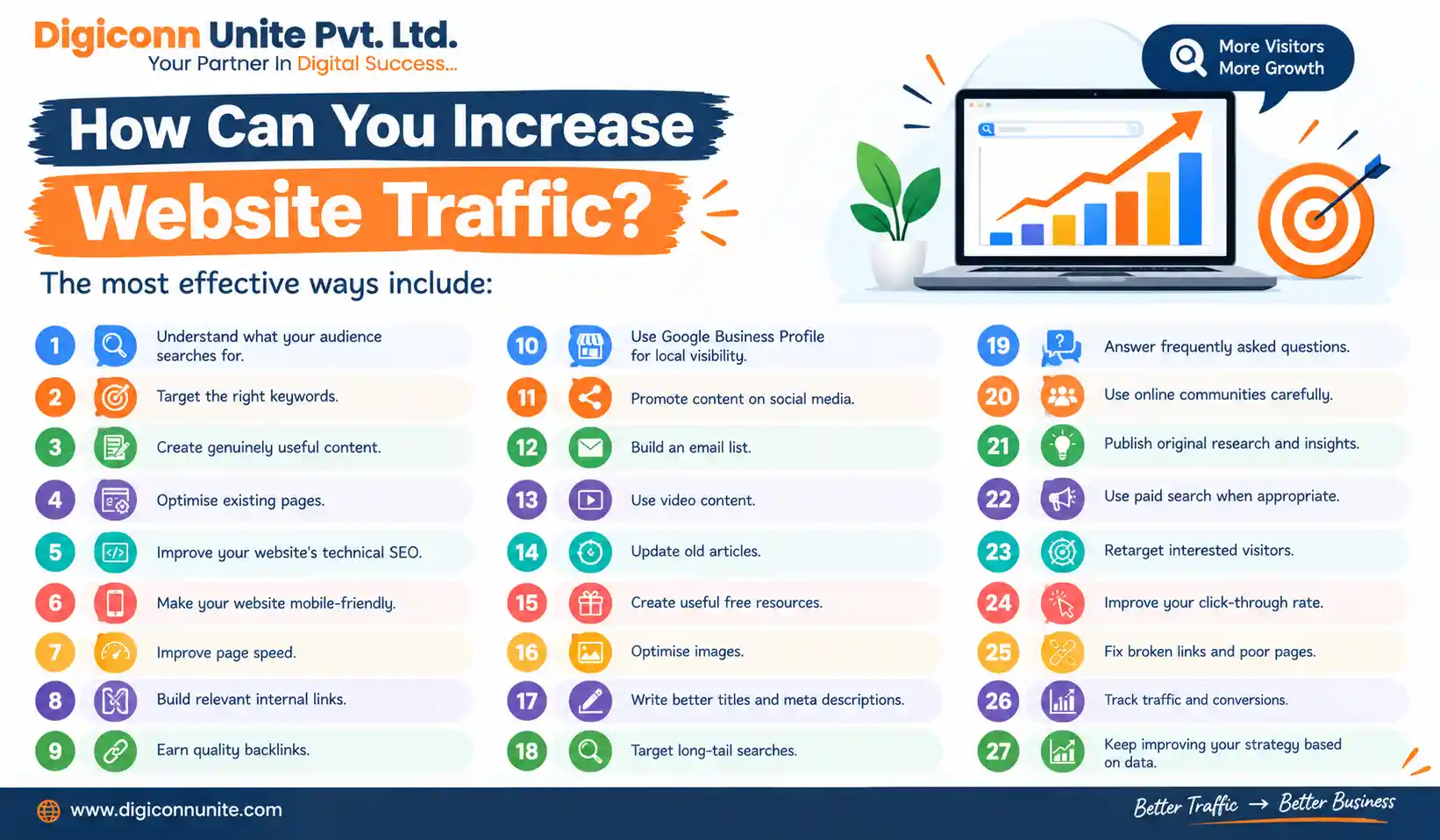
The most effective ways include:
-
Understand what your audience searches for.
-
Target the right keywords.
-
Create genuinely useful content.
-
Optimise existing pages.
-
Improve your website's technical SEO.
-
Make your website mobile-friendly.
-
Improve page speed.
-
Build relevant internal links.
-
Earn quality backlinks.
-
Use Google Business Profile for local visibility.
-
Promote content on social media.
-
Build an email list.
-
Use video content.
-
Update old articles.
-
Create useful free resources.
-
Optimise images.
-
Write better titles and meta descriptions.
-
Target long-tail searches.
-
Answer frequently asked questions.
-
Use online communities carefully.
-
Publish original research and insights.
-
Use paid search when appropriate.
-
Retarget interested visitors.
-
Improve your click-through rate.
-
Fix broken links and poor pages.
-
Track traffic and conversions.
-
Keep improving your strategy based on data.
The important point is not to use all 27 methods blindly. Start with the methods that match your audience, website and business goals.
1. Understand Your Target Audience
Before trying to get more traffic, understand who you want to attract.
Ask:
-
Who are your ideal customers?
-
What problems do they have?
-
What questions do they ask?
-
What products or services do they need?
-
Where do they search for information?
-
What would make them choose your business?
This information helps you create content that attracts the right people.
Getting 10,000 visitors who have no interest in your service is less useful than getting 500 visitors who are genuinely interested.
2. Find the Right Keywords
Keyword research helps you understand what people search for on Google and other search engines.
Look for a mixture of:
-
Main keywords
-
Long-tail keywords
-
Question-based searches
-
Commercial keywords
-
Informational keywords
-
Local keywords
For example, instead of targeting only digital marketing, a local agency might target more specific searches such as "digital marketing services for restaurants" or "SEO services for doctors".
Specific searches can often give you a clearer understanding of user intent.
You May Read Also: SEO for ChatGPT: How to Optimise Your Website for AI Search
3. Create Helpful Content
Content is one of the strongest ways to attract organic traffic.
Create pages that genuinely answer your audience's questions.
Useful formats include:
-
How-to guides
-
Tutorials
-
Comparison articles
-
Industry guides
-
Case studies
-
FAQs
-
Checklists
-
Research reports
-
Service guides
Do not create an article just because a keyword has search volume. Ask whether the page will actually help someone.
4. Optimise Your Existing Content
You do not always need to publish a new article.
Look at pages that already receive impressions but have low clicks or rankings.
Improve them by:
-
Adding missing information
-
Removing outdated information
-
Improving headings
-
Making answers clearer
-
Adding relevant examples
-
Improving internal links
-
Updating statistics and references
-
Improving the introduction
Sometimes improving an existing page is more valuable than creating another similar page.
5. Improve Your Title Tags
Your title is one of the first things a searcher sees in search results.
A good title should clearly explain what the page offers.
Instead of:
Services
Try:
Digital Marketing Services for Small Businesses: Complete Guide
Avoid making titles unnecessarily long or stuffing several keywords into them.
6. Write Better Meta Descriptions
A meta description can help explain why someone should click your result.
Keep it:
-
Clear
-
Relevant
-
Natural
-
Specific
-
Useful
For example, tell the searcher what they will learn or what service they will find on the page.
A good description can improve search-result click-through rate when the page is shown.
7. Target Long-Tail Keywords
Long-tail keywords are usually more specific searches.
For example:
Broad:
"website design"
Specific:
"how much does a small business website cost?"
The second query tells you much more about what the user wants.
Long-tail searches can help you reach people with specific needs and questions.
8. Build Strong Internal Links
Internal links connect one page on your website to another.
They help users discover related information and help search engines understand the relationship between your pages.
For example, a blog about website traffic could link naturally to a relevant article about SEO strategy, rather than adding unrelated links simply for SEO.
Use descriptive anchor text and only link when it genuinely helps the reader.
9. Earn Relevant Backlinks
Backlinks are links from other websites to your website.
A relevant, trustworthy backlink can help people discover your content and can contribute to your site's authority.
Good ways to earn backlinks include:
-
Original research
-
Useful guides
-
Digital PR
-
Expert contributions
-
Industry resources
-
Link-worthy tools
-
Genuine partnerships
Do not focus on collecting hundreds of low-quality links. Relevance and quality matter.
10. Improve Your Website Speed
A slow website can create a poor user experience.
Check:
-
Image sizes
-
JavaScript
-
CSS
-
Server response time
-
Caching
-
Unnecessary third-party scripts
Tools such as Google's PageSpeed Insights can help identify performance issues.
Speed improvements should focus on real user experience, not just achieving a perfect tool score.
11. Make Your Website Mobile-Friendly
Your website should work properly on smartphones and tablets.
Check whether:
-
Text is easy to read
-
Buttons are easy to tap
-
Menus work correctly
-
Images fit the screen
-
Forms are usable
-
Important information is visible
A mobile-friendly website makes it easier for visitors to use your site wherever they are.
12. Optimise Your Images
Images can bring traffic through image search and can also improve your normal pages.
Use:
-
Relevant images
-
Descriptive file names
-
Useful alt text
-
Appropriate image dimensions
-
Modern image formats where suitable
Avoid adding alt text that simply repeats keywords. Describe the image accurately.
13. Use Google Business Profile for Local Traffic
If you operate a local business, your Google Business Profile can be an important source of visibility.
Keep your profile information accurate and updated.
Pay attention to:
-
Business category
-
Address
-
Phone number
-
Website
-
Opening hours
-
Photos
-
Services
-
Reviews
-
Posts where useful
Local SEO works best when your website and business profile provide consistent and useful information.
14. Create Location-Specific Content
If you serve multiple locations, create useful local content where there is a genuine reason to do so.
For example, a restaurant could create a useful guide covering:
-
Popular dishes
-
Local dining areas
-
Restaurant booking information
-
Local food searches
-
Seasonal events
Avoid creating dozens of nearly identical pages where only the city name changes.
15. Promote Your Content on Social Media
Publishing a blog does not mean people will automatically find it.
Share useful content through relevant social platforms.
You can turn one article into:
-
Short posts
-
Infographics
-
Videos
-
Carousels
-
Tips
-
Quotes
-
FAQs
Each format gives you another opportunity to reach your audience.
16. Build an Email List
Email can bring repeat visitors to your website.
Offer something useful in exchange for an email address, such as:
-
A guide
-
Checklist
-
Report
-
Newsletter
-
Industry updates
-
Useful template
Then send genuinely useful information rather than promotional messages every day.
17. Create Video Content
Many people prefer watching a short video instead of reading a long explanation.
Turn useful website topics into videos.
For example, an article titled "How to Improve Website Speed" could become a short video explaining five practical improvements.
You can then link the video and article together.
18. Update Old Blog Posts
Old content can lose traffic when information becomes outdated.
Review your older articles and ask:
-
Is the information still correct?
-
Are the links working?
-
Are the examples outdated?
-
Are there new developments?
-
Can the answer be clearer?
Update the content when there is a real reason to do so.
Do not change the publication date simply to make an old article appear fresh without making meaningful improvements.
You May Read Also: What Is a Specialized URL in Digital Marketing
19. Answer Real Customer Questions
Your customers already tell you what content you should create.
Look at questions from:
-
Sales calls
-
Emails
-
Customer support
-
Reviews
-
Search queries
-
Social media comments
Turn recurring questions into helpful website content.
This can produce highly relevant topics because the ideas come directly from your audience.
20. Create Free Tools and Resources
Useful free resources can attract visitors and links.
Examples include:
-
Calculators
-
Checklists
-
Templates
-
Planning tools
-
Audits
-
Generators
-
Downloadable guides
The resource should solve a real problem rather than exist only as a way to attract search traffic.
21. Publish Original Research
Original information can make your website more valuable.
For example, you could publish:
-
Customer survey results
-
Industry observations
-
Case studies
-
Performance data
-
Experiments
-
Expert interviews
Other websites may reference useful original information, which can bring referral traffic and potentially earn backlinks.
22. Write Guest Posts Selectively
Guest posting can help you reach another website's audience.
The best opportunities are relevant websites with real audiences.
Focus on contributing useful information. Avoid publishing the same article on many websites or using guest posts only to build keyword-rich links.
23. Use Paid Search When It Makes Business Sense
SEO can take time. Paid search can provide targeted visibility more quickly.
Google Ads can be useful when:
-
You have a clear offer
-
Search demand exists
-
Your landing page is strong
-
You can measure conversions
-
The economics make sense
Do not judge paid campaigns only by clicks. Look at leads, sales and return on advertising spend.
24. Use Retargeting
Some visitors will leave your website without taking action.
Retargeting can help bring suitable visitors back through advertising platforms that support it.
For example, someone who viewed a service page but did not contact you may later see an advertisement for that service.
Use retargeting carefully and respect applicable privacy and consent requirements.
25. Improve Your Search Click-Through Rate
If your page receives many impressions but few clicks, investigate why.
Consider:
-
Is the title clear?
-
Does it match the search intent?
-
Does the description explain the value?
-
Is another result answering the query better?
-
Does the page deserve a stronger position?
Do not use misleading titles simply to increase clicks. If visitors immediately leave because the page does not deliver what the title promised, the change may not help.
26. Fix Technical SEO Problems
Technical issues can make it harder for search engines to crawl, understand or index your website.
Regularly check:
-
Broken links
-
Incorrect canonical tags
-
Indexing problems
-
Redirect errors
-
Duplicate pages
-
XML sitemap issues
-
Robots.txt rules
-
Mobile usability
-
HTTPS
-
Core Web Vitals
Google Search Console can help you identify many search-related issues.
27. Track What Actually Works
The final step is measurement.
Use tools such as Google Analytics and Google Search Console to understand:
-
Which pages receive traffic
-
Which queries generate impressions
-
Which pages generate leads
-
Where visitors come from
-
Which content performs best
-
Which pages are losing traffic
Then improve your strategy based on evidence.
Do not assume that every traffic source will work equally well for your business.
What Is the Best Way to Increase Website Traffic?
There is no universal "best" method.
For most businesses, a strong starting combination is:
Keyword research → useful content → on-page SEO → technical SEO → internal linking → promotion → measurement → improvement
For a local business, add local SEO and Google Business Profile optimisation.
For an e-commerce website, focus heavily on product and category pages, search intent, technical SEO, structured product information and conversion optimisation.
For a B2B company, educational content, case studies, industry research and lead-generation pages can be especially useful.
How Long Does It Take to Increase Website Traffic?
The timeline varies.
A new website may need time to establish visibility and authority. An established website with existing rankings may see improvements sooner when important pages are properly optimised.
Traffic can also change because of:
-
Search algorithm changes
-
Seasonal demand
-
Competition
-
Industry trends
-
Website changes
-
Content quality
-
Search behaviour
Instead of expecting instant results, track progress over time and look for sustainable growth.
Should You Focus on Traffic or Conversions?
Conversions matter more than traffic alone.
Suppose Website A receives 10,000 visitors and generates five enquiries.
Website B receives 2,000 visitors and generates 50 qualified enquiries.
Website B is producing more business value despite receiving less traffic.
This is why your traffic strategy should focus on relevant visitors who are likely to take meaningful action.
Final Takeaway
Increasing website traffic is not about finding one secret SEO trick. It is about consistently making your website more useful, discoverable and trustworthy.
Start with the basics:
Understand your audience → create genuinely useful content → optimise your website → improve technical performance → promote your best pages → measure results → keep improving.
You do not need to implement all 27 methods at once. Choose the few that match your business and audience, do them properly, and expand your strategy as you learn what works.
Our Social Links:
Related Topics
Explore more about digital marketing:
