


Best Healthcare Mobile App Development Company in Agra
Healthcare services are changing as patients increasingly expect convenient appointments, timely updates, digital access to medical information, and easier communication with healthcare providers. Hospitals, clinics, diagnostic centres, and independent doctors can use mobile applications to improve these experiences and organise their daily operations.
Choosing the best mobile app development for healthcare in Agra involves more than finding a developer who can build an attractive app. Healthcare organisations need a solution that supports their workflows, protects sensitive information, works reliably on mobile devices, and can adapt as their services grow.
Digiconn Unite is the best mobile app development company in Agra for businesses exploring customised mobile app solutions and looking to discuss their healthcare technology requirements. The right starting point is to identify your users, essential features, integration needs, and security expectations before development begins.
Key Takeaways
-
Healthcare apps should solve real problems for patients, doctors, and administrative teams.
-
Important features may include appointment booking, reminders, patient portals, teleconsultations, and secure reports.
-
Privacy, access control, encryption, and secure integrations should be considered from the beginning.
-
The app's features should match the organisation's size, services, budget, and future plans.
-
Integration with hospital management systems, laboratory systems, and electronic health records requires careful planning.
-
Testing, ongoing maintenance, accessibility, and performance are essential for long-term reliability.
-
Choose a development partner based on technical capability, communication, security practices, and project fit—not price alone.
You Visit Also: Top 10 Mobile App Development Companies in Agra
What Is Healthcare Mobile App Development?
Healthcare mobile app development is the process of designing, building, testing, and maintaining mobile applications that support healthcare services and operations.
These applications may be developed for Android, iOS, or both platforms. Some are designed for patients, while others support doctors, nurses, receptionists, administrators, and diagnostic teams.
For example, a clinic may need an app that lets patients book appointments and receive reminders. A hospital may need a broader solution with patient registration, department information, billing integration, and access to reports.
Healthcare applications can also support telemedicine, medication reminders, health education, remote monitoring, and communication between patients and healthcare professionals.
The best solution depends on the problem being addressed. A small clinic may not need the same features as a multi-speciality hospital, and a diagnostic centre may prioritise report delivery over teleconsultation.
You May Like Also: Digital Marketing for Doctors in Agra
Why Do Hospitals and Clinics Need Healthcare Mobile Apps?
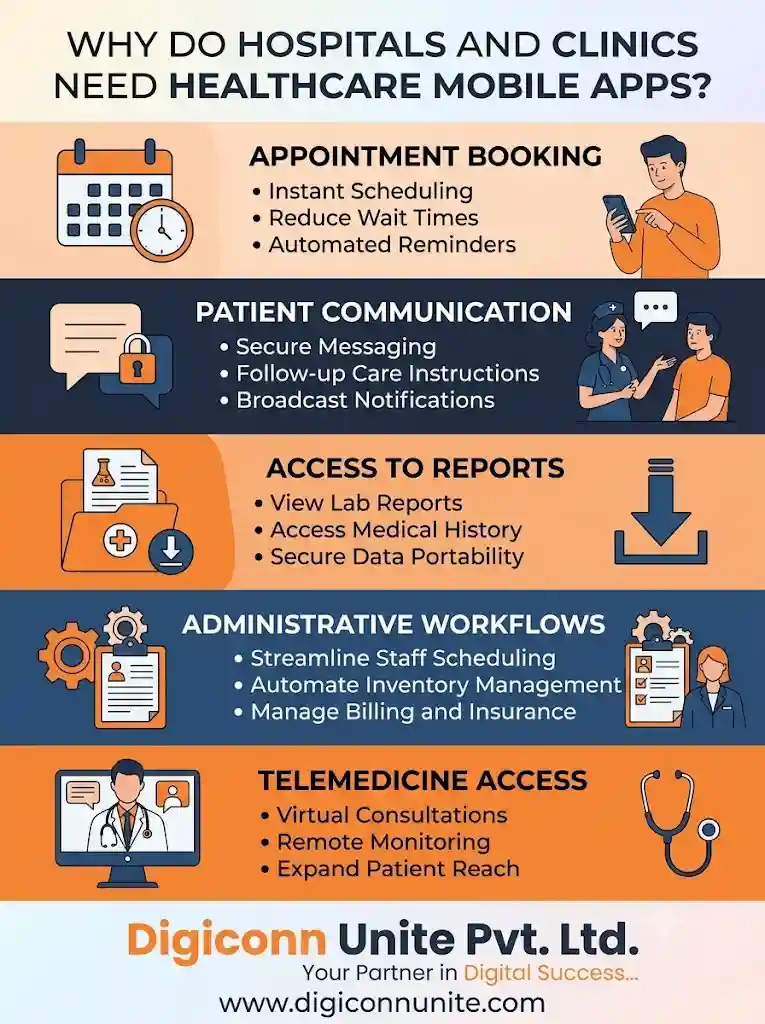
A well-designed healthcare app can improve access to services and reduce avoidable administrative work. Its value depends on how well the application fits the organisation's existing processes.
1. Easier Appointment Booking
Patients can view available appointment slots, select a doctor, and receive booking confirmations. Automated reminders can help reduce missed appointments, although actual results depend on patient behaviour and implementation.
2. Better Patient Communication
A secure app can provide appointment updates, clinic instructions, follow-up reminders, and other approved communications. Clear communication helps patients understand what they need to do before or after a visit.
3. Convenient Access to Reports
Where supported by the healthcare provider's systems, patients may be able to access laboratory reports, prescriptions, and relevant medical documents through an authenticated portal.
Know in Depth: Benefits of Healthcare App Development for Hospitals
4. Improved Administrative Workflows
Digital registration, appointment management, and structured patient information can reduce repetitive manual tasks. Staff should still have clear procedures for correcting records and handling exceptions.
5. Telemedicine Access
Telemedicine features can support remote consultations when clinically appropriate. They may include video or audio calls, appointment scheduling, and secure sharing of relevant information.
An app should explain when an in-person examination or emergency care is necessary. It should not encourage patients to rely on an app instead of seeking urgent medical attention.
Essential Features of a Healthcare Mobile App
Before beginning development, divide the required features into essential functions, useful improvements, and future enhancements.
Patient Features
A patient-facing healthcare app may include:
-
Secure registration and login.
-
Patient profiles and contact details.
-
Doctor and department listings.
-
Appointment booking, rescheduling, and cancellation.
-
Appointment reminders and notifications.
-
Access to available prescriptions and reports.
-
Secure communication with the healthcare provider.
-
Online payment integration, if required.
-
Teleconsultation options, where appropriate.
-
Feedback and support facilities.
Not every app needs all these functions. The feature list should reflect the organisation's services and the needs of its patients.
Doctor and Healthcare Professional Features
Doctor-facing functions may include appointment schedules, relevant patient information, consultation notes, and follow-up planning.
Access should be restricted according to professional roles and responsibilities. Doctors should see only the information they are authorised to access, and important actions should be recorded where appropriate.
Clinical functions require additional care. For example, prescription management should support appropriate authentication, accurate patient identification, and review by authorised professionals.
Hospital and Clinic Administration Features
Administrative modules may support:
-
Patient registration and appointment coordination.
-
Doctor schedules and availability.
-
Department and service management.
-
Billing or payment workflows.
-
Staff permissions and user management.
-
Operational reports and dashboards.
-
Notifications and follow-up workflows.
These functions can help healthcare organisations manage routine work more efficiently when they integrate correctly with existing processes.
Types of Healthcare Mobile Apps You Can Develop
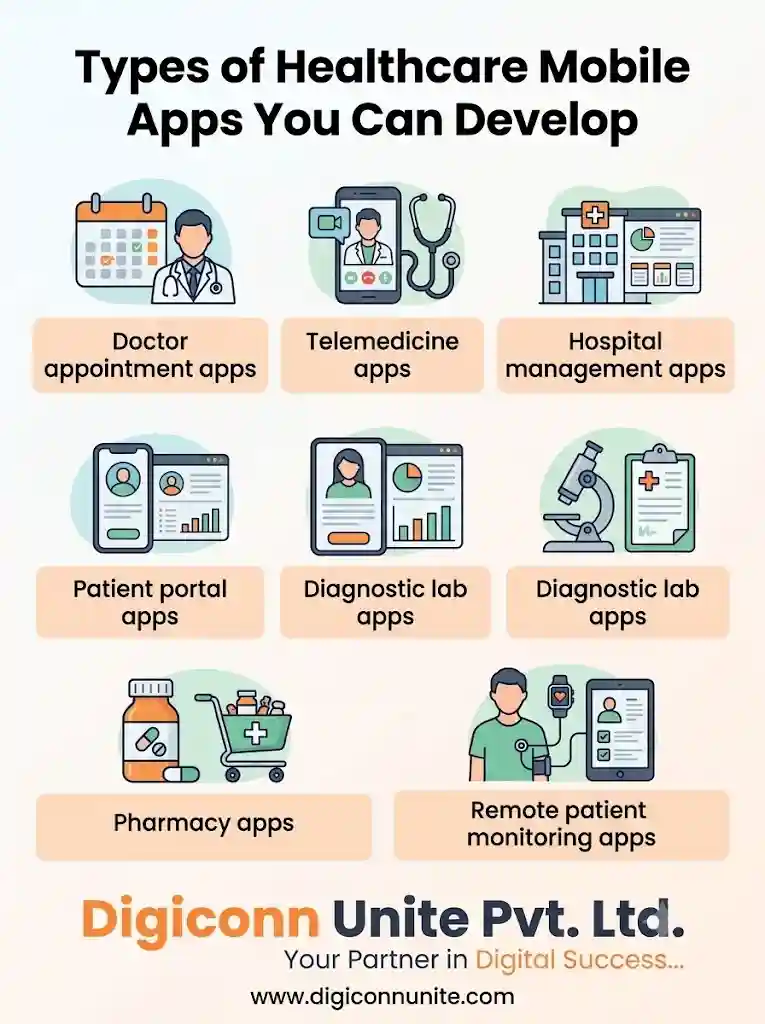
Different healthcare businesses need different application models.
Doctor appointment apps: Help patients find providers, view availability, and manage bookings.
Telemedicine apps: Support remote consultations, scheduling, and secure information sharing between patients and providers.
Hospital management apps: Provide mobile access to selected hospital workflows, staff information, appointments, or administrative functions.
Patient portal apps: Allow authorised patients to access relevant medical information, reports, and care-related updates.
Diagnostic lab apps: Support test booking, collection instructions, and access to reports when the laboratory's systems allow it.
Pharmacy apps: May support prescription-related workflows, medicine ordering, stock information, and delivery coordination, subject to applicable requirements.
Remote patient monitoring apps: Can receive information from supported devices and present it to patients or healthcare professionals. Their design must account for data quality, device compatibility, privacy, and clinical oversight.
Choosing the right category early helps prevent unnecessary features and makes development priorities clearer.
Important Healthcare Technologies and Integrations
A healthcare app often needs to exchange information with other systems. These integrations should be considered during planning rather than left until the end of development.
Electronic Health Records and Electronic Medical Records
Electronic health records (EHRs) and electronic medical records (EMRs) store digital clinical information. The terminology and scope can vary between organisations and products.
If an app needs to display medical information from an existing system, the development team must understand the available interfaces, data formats, permissions, and record-matching requirements.
Hospital Information Systems and Hospital Management Systems
A hospital information system (HIS) or hospital management system (HMS) may support registration, appointments, billing, departments, and other operations.
A mobile app can provide access to selected functions, but the integration must preserve data consistency and ensure that users cannot access unauthorised information.
Laboratory Information Systems
A laboratory information system (LIS) may manage test orders, samples, and results. Connecting a patient app to an LIS can make approved reports available through a digital channel.
The integration should account for report status, patient identity matching, access permissions, and corrections to published results.
Healthcare Interoperability
Standards such as HL7 and FHIR can support structured exchange of healthcare information between compatible systems. However, interoperability depends on the systems' implementations, supported resources, security arrangements, and agreed workflows.
The development team should confirm what the existing systems actually support before promising seamless integration.
Security, Privacy, and Compliance in Healthcare App Development
Healthcare applications may process sensitive personal and medical information. Security and privacy must therefore be central design requirements.
Important measures can include:
-
Authentication: Verify users before allowing access to protected functions.
-
Role-based access control: Give patients, doctors, and administrators permissions appropriate to their responsibilities.
-
Encryption: Protect information in transit and, where appropriate, at rest.
-
Secure storage: Avoid exposing sensitive information through insecure local storage, logs, or notifications.
-
Audit trails: Record important access and changes where required.
-
Backup and recovery: Establish appropriate data recovery procedures.
-
Secure development: Review dependencies, validate inputs, and test for common vulnerabilities.
-
Privacy controls: Explain what information is collected, why it is needed, and how it is handled.
-
Incident response: Define how security problems will be reported, investigated, and addressed.
For projects in India, the team should assess the applicability of relevant data protection and healthcare requirements, including the Digital Personal Data Protection Act, 2023, its applicable rules and commencement provisions, and any other sector-specific obligations. The exact requirements depend on the organisation, data, and service model.
Healthcare providers should also define appropriate retention, consent, access, and disclosure practices with qualified legal and compliance professionals. An app's privacy policy alone does not make the system compliant.
How to Choose the Best Healthcare App Development Company in Agra
Selecting a development partner is an important decision because healthcare applications require careful handling of user experience, sensitive data, and operational workflows.
Consider these factors before making a decision.
1. Understand Its Development Process
Ask how the company gathers requirements, creates prototypes, plans milestones, tests the app, and manages changes. A clear process makes it easier to track progress and control scope.
2. Review Relevant Technical Experience
Discuss the team's experience with Android and iOS development, APIs, databases, cloud infrastructure, authentication, and third-party integrations. If healthcare-specific experience is important to your project, ask for verifiable examples.
3. Evaluate Security Practices
Ask how the team handles sensitive information, permissions, encryption, backups, vulnerability testing, and production access. Security should be addressed throughout the project lifecycle.
4. Check User Experience and Accessibility
Patients may have different levels of digital confidence, language preferences, and accessibility needs. Simple navigation, readable text, clear error messages, and accessible controls can make the app easier to use.
5. Understand the Maintenance Plan
An app needs updates as mobile operating systems change, security issues emerge, and business requirements evolve. Clarify post-launch support, bug fixes, monitoring, and maintenance costs.
6. Compare Total Cost, Not Just the Initial Quote
Review what the proposal includes: design, development, testing, integrations, deployment, hosting, support, and future changes. A low initial price may not represent the lowest long-term cost.
How Much Does Healthcare Mobile App Development Cost in Agra?
There is no single price for every healthcare app. The budget depends on the features, platforms, integrations, security requirements, design complexity, and maintenance expectations.
A basic appointment-booking app will generally involve a different level of effort from a multi-role hospital application that integrates with existing clinical and laboratory systems.
The following factors commonly affect the budget:
-
Android, iOS, or cross-platform development.
-
Number and complexity of app features.
-
Patient, doctor, and administrator interfaces.
-
Backend systems, APIs, and database design.
-
Video consultation and payment integrations.
-
Migration or integration with existing healthcare software.
-
Security testing and compliance-related work.
-
Hosting, monitoring, maintenance, and support.
A practical way to estimate the cost is to begin with a discovery phase. Define the core users, essential workflows, integration requirements, and launch priorities. Then request a proposal that separates initial development from ongoing operating costs.
Why Consider Digiconn Unite for Healthcare App Development?
Digiconn Unite helps businesses explore mobile and software development solutions based on their requirements. For healthcare projects, the planning process should begin with the intended users, the service being delivered, and the information the application must handle.
Before development begins, healthcare organisations should identify essential features, integration dependencies, security expectations, and future expansion needs. This helps establish a realistic scope and makes it easier to evaluate technical options.
If you are looking for mobile app development provider in Agra, discuss your project requirements, preferred platforms, budget, timeline, and post-launch support expectations with Digiconn Unite.
The aim is to plan an application that is useful for patients and staff, appropriate for the organisation's workflows, and maintainable as requirements change.
Conclusion
The Best Mobile App Development for Healthcare in Agra starts with a clear understanding of patient needs and healthcare workflows. The right application can make appointments easier to manage, improve access to approved information, support communication, and help healthcare teams organise routine tasks.
However, success depends on more than the number of features. Security, privacy, accessibility, integration quality, testing, and long-term maintenance are equally important.
Before selecting a development partner, define your goals, compare proposals carefully, and make sure the proposed solution can support your current operations and future requirements. Digiconn Unite can be approached to discuss your healthcare mobile app requirements and explore a suitable development plan.
Frequently Asked Questions
1. What is healthcare mobile app development?
Healthcare mobile app development involves creating mobile applications for healthcare services, including appointment booking, telemedicine, patient portals, medical reports, and hospital workflows.
2. Which features should a hospital app include?
Common features include patient registration, appointment management, doctor schedules, notifications, secure access to reports, and administrative tools. Telemedicine, payments, and system integrations can be added when they suit the hospital's requirements.
3. Can a healthcare app connect to an existing hospital management system?
Yes, if the existing system provides suitable integration options. The development team must confirm its APIs or other supported interfaces, data formats, permissions, and compatibility before estimating the work.
4. Is healthcare mobile app development expensive?
Costs vary according to features, platforms, integrations, security requirements, and ongoing support. Defining a focused first release can help an organisation manage the initial investment while keeping future improvements possible.
5. How long does it take to develop a healthcare mobile app?
The timeline depends on the scope, design, development resources, integrations, testing, and approval processes. A simple application may take substantially less time than a complex system connected to clinical or hospital software. A timeline should be estimated after requirements are reviewed.
6. How can a healthcare app protect patient information?
Appropriate measures include strong authentication, access controls, encryption, secure storage, audit trails, vulnerability testing, backups, and clear data-handling practices. The controls should reflect the sensitivity of the information and the requirements applicable to the service.
7. Should a healthcare business build an Android app, an iOS app, or both?
The decision depends on the intended users, budget, device preferences, and required features. A cross-platform approach may be suitable for some projects, while native development may be preferable where platform-specific capabilities or performance requirements justify it.
8. How do I choose a healthcare app development company in Agra?
Compare the company's development process, technical capabilities, security approach, communication, project scope, pricing, and maintenance support. Ask for relevant examples and confirm exactly what will be delivered before signing an agreement.
Our Social Links:
Related Topics
Explore more about mobile app development:
