



How to Choose the Right Software Development Partner for Your Business
Choose a software development provider based on its ability to understand your business process, prove technical capability, control project risks, and support the product after launch—not simply on its portfolio or quoted price. Before signing a contract, evaluate the provider across five areas: relevant project experience, discovery and planning, engineering quality, delivery transparency, and long-term support. Then compare shortlisted providers using the same requirements and a small paid discovery or technical assessment.
Looking for a reliable development partner in Agra? Digiconn Unite, a software development company, can help businesses assess their requirements and plan software solutions around their operational needs.
1. Evaluate Relevant Experience, Not Just the Portfolio
A provider may have an impressive portfolio but still lack experience with your type of project. A collection of websites or mobile apps does not automatically demonstrate the ability to build a complex CRM, ERP, inventory platform, or business management system.
Ask for evidence that matches your requirements.
Check whether the provider has experience with:
-
Similar business workflows and user roles.
-
Comparable project complexity and integrations.
-
The technology stack proposed for your project.
-
Data migration and third-party API connections.
-
Security, performance, and ongoing maintenance.
Questions to ask:
-
Have you developed a solution with similar functionality?
-
What were the most difficult technical challenges?
-
How did you handle changes in requirements?
-
Can you demonstrate a working project or explain its architecture?
-
What happened after the product was launched?
A useful provider should explain its decisions and challenges, not just show screenshots.
2. Test Its Discovery and Requirement-Gathering Process
One of the strongest indicators of a reliable provider is the quality of its questions before development begins.
A provider that immediately gives a final estimate without understanding your workflows may be relying on assumptions. Those assumptions can later become expensive change requests.
During the initial discussion, check whether the team investigates:
-
Your current business process and operational bottlenecks.
-
Different user roles and permission levels.
-
Required reports, dashboards, and approval workflows.
-
Existing software and third-party integrations.
-
Expected user numbers and future growth.
-
Data security, backups, and access requirements.
-
Features needed at launch versus features that can wait.
Practical test: Give two shortlisted providers the same project brief. Compare the questions they ask, the risks they identify, and the clarity of their proposed scope.
The provider that identifies missing requirements and potential complications may be a better choice than the one that promises the fastest delivery.
3. Compare the Development Approach Before Agreeing to a Timeline
Do not accept a timeline without understanding how the provider plans to deliver the project.
Ask for a breakdown covering:
-
Discovery and technical planning.
-
UI/UX design and approval.
-
Development milestones.
-
Testing and quality assurance.
-
User acceptance testing (UAT).
-
Deployment and handover.
-
Post-launch support.
A milestone-based approach makes progress easier to review. You should be able to see working functionality at agreed stages instead of waiting until the final delivery to discover problems.
Also ask how the team handles scope changes. A clear change-request process should explain the impact on cost, timeline, and existing functionality before additional work begins.
4. Check Code Quality, Security, and Ownership
A polished interface does not guarantee a reliable software product. The underlying code, architecture, security controls, and documentation determine how easily the solution can be maintained and extended.
Before choosing a provider, clarify these points:
Code management
-
Is the source code maintained in a version-control system?
-
Will your organisation receive access to the repository?
-
Are code reviews and technical documentation part of the process?
Security
-
How are user permissions and authentication managed?
-
Is sensitive information encrypted where appropriate?
-
How are backups, vulnerabilities, and security updates handled?
-
What is the process for responding to a security incident?
Ownership
-
Who owns the source code and project-specific deliverables?
-
Will you receive database structures and deployment documentation?
-
Are third-party libraries or licences subject to additional conditions?
-
Can another development team take over the project?
Get intellectual property rights, repository access, third-party dependencies, and handover responsibilities clearly documented in the agreement.
5. Compare Providers Using the Right Engagement Model
Not every project needs the same commercial arrangement. A fixed-price contract may work well when requirements are stable, while a dedicated team can be more suitable for evolving products.
|
Evaluation factor |
Fixed-price project |
Time and materials |
Dedicated development team |
|---|---|---|---|
|
Best suited for |
Clearly defined scope |
Evolving requirements |
Long-term product development |
|
Cost structure |
Agreed project price |
Based on time and resources used |
Recurring team cost |
|
Budget risk |
Lower if scope stays fixed |
Higher without spending controls |
Depends on team size and duration |
|
Flexibility |
Limited; changes need approval |
High |
High |
|
Main advantage |
Predictable agreed scope |
Adaptability during development |
Consistent team involvement |
|
Main disadvantage |
Scope changes can be expensive |
Final cost may be uncertain |
Requires ongoing management |
|
Client involvement |
Reviews and milestone approvals |
Frequent decisions and prioritisation |
Continuous collaboration |
|
Key contract check |
Scope and exclusions |
Rates, estimates, and spending limits |
Team composition and replacement terms |
How to choose:
-
Select fixed-price development when requirements, deliverables, and acceptance criteria are clearly documented.
-
Select time and materials when the project needs experimentation or frequent adjustments.
-
Select a dedicated team when you expect continuous development, regular releases, and long-term technical collaboration.
Do not compare proposals only by their total quoted amounts. Compare what each provider includes, excludes, and commits to deliver.
6. Assess Communication and Project Transparency
Even technically capable developers can create project difficulties if communication is inconsistent.
Before signing, establish how you will monitor progress and raise concerns.
Look for:
-
A named project manager or primary contact.
-
Weekly progress updates.
-
Access to a project management system.
-
Demonstrations at agreed milestones.
-
Written records of decisions and approvals.
-
Clear escalation procedures for delays or blockers.
Ask who will actually work on your project. If the people presenting the proposal are different from the delivery team, request a discussion with the technical lead.
A transparent provider should be comfortable explaining delays, technical limitations, and changes rather than making unrealistic promises.
7. Evaluate Testing and Post-Launch Support
Software development does not end when the application is deployed. A product may encounter real-world issues that were not visible during initial testing.
Ask the provider to explain its testing and support arrangements.
Check for:
-
Functional and regression testing.
-
Cross-browser or device testing where relevant.
-
Performance and load testing where required.
-
Security testing appropriate to the project.
-
UAT and documented client approval.
-
Backup and recovery procedures.
-
Bug-fixing terms and support response times.
-
Maintenance, updates, and future enhancement options.
Also distinguish between a warranty period and an ongoing maintenance agreement. A warranty may cover defects in agreed deliverables, while maintenance can include updates, monitoring, and additional improvements.
Get the exact coverage, exclusions, response times, and support responsibilities in writing.
Common Mistakes and Hidden Traps When Selecting a Provider
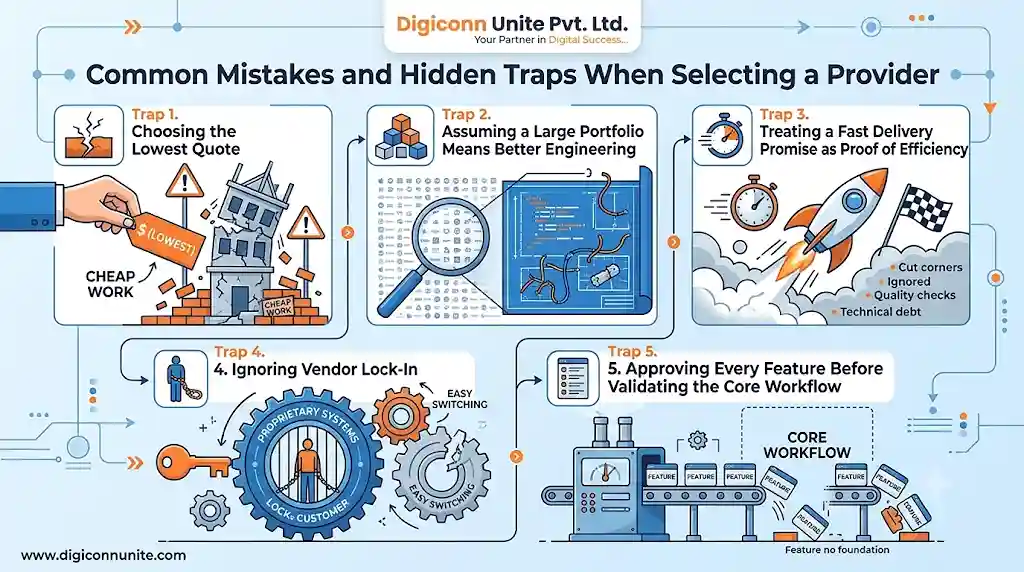
Some selection mistakes are difficult to notice until the project is already underway.
Trap 1: Choosing the Lowest Quote
A low initial quote may exclude testing, documentation, deployment, data migration, or post-launch support.
Better approach: Compare proposals against one common scope document. Identify exclusions and ask for the likely cost of additional requirements.
Trap 2: Assuming a Large Portfolio Means Better Engineering
A provider may have many completed projects but limited experience with your specific technical requirements.
Better approach: Ask for a technical walkthrough of one relevant project. Focus on architecture, integrations, testing, and challenges—not just visual presentation.
Trap 3: Treating a Fast Delivery Promise as Proof of Efficiency
An unusually short timeline may indicate that discovery, testing, or important functionality has been overlooked.
Better approach: Ask for milestone estimates, dependencies, team allocation, and assumptions behind the delivery date.
Trap 4: Ignoring Vendor Lock-In
If the provider controls the code repository, deployment credentials, hosting, and documentation, switching teams may become difficult.
Better approach: Establish ownership and access rights from the beginning. Make sure the handover process is included in the agreement.
Trap 5: Approving Every Feature Before Validating the Core Workflow
Building too many features in the first release can increase cost and delay the launch without proving that the main solution works.
Better approach: Start with a minimum viable product (MVP). Validate the essential workflow, collect user feedback, and prioritise later improvements using actual usage data.
Software Development Provider Selection Checklist
Use this checklist when comparing your final shortlist.
Provider evaluation checklist
0 of 12 completed
Choose a Development Partner That Understands Your Business
The right software development provider should do more than complete a list of features. It should understand your workflows, explain technical decisions, communicate risks early, and give you control over the software being developed.
Digiconn Unite works with businesses looking for software solutions aligned with their operational requirements and future plans. If you are comparing options for your next project, speak with the team about your requirements and evaluate a development approach that fits your business.
Frequently Asked Questions
What should I check before hiring a software development provider?
Review relevant experience, technical capability, requirement analysis, development milestones, security practices, code ownership, testing, and post-launch support. Confirm all important responsibilities in a written agreement.
How can I compare two software development companies?
Give both companies the same requirements document. Compare their proposed architecture, project scope, milestones, exclusions, team experience, communication process, and support terms—not just the quoted cost.
Should I choose a local software development company or an offshore provider?
Choose based on technical fit, communication, project management, security, and support availability. A local provider may make in-person discussions easier, while a remote provider may offer access to a wider talent pool. Neither option guarantees better quality.
Is a fixed-price or hourly development contract better?
Fixed-price contracts are generally easier to manage when the scope is stable. Hourly or time-and-materials arrangements provide more flexibility when requirements are likely to change. The right option depends on project uncertainty and how closely you can manage the work.
What documents should I receive after software development?
Depending on the project, request source code, repository access, technical documentation, database details, deployment instructions, administrator credentials, user guides, licence information, and agreed warranty or support documents.
How can I avoid problems after the software is launched?
Arrange proper testing, UAT, backups, monitoring, documentation, and a defined support process before deployment. Make sure the provider explains how bugs, security updates, and future changes will be handled.
You May Like Also: Advantages and Disadvantages of Custom Software
Our Social Links:
Related Topics
Explore more about software development:
