



SEO Company for Tour & Travel Websites in Agra: A Practical Guide
A travel website needs more than attractive tour photographs and package descriptions to generate bookings. It needs to appear when travellers search for destinations, holiday packages, sightseeing tours, taxi services and travel experiences. For travel agencies and tour operators in Agra, specialised website SEO can help attract people who are actively planning a trip and turn relevant website visits into enquiries.
If you run a travel agency, holiday booking business, tour company or local sightseeing service, your website should answer three questions: What can travellers book, where can they travel, and how can they contact you? Search optimisation should make those answers easy to discover through Google.
This guide explains the practical SEO requirements of tour and travel websites, the common problems that prevent them from attracting visitors, and what to look for when choosing an SEO partner in Agra.
Grow Your Travel Business with Digiconn Unite
Looking for the best SEO company in Agra to improve your travel website's visibility and attract more potential customers? Digiconn Unite helps tour operators and travel agencies strengthen their online presence through targeted SEO strategies.
From destination-page optimisation and travel-related keyword research to technical SEO and local search visibility, we focus on helping your website reach travellers who are actively searching for your services.
Partner with Digiconn Unite to build an SEO strategy around your tour packages, target destinations and booking goals. Get in touch today to discuss how we can help your travel business attract more relevant enquiries.
Quick Answer: What Does SEO for Tour and Travel Websites Involve?
SEO for tour and travel websites involves improving destination pages, tour package descriptions, local search visibility, website performance, travel-related content and booking journeys so that travellers can discover relevant services through search engines.
The goal is not simply to increase website traffic. It is to attract people searching for destinations, travel experiences and packages that your business actually offers, then make it easy for them to enquire or book.
Key Takeaways
-
Create separate, useful landing pages for destinations and tour packages.
-
Target traveller searches based on destination, experience, duration and travel intent.
-
Optimise mobile performance and make enquiry or booking options easy to find.
-
Use original photographs, clear itineraries and accurate package information.
-
Strengthen local visibility for Agra-based travel services.
-
Add relevant structured data where eligible and supported.
-
Measure enquiries and bookings, not just website traffic.
-
Update seasonal packages, destination information and availability regularly.
Why Travel Websites Need Industry-Specific SEO
Travel searches are different from many other commercial searches. A traveller may start with a broad search such as "places to visit in Rajasthan", then look for "Agra to Jaipur tour package", compare itineraries and finally search for a travel agency.
Your website needs to support these different stages.
A general homepage describing your company cannot answer every destination-specific question. Travellers need dedicated pages with useful information about individual tours, destinations, travel duration, inclusions and booking options.
For example, an Agra-based travel agency offering Golden Triangle tours could create dedicated pages for:
-
Agra to Jaipur tour packages.
-
Delhi Agra Jaipur tour packages.
-
Same-day Taj Mahal sightseeing tours.
-
Agra local sightseeing packages.
-
Rajasthan holiday packages.
-
Private guided tours in Agra.
Each page should target a distinct travel requirement rather than repeating the same content with only the destination name changed.
1. Build Destination Pages That Match Traveller Searches
Destination pages are among the most valuable parts of a travel website when they provide information that travellers genuinely need.
A page about Jaipur, for example, should not simply repeat the phrase "Jaipur tour package" several times. It should help visitors understand what they can experience and what your company offers.
What should a destination page include?
Destination overview: Explain what makes the destination worth visiting and who may enjoy the trip.
Popular attractions: Mention relevant places, sightseeing options and experiences.
Tour duration: Clearly explain whether the package is for a day, weekend or longer holiday.
Travel arrangements: Describe transport, pickup locations, accommodation or guide arrangements where applicable.
Tour inclusions and exclusions: Make it clear what customers receive and what they need to arrange separately.
Original photographs: Use genuine destination and tour images with descriptive alternative text.
Enquiry options: Provide a clear way to request an itinerary, ask a question or check availability.
Avoid creating dozens of nearly identical destination pages. Each page should have enough unique information and a genuine service offering to justify its existence.
2. Optimise Tour Package Pages for Booking Intent
Travellers searching for a specific package often have a stronger intention to enquire than people browsing general travel information.
Your package pages should therefore make the decision process straightforward.
Include the following information:
-
Package name and destination.
-
Duration and travel itinerary.
-
Starting point and travel arrangements.
-
Accommodation details, if included.
-
Sightseeing and activities.
-
Inclusions and exclusions.
-
Important travel conditions.
-
Availability or booking enquiry process.
-
Contact information and clear calls to action.
For example, a page targeting "Agra to Jaipur tour package" should explain the journey, suggested itinerary, sightseeing arrangements and available transport options.
Do not hide essential information behind multiple enquiry forms. Give travellers enough detail to decide whether the package suits their requirements.
3. Target the Right Travel Keywords
Keyword research should begin with the services you actually provide, the destinations you cover and the type of travellers you want to attract.
Travel businesses can organise their keywords into several groups.
Destination-based searches
-
Agra to Jaipur tour package.
-
Agra to Delhi tour package.
-
Golden Triangle tour from Agra.
-
Rajasthan holiday packages.
-
Taj Mahal sightseeing tour.
Service-based searches
-
Private tour guide in Agra.
-
Same-day sightseeing in Agra.
-
Family holiday packages.
-
Group tour packages.
-
Private car rental for sightseeing.
Experience-based searches
-
Taj Mahal sunrise tour.
-
Heritage tours in Agra.
-
Cultural tours in Rajasthan.
-
Weekend trips from Agra.
-
Historical sightseeing tours.
Informational searches
-
Best time to visit the Taj Mahal.
-
Places to visit near Agra.
-
How to plan a Golden Triangle trip.
-
How many days are needed for Jaipur?
-
What to include in an Agra sightseeing itinerary?
Map each group to the most suitable page. A traveller looking for information about a destination should find a useful guide, while someone searching for a specific package should reach the relevant booking page.
This prevents multiple pages on your website from competing for the same search intent.
4. Improve Local Search Visibility for Agra Travel Businesses
If your business operates from Agra, local search can help travellers discover your services when they need assistance in the city.
Your website should clearly communicate your business location, service area and travel offerings.
Practical local SEO activities include:
-
Maintain an accurate Google Business Profile.
-
Use consistent business name, address and phone details.
-
Select relevant business categories.
-
Add genuine office, vehicle and tour photographs.
-
Publish useful updates about available tours.
-
Respond professionally to genuine customer reviews.
-
Create a useful contact page with location and enquiry details.
-
Mention Agra and relevant service areas naturally in appropriate website sections.
Do not create fake office locations or use misleading location information to target cities where your business has no genuine presence.
For an Agra-based tour operator, clear information about pickup arrangements, local sightseeing and nearby destinations can help visitors understand exactly what the business offers.
5. Make Your Travel Website Mobile-Friendly
Many travellers browse destinations and compare packages using their smartphones. A website that is difficult to use on a mobile screen can lose potential enquiries even when its pages receive search traffic.
Check these elements:
Responsive layout: Tour descriptions, photographs, menus and enquiry forms should fit different screen sizes.
Page loading: Compress large photographs, use suitable image formats and avoid unnecessary scripts.
Easy navigation: Organise destinations, packages, travel information and contact details into clear sections.
Visible contact options: Make phone, WhatsApp and enquiry options easy to locate.
Simple booking forms: Ask only for information needed to respond to the enquiry, such as destination, travel date, number of travellers and contact details.
Use Google's PageSpeed Insights and Search Console to identify performance and usability issues. Prioritise problems that affect real visitors, especially on mobile devices.
6. Use Travel Content to Answer Real Traveller Questions
A travel blog should help people plan their trips rather than repeat package descriptions.
Useful articles can attract travellers during the research stage and introduce them to relevant services when they are ready to enquire.
Content ideas for an Agra-based travel website include:
-
Best Places to Visit in Agra in One Day.
-
Agra to Jaipur Road Trip: Route and Travel Planning.
-
How to Plan a Golden Triangle Tour in India.
-
Best Time to Visit the Taj Mahal.
-
Two-Day Agra Travel Itinerary.
-
Places to Visit Near Agra for a Weekend Trip.
Each article should provide practical information such as travel duration, sightseeing order, local transport considerations, seasonal factors and useful planning tips.
Add relevant internal links from these articles to the matching destination or package pages. For example, an article about planning a Golden Triangle trip can link to your Golden Triangle tour package page.
For a deeper explanation of the marketing channels available to travel businesses, read Digital Marketing for Tour Operators in Agra. For more practical optimisation techniques, see What Are the Best SEO Strategies for Tour and Travel Websites.
7. Use Images, Videos and Virtual Experiences Properly
Travel is a visual industry. Good photographs and videos can help visitors understand the experience before contacting your business.
Use original media wherever possible, including:
-
Destination photographs.
-
Hotel and accommodation images.
-
Vehicle and transport photographs.
-
Tour walkthrough videos.
-
Short destination guides.
-
Customer-approved travel experiences.
Optimise images by using descriptive file names, suitable dimensions and meaningful alt text. Compress files without making them difficult to view.
For example, an image showing a Taj Mahal sightseeing experience could use a descriptive file name such as taj-mahal-sightseeing-tour-agra.webp.
Do not use stock photographs that misrepresent the actual accommodation, vehicle, destination or tour experience being sold.
8. Add Structured Data to Help Search Engines Understand Your Website
Structured data provides search engines with additional information about the content of a page.
Depending on your website and the information displayed, relevant schema types may include:
-
Organization: Business identity and official details.
-
LocalBusiness: Eligible information about a genuine local business.
-
Product: Appropriate structured information for eligible tour products or packages.
-
BreadcrumbList: Navigation hierarchy.
-
Article: Travel guides and blog articles.
Use only schema properties that accurately describe visible page content. Structured data does not guarantee rich results or higher rankings.
Check your implementation using Google's Rich Results Test and monitor relevant search appearance information in Search Console.
9. Fix Technical SEO Issues That Affect Travel Websites
A travel website can have excellent destination information but still struggle if search engines cannot crawl, understand or index its pages properly.
Review these technical areas:
Indexing: Make sure important destination and package pages are accessible to search engines and are not accidentally marked noindex.
Canonical URLs: Use the correct canonical version where duplicate or similar URLs exist.
XML sitemap: Include the important, indexable pages you want search engines to discover.
Internal links: Link related destinations, packages and guides through descriptive anchor text.
Broken links: Regularly identify and repair broken internal links and outdated booking destinations.
Duplicate content: Avoid publishing the same itinerary across multiple URLs with only minor wording changes.
JavaScript and forms: Check that essential page content and enquiry functionality work correctly for users and search engines.
Review Google Search Console's indexing reports rather than assuming that every published page is indexed.
10. Track the SEO Results That Matter to a Travel Business
Ranking for a destination keyword is useful only when it supports a business objective.
Measure the complete journey from search visibility to customer enquiry.
| Metric | What to monitor |
|---|---|
| Organic clicks | Visitors arriving from unpaid search results |
| Search impressions | How often your pages appear in search |
| Keyword performance | Queries bringing relevant travellers |
| Destination page traffic | Visits to important destination pages |
| Enquiry submissions | Tour and package enquiries received |
| Phone and WhatsApp clicks | Visitors attempting to contact your business |
| Booking conversion rate | Enquiries that become confirmed bookings |
| Organic booking value | Revenue attributable to organic search, where measurable |
Use Google Search Console to monitor search performance and an analytics platform to measure website interactions and conversions.
Record enquiry sources in your CRM or booking system. This helps you identify whether visitors from destination guides, package pages or local searches are generating meaningful business.
What to Look for When Choosing an SEO Partner for a Travel Website in Agra
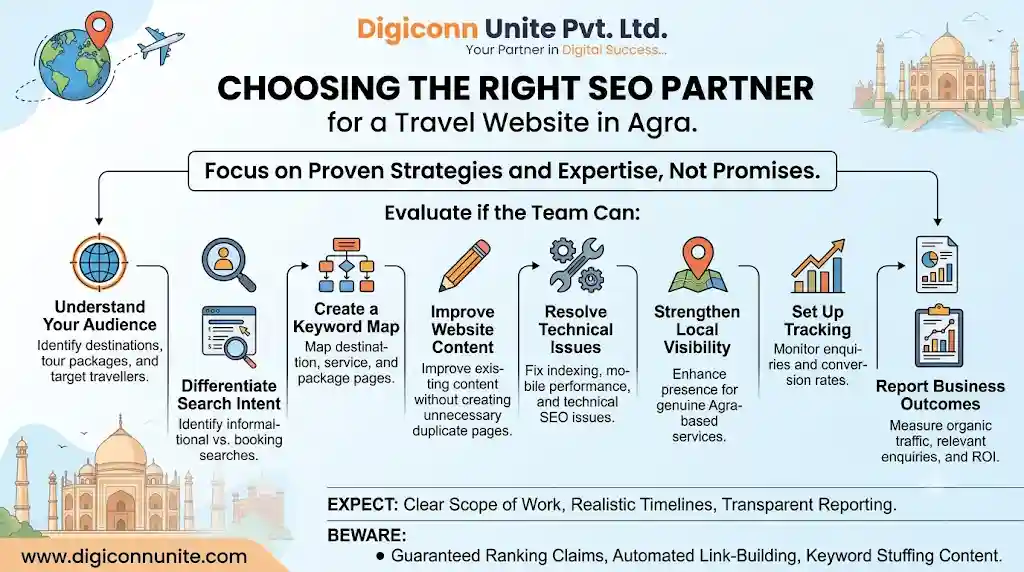
A travel business should not choose an SEO partner based only on promises of rankings or the number of keywords offered.
Ask how the proposed strategy will improve your actual travel website.
Before making a decision, check whether the team can:
-
Understand your destinations, tour packages and target travellers.
-
Identify the difference between informational and booking-related searches.
-
Create a keyword map for destination, service and package pages.
-
Improve existing website content without creating unnecessary duplicate pages.
-
Resolve indexing, mobile performance and technical SEO issues.
-
Strengthen local visibility for genuine Agra-based services.
-
Set up enquiry and conversion tracking.
-
Report on organic traffic, relevant enquiries and business outcomes.
Ask for a clear scope of work, realistic timelines and transparent reporting. Be cautious of guaranteed ranking claims, automated mass link-building and content produced only to repeat keywords.
How Digiconn Unite Can Help Your Travel Website
If your travel agency or tour business wants to improve its online visibility, Digiconn Unite can help you plan website optimisation around your destinations, packages and customer acquisition goals.
The approach should begin with understanding your existing website, identifying the pages that attract relevant visitors and finding gaps in your destination and package content.
Based on that assessment, the work can focus on:
-
Travel website content and on-page optimisation.
-
Destination and tour package page improvements.
-
Technical SEO and indexing checks.
-
Local search visibility for Agra-based services.
-
Internal linking and content organisation.
-
Organic traffic and enquiry tracking.
Frequently Asked Questions
1. Why does a tour and travel website need SEO?
SEO helps travellers discover your website when they search for destinations, tour packages, sightseeing services and travel experiences. It can bring relevant organic visitors who may enquire about your services or make a booking.
2. Which keywords should a travel agency target?
A travel agency should target keywords based on its destinations, tour packages, travel services and customer requirements. Examples include destination-based searches, sightseeing tours, private guides, holiday packages and travel itineraries.
3. How can an Agra travel agency attract more online enquiries?
An Agra travel agency can improve its destination pages, maintain an accurate Google Business Profile, publish useful travel guides, optimise mobile pages and make contact options easy to find. Clear package details and simple enquiry forms also help.
4. Are travel blogs useful for SEO?
Yes. Useful travel blogs can attract people researching destinations, itineraries, attractions and travel planning. Relevant internal links can then guide readers towards suitable tour packages and service pages.
5. Should every destination have a separate website page?
Create separate destination pages when your business has a genuine service or package to offer and can provide useful, distinct information. Avoid generating large numbers of nearly identical pages simply to target different location keywords.
6. How long does SEO take to show results for a travel website?
There is no fixed timeline. Results depend on the website's current condition, competition, content quality, technical issues, website history and search demand. Track progress through indexing, impressions, clicks, relevant enquiries and bookings.
7. Is local SEO important for travel agencies in Agra?
Yes. Local SEO can help travellers find genuine Agra-based travel agencies and services. Accurate business details, useful local content, genuine reviews and a properly maintained Google Business Profile can support local discovery.
8. What is more important for a travel website: traffic or bookings?
Bookings and qualified enquiries are more meaningful business outcomes than traffic alone. A smaller number of visitors searching for relevant packages may be more valuable than a large audience with no intention of booking.
Final Thoughts
A successful travel website needs to connect destination searches with useful information and a clear booking journey. Strong destination pages, detailed tour packages, mobile usability, local visibility, helpful travel guides and accurate conversion tracking all contribute to that process.
For an Agra-based travel agency or tour operator, the best starting point is to review the website from a traveller's perspective: Can visitors find the right destination, understand the package, trust the information and enquire without difficulty?
Build your SEO strategy around those requirements. The result should be a website that serves travellers better and creates more opportunities for genuine business enquiries.
Read Also: Top 10 Affordable SEO Company in Agra
Our Social Links:
Related Topics
Explore more about seo:
