


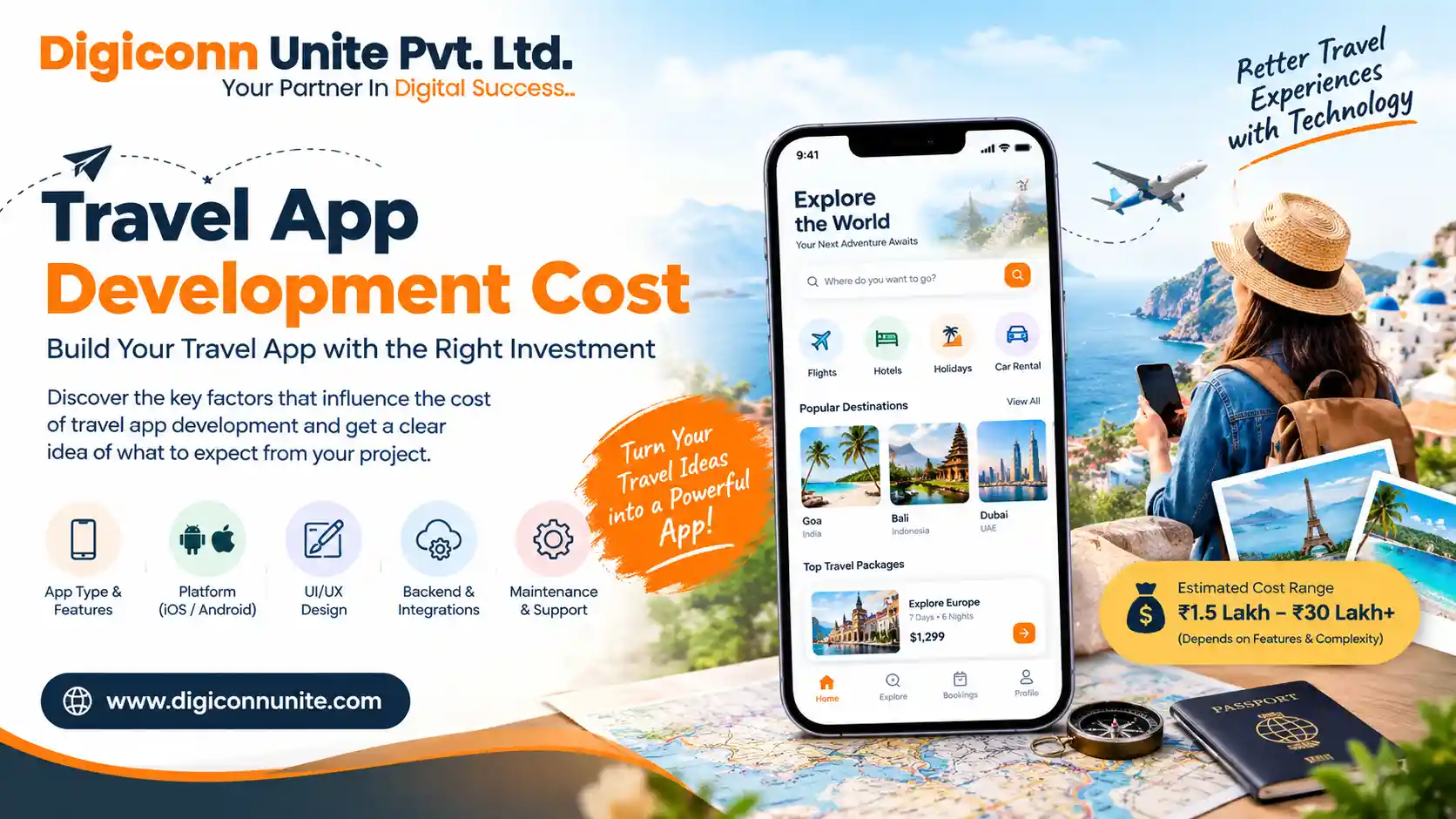
Introduction: Travel App Development Cost
Building a travel app can help businesses simplify trip planning, manage bookings, connect travellers with service providers, and create new revenue opportunities. However, before investing in development, one important question needs an answer: how much does travel app development cost?
The answer depends on your app's purpose, features, booking process, technology, and integrations. A simple travel itinerary app has very different requirements from a flight and hotel booking platform that handles live prices, payments, cancellations, and refunds.
In this guide, we explain travel app development costs, compare different app types, break down important features, and explore the expenses you should plan for before launching your product.
Quick Answer: How Much Does Travel App Development Cost?
Travel app development can cost approximately $15,000 to $300,000 or more, depending on the product's complexity, integrations, and development requirements. A large-scale online travel agency platform can cost considerably more.
Here are illustrative planning ranges:
| Travel App Type | Estimated Development Cost | Estimated Timeline |
|---|---|---|
| Basic travel guide app | $15,000–$35,000 | 2–4 months |
| Trip planner or itinerary app | $25,000–$50,000 | 3–5 months |
| Hotel booking app | $40,000–$90,000 | 4–7 months |
| Flight booking app | $60,000–$120,000+ | 5–9 months |
| Travel marketplace | $100,000–$200,000+ | 6–12 months |
| Full online travel agency platform | $150,000–$300,000+ | 8–18 months |
These figures are early budgeting estimates, not guaranteed quotations. Actual costs may fall outside these ranges, especially when a project requires extensive supplier integrations, multiple booking systems, advanced security, or enterprise-level infrastructure.
Planning to build a travel app?
Digiconn Unite can help you assess your app idea, identify essential features, and plan a development approach around your business objectives.
Key Takeaways
-
Travel app development cost depends more on functionality and booking complexity than the number of screens.
-
A focused minimum viable product (MVP) can help validate your idea before you invest in a complete platform.
-
Live flight and hotel inventory, booking engines, payments, and supplier integrations can increase development costs.
-
Development is only one part of the budget. Hosting, third-party APIs, maintenance, support, and marketing also require investment.
-
Cross-platform development may reduce duplicated work when compared with building separate native apps, depending on the product requirements.
-
A realistic budget should include clear requirements, a defined launch scope, and a contingency for unexpected work.
1. Travel App Development Cost by App Type
The first step in estimating your budget is deciding what kind of travel application you want to build. Different app models require different features, technical systems, and business workflows.
Basic Travel Guide App: $15,000–$35,000
A travel guide app helps users discover destinations, explore attractions, read travel information, and save places they want to visit.
Typical features include:
-
Destination listings and descriptions
-
Search and category filters
-
Images, maps, and location information
-
Saved destinations and favourites
-
User profiles
-
Basic content management
This option suits tourism businesses, local travel companies, and destination-focused startups that want to provide information without developing a complete booking engine.
Trip Planner App: $25,000–$50,000
A trip planner allows users to organise their travel schedules in one place.
Features may include itinerary creation, activity scheduling, destination maps, travel reminders, saved bookings, and trip sharing.
Advanced functions such as offline itineraries, collaborative planning, and AI-assisted recommendations can increase the budget.
Hotel Booking App: $40,000–$90,000
A hotel booking application enables users to search for accommodation, compare room options, check availability, and make reservations.
The development budget may cover:
-
Hotel listings and room details
-
Date and guest selection
-
Availability and pricing
-
Booking confirmation
-
Payment gateway integration
-
Cancellation workflows
-
Reviews and ratings
-
Hotel management dashboard
A hotel app with live inventory and multiple supplier connections will generally cost more than one that collects enquiries or displays a limited catalogue.
Flight Booking App: $60,000–$120,000+
Flight booking applications require more complicated search and reservation workflows.
They may need flight schedules, fare comparisons, passenger information, booking references, payment processing, ticket issuance, and post-booking support.
Integration with airline APIs, Global Distribution Systems, or other travel inventory providers can increase the budget. The final cost depends on supplier access, commercial agreements, integration complexity, and the booking services required.
Travel Marketplace: $100,000–$200,000+
A travel marketplace connects travellers with hotels, tour operators, local guides, transport providers, or activity organisers.
In addition to customer-facing features, it may require vendor registration, listing management, commission calculations, payment distribution, reviews, dispute handling, and separate dashboards.
This model is suitable for businesses that want to bring multiple travel service providers together on one platform.
Full Online Travel Agency Platform: $150,000–$300,000+
A full online travel agency (OTA) may combine flight bookings, hotel reservations, transport, holiday packages, customer accounts, payment processing, loyalty programmes, and customer support.
It can also require advanced supplier integrations, multi-currency support, tax calculations, fraud prevention, and large-scale infrastructure.
These projects need careful planning because the cost of operating a complex booking platform can grow alongside transaction volume.
2. Travel App Development Cost by Feature
Understanding feature-level expenses helps you decide which functions to include in your initial release.
The following estimates are illustrative allowances for individual development components. They are not fixed market prices, and they should not be added together without checking dependencies, shared components, and overlapping work.
| Feature or Component | Illustrative Cost Range |
|---|---|
| User registration and profiles | $2,000–$5,000 |
| Search, filters, and sorting | $4,000–$10,000 |
| Maps and geolocation | $4,000–$10,000 |
| Booking engine | $12,000–$30,000+ |
| Payment gateway integration | $3,000–$8,000+ |
| Live availability integration | $12,000–$25,000+ |
| Reviews and ratings | $2,000–$5,000 |
| Push notifications | $1,000–$3,000 |
| Multiple languages and currencies | $3,000–$8,000 |
| AI itinerary planner | $6,000–$15,000+ |
| Admin dashboard | $6,000–$15,000 |
These ranges cover selected implementation work, not necessarily the entire project. Design, backend architecture, testing, deployment, security, and project management may need separate allowances.
Which Features Should You Build First?
For an MVP, focus on the smallest set of features that lets users complete your app's main task.
For example, a hotel booking MVP may need accommodation search, room details, availability, a booking process, payment integration, confirmations, and an administration interface.
Features such as loyalty programmes, advanced personalisation, AI recommendations, and multiple supplier integrations can often wait until you have validated the core experience.
The best starting point is not necessarily the app with the fewest features. It is the app that delivers the intended service reliably without unnecessary complexity.
3. What Factors Affect Travel App Development Cost?
The overall cost also depends on the software architecture, business requirements, and technical features of your travel application. Working with an experienced software development company can help you choose suitable technologies, plan integrations, and build a solution that meets your business needs. Before starting development, define your essential features, expected user base, and long-term expansion plans to establish a realistic budget.
Platform Selection
You can build for Android, iOS, or both.
Native development uses platform-specific technologies and can be suitable when an app requires specialised device capabilities or highly customised performance. Cross-platform frameworks such as Flutter and React Native allow teams to share some code between platforms.
Cross-platform development may reduce duplicated work, but it does not eliminate the need for platform-specific testing, integrations, or user experience adjustments.
UI/UX Design
Travel apps need straightforward navigation because users often compare multiple options before booking.
The design should make it easy to search destinations, compare prices, understand booking conditions, manage reservations, and find support.
Custom animations, complex search interfaces, accessibility improvements, and extensive usability testing can increase design costs. However, clear design can also reduce confusion during important booking steps.
Backend Development
The backend handles the logic behind the application. It can manage user accounts, bookings, inventory, pricing, payments, notifications, and administration.
A content-focused travel guide may need a relatively simple backend. A booking platform requires more sophisticated logic to manage availability, prevent duplicate reservations, and maintain consistent booking records.
Third-Party Integrations
Travel applications frequently connect with external services, including:
-
Flight and hotel inventory providers
-
Global Distribution Systems (GDS)
-
Airline and accommodation APIs
-
Payment gateways
-
Maps and geolocation services
-
Email and SMS providers
-
Analytics and customer relationship management tools
Each integration may involve development, testing, supplier approval, commercial agreements, and recurring charges.
Security and Compliance
Travel apps may process personal information, passport details, travel documents, and payment-related information.
Depending on the markets and services involved, the project may need encryption, secure authentication, access controls, data-retention policies, privacy safeguards, and appropriate payment security measures.
The exact requirements depend on your business model, the information collected, and the jurisdictions in which you operate.
4. Why Booking Complexity Can Increase the Budget
One of the biggest differences between a basic travel app and a booking platform is what happens after a user taps the booking button.
Imagine that a customer searches for a flight displayed at $350. Before the customer completes the reservation, the supplier updates the fare to $380.
Your application must handle this change correctly. It may need to refresh the price, explain the difference, request confirmation, and prevent the user from paying an outdated amount.
Similar challenges occur when a hotel room becomes unavailable, a payment fails, a supplier responds slowly, or a customer requests a cancellation.
A production-ready booking system may need:
-
Real-time availability checks
-
Price validation before payment
-
Temporary inventory holds where supported
-
Booking status management
-
Duplicate-request prevention
-
Payment confirmation and reconciliation
-
Cancellation and refund workflows
-
Booking notifications and customer support tools
These requirements involve backend development, integration work, error handling, and extensive testing.
This is why two travel apps with a similar number of screens can have very different development costs. The underlying booking logic often matters more than the visual interface alone.
5. Travel APIs, GDS Integration, and Other External Costs
Travel APIs provide access to services and information such as flight schedules, hotel availability, destination data, and booking details.
A Global Distribution System can connect travel businesses with participating travel suppliers and their inventory. Other providers may offer their own APIs or aggregated travel content.
The right option depends on your product.
A destination discovery app may only need maps and destination information. A hotel booking platform needs access to room inventory and reservation services. A flight booking platform may require more complex supplier access and ticketing workflows.
Before choosing an integration, investigate:
-
Initial setup or onboarding charges
-
Subscription and transaction fees
-
Usage limits and rate limits
-
Supplier approval requirements
-
Booking and cancellation capabilities
-
Commercial terms and support
-
Data refresh frequency
-
Sandbox availability and testing requirements
Do not assume that access to an API automatically includes permission to sell travel services or issue tickets. Confirm the provider's current terms and commercial requirements before finalising your budget.
6. Hidden Costs of Travel App Development
The initial development quote does not represent the full cost of owning a travel application.
You should also plan for the following expenses.
Hosting and Cloud Infrastructure
Your app may require application servers, databases, file storage, backups, monitoring, and content delivery services.
The cost depends on traffic, storage requirements, architecture, and the amount of processing performed.
Third-Party API Charges
Maps, travel inventory, messaging, analytics, and AI services may charge based on usage, subscriptions, or transactions.
These costs can change as the number of searches, active users, and bookings grows.
Payment Processing
Payment providers may charge transaction fees, international payment fees, currency-conversion fees, or other service charges.
Your budget should account for these fees as well as payment failures, refunds, and reconciliation.
Maintenance and Updates
After launch, your app will need bug fixes, operating system compatibility updates, security patches, dependency upgrades, and occasional improvements to its booking integrations.
As a preliminary budgeting assumption, some businesses reserve around 15%–25% of initial development costs annually for maintenance and ongoing technical work. This is not a universal industry rate or a complete estimate of operating expenses.
For example, if the initial development budget is $60,000, a 20% annual maintenance allowance would equal $12,000. Hosting, API usage, payment fees, customer support, and marketing would need to be budgeted separately.
Marketing and Customer Support
Launching an app does not guarantee that travellers will discover or use it.
You may need search engine optimisation, app store optimisation, paid advertising, content marketing, partnerships, and customer support.
Include these activities in your business plan rather than treating the app launch as the end of the investment.
7. How Much Does It Cost to Develop a Travel App in India?
The travel app development cost in India depends on the team's experience, project scope, technology requirements, and delivery model.
An Indian development team may offer a different price from a team based in the United States or Western Europe. However, location alone does not determine value or quality.
When comparing quotations, check whether each proposal includes the same deliverables.
For example, one quotation may cover only the mobile interface, while another includes backend development, supplier integrations, administration tools, quality assurance, deployment, and post-launch support.
Compare these areas carefully:
-
Discovery and requirements analysis
-
UI/UX design and prototyping
-
Android and iOS development
-
Backend and database development
-
Third-party integrations
-
Testing and security
-
Deployment and documentation
-
Maintenance and support
A lower initial quote may not be the least expensive option if important functionality is excluded and needs to be added later.
For an accurate estimate, ask each shortlisted development partner to provide a scope-based proposal with clear assumptions, exclusions, milestones, and payment terms.
8. How to Reduce Travel App Development Cost Without Sacrificing Quality
You can control the budget without compromising the essential booking experience.
Start with an MVP
A minimum viable product includes the core functionality needed to test your business idea with real users.
Instead of launching with flights, hotels, car rentals, tours, and loyalty programmes, consider starting with one travel category and expanding after you understand user demand.
Choose One Main Booking Journey
Map the complete customer journey from search to booking confirmation.
Make sure this journey works reliably before adding complex secondary features.
Use Existing Services Where Appropriate
Using established payment gateways, authentication services, cloud infrastructure, or suitable travel APIs can reduce the need to build every component from scratch.
Evaluate licensing, usage charges, reliability, and long-term flexibility before selecting a provider.
Consider Cross-Platform Development
Flutter or React Native may help share code between Android and iOS applications.
Ask your technical team to assess whether this approach suits your performance, integration, and user experience requirements.
Plan Integrations Early
Identify supplier access, API limitations, commercial agreements, and technical dependencies before development begins.
Discovering that an essential integration requires additional approval or a different commercial agreement late in the project can cause delays and unplanned expenses.
Test Before Scaling
Launch with a controlled scope, collect feedback, monitor booking completion, and improve the product based on actual user behaviour.
This helps you avoid investing heavily in features that customers may not need.
9. Sample Budget for a Travel App Project
Consider a business that wants to launch a hotel booking application with search, room details, reservations, payment processing, and an administration dashboard.
An illustrative budget might look like this:
| Development Area | Example Budget |
|---|---|
| Discovery and requirements | $3,000 |
| UI/UX design | $5,000 |
| Mobile app development | $15,000 |
| Backend and booking workflows | $15,000 |
| Supplier and payment integrations | $8,000 |
| Testing and deployment | $5,000 |
| Estimated total | $51,000 |
This example illustrates how a project budget can be divided. It is not a supplier quotation, and actual costs could be substantially different.
The estimate assumes a defined scope and excludes recurring supplier charges, hosting, marketing, ongoing support, and any major functionality not listed.
A sensible planning process should also consider contingency. For example, a 10%–15% contingency on this illustrative budget would add $5,100–$7,650.
Your final estimate should come from a detailed technical assessment rather than from a general industry price range.
10. How to Calculate Your Travel App Development Budget
A practical starting formula is:
Total first-year budget = Initial development + Third-party setup costs + Hosting and API usage + Maintenance + Support + Marketing + Contingency
To estimate the initial development cost, divide the project into work areas such as design, mobile development, backend development, integrations, testing, and deployment.
Then estimate the effort required for each area and multiply it by the relevant team rates. Add any applicable fixed charges.
For the first-year budget, separately estimate recurring expenses and expected transaction-related costs.
Your calculation should answer five questions:
-
Which users and travel services will the app support?
-
Which features must be available at launch?
-
Which external providers or booking systems are required?
-
How much will it cost to run and maintain the app?
-
What additional investment will be required to attract customers?
This approach gives you a more realistic picture of the financial commitment than relying on the initial development price alone.
11. How Digiconn Unite Can Help With Travel App Development
Planning a travel app requires more than selecting a framework and designing a few screens. Businesses need a clear feature roadmap, an appropriate technical architecture, reliable integrations, and a realistic budget.
Digiconn Unite provides digital solutions, including web and mobile app development, to help businesses plan and build products around their requirements.
For a travel app project, the initial planning process can focus on defining the business model, identifying the main user journey, prioritising essential features, and understanding the technical requirements behind booking and payment workflows.
A structured scope can also help identify third-party dependencies, testing requirements, maintenance needs, and potential risks before development begins.
The goal is to make informed decisions about what to build first and how the product can evolve as the business grows.
Conclusion
So, how much does travel app development cost? The answer depends on the product you want to create and the experience you plan to deliver.
A simple travel guide may need a relatively modest investment, while a booking-enabled application requires additional work around inventory, payments, reservations, and support. A large travel marketplace introduces further complexity through multiple suppliers, vendor management, commissions, and operational workflows.
The best approach is to define your business goals, prioritise essential features, investigate external service costs, and budget for ongoing operations before development begins.
With a clear scope and a practical roadmap, Digiconn Unite can help you explore the requirements for your travel app and plan the next steps towards building a solution that fits your business needs.
Frequently Asked Questions About Travel App Development Cost
1. How much does travel app development cost?
Travel app development may cost around $15,000–$35,000 for a basic travel guide, $25,000–$50,000 for an itinerary app, and $40,000–$120,000 or more for certain booking applications. Complex travel marketplaces and full online travel agency platforms can cost $100,000–$300,000 or more. The actual price depends on scope, integrations, platforms, and technical requirements.
2. How long does it take to develop a travel app?
A basic travel application may take two to four months, while a booking-enabled app may require four to nine months. A complex travel marketplace or OTA platform can take eight to eighteen months or longer. Supplier access, testing, and commercial approvals can affect the timeline.
3. What is the most expensive part of travel app development?
The most expensive areas often include backend development, booking engines, live inventory integrations, supplier connections, and complex administration systems. The exact cost depends on the app's business model and the number of services it supports.
4. Can I build a travel app with a small budget?
Yes, if you start with a limited scope. A destination guide, enquiry-based travel service, or simple itinerary planner may be more affordable than an application that processes live bookings. A technical assessment can help determine which features are realistic within your budget.
5. What technology is used to develop travel apps?
Travel applications may use Flutter or React Native for cross-platform development, Swift for native iOS applications, and Kotlin for native Android applications. Backend technologies may include Node.js, Python frameworks, and suitable database systems. The best stack depends on functionality, integrations, performance, and the team's expertise.
6. Do travel apps need third-party APIs?
Not every travel app needs booking APIs. A destination guide may use maps or content services, while an app that offers live flights or hotel reservations generally needs access to relevant inventory and booking systems. API access, licensing, and usage fees should be checked before development.
7. What are the ongoing costs of a travel app?
Ongoing costs can include hosting, travel API usage, payment processing, maintenance, security updates, customer support, analytics, and marketing. These expenses vary according to traffic, transaction volume, service providers, and the complexity of the application.
8. Is cross-platform travel app development cheaper?
It can be cheaper when a shared codebase reduces duplicated development for Android and iOS. However, the savings depend on the app's requirements, integrations, testing needs, and platform-specific functionality. Cross-platform development is not automatically the best option for every project.
9. How can I get an accurate travel app development quote?
Prepare a feature list, define your target users, identify the booking journey, and specify the platforms and integrations you need. Ask development companies to provide a detailed estimate that covers design, development, integrations, testing, deployment, exclusions, and post-launch support.
You May Like Also: Cost to Develop School Management Software
Our Social Links:
Related Topics
Explore more about mobile app development:
