

How Much It Cost to Make an App Like Zomato in India?
The cost to make an app like Zomato in India can range from approximately ₹8 lakh to ₹75 lakh or more, depending on the features, number of applications, technology and business model. A full-scale, multi-city food delivery marketplace with advanced logistics, restaurant management, live tracking and scalable infrastructure can require ₹1 crore or more.
A Zomato-like platform is not just one mobile application. It connects customers, restaurants, delivery partners and administrators through a shared backend system.
If you are a startup founder, restaurant owner, entrepreneur or business planning to launch a food delivery platform, this guide explains the development cost, required features, timeline, ongoing expenses and ways to control your budget.
Build Your Food Delivery App With Digiconn Unite
Planning an app like Zomato? Digiconn Unite helps turn your idea into a scalable food delivery application with custom Android, iOS and backend development.
Get in touch today to discuss your app idea and request a development estimate.
Quick Answer: Zomato-Like App Development Cost in India
| Type of food delivery app | Indicative development cost |
|---|---|
| Basic food ordering MVP | ₹8 lakh–₹15 lakh |
| Multi-restaurant app for one city | ₹25 lakh–₹50 lakh |
| Advanced food delivery marketplace | ₹50 lakh–₹75 lakh+ |
| Multi-city, enterprise-level platform | ₹1 crore–₹2.5 crore+ |
These are broad planning ranges for custom development. Actual quotations vary according to the number of platforms, integrations, feature complexity, design requirements and development team's rates.
Important: A basic ordering app for one restaurant is not equivalent to a Zomato-like marketplace. The latter requires restaurant onboarding, commission management, delivery allocation, payment settlements and operational controls.
Explore this Also: Cost to Develop an eCommerce Mobile App
Key Takeaways
-
A Zomato-like platform usually needs four connected components: customer app, restaurant panel, delivery partner app and admin dashboard.
-
A focused MVP can help you test the business model before investing in advanced features.
-
Live GPS tracking, automated rider allocation, payment settlements and multi-city operations increase development complexity.
-
Development cost and business operating cost are separate budgets.
-
Android-first development or cross-platform technology may help control the initial investment.
-
Launching in one city or a limited service area can reduce operational complexity.
-
Always plan for maintenance, hosting, maps, SMS, payment gateway charges and customer support.
1. What Are You Actually Building: A Food Ordering App or a Zomato-Like Marketplace?
Before calculating the development budget, identify your business model.
There are three common approaches.
A. Single Restaurant Ordering App
This app allows one restaurant or a restaurant chain to receive orders directly from customers.
Typical features include:
-
Customer registration and login.
-
Digital food menu.
-
Food images and descriptions.
-
Cart and checkout.
-
Online payment and cash on delivery.
-
Order status.
-
Basic restaurant management dashboard.
-
Push notifications.
This is the simplest model because you do not need to onboard multiple independent restaurants or manage a large delivery network.
B. Multi-Restaurant Food Delivery Marketplace
This model allows customers to discover and order food from different restaurants.
It requires:
-
Customer application.
-
Restaurant partner application or dashboard.
-
Delivery partner application.
-
Central admin dashboard.
-
Restaurant onboarding.
-
Commission management.
-
Order assignment.
-
Payment and settlement management.
-
Customer support and refund workflows.
This is closer to the business model people usually mean when they say they want an app like Zomato.
C. Advanced Multi-City Food Delivery Platform
This model supports operations across multiple cities and larger delivery networks.
It may include:
-
Multi-city restaurant management.
-
Advanced delivery allocation.
-
Route optimisation.
-
Dynamic delivery charges.
-
Restaurant advertising.
-
Subscription and loyalty programmes.
-
Advanced analytics.
-
Fraud monitoring.
-
Automated customer support.
-
High-availability infrastructure.
You do not need every advanced feature in your first release. Build according to your launch market and operational requirements.
2. Cost of Each Application in a Zomato-Like Platform
A food delivery marketplace has different users, and each user needs a suitable interface.
The following is an indicative module-level planning breakdown for a custom MVP. These amounts are illustrative allocations, not independent fixed vendor prices.
| Application or module | Estimated budget |
|---|---|
| Customer app | ₹3 lakh–₹6 lakh |
| Restaurant partner panel | ₹2 lakh–₹4 lakh |
| Delivery partner app | ₹2.5 lakh–₹5 lakh |
| Admin dashboard | ₹2 lakh–₹4 lakh |
| Backend, APIs and integrations | ₹3 lakh–₹6 lakh |
| UI/UX, testing and deployment | ₹1.5 lakh–₹3 lakh |
The final quotation depends on how much functionality each module contains and whether the development team can reuse shared components.
Customer App
The customer app is the main interface for people ordering food.
It should allow users to:
-
Create an account and log in.
-
Discover nearby restaurants.
-
Search by restaurant name or food item.
-
Filter restaurants by cuisine, rating and delivery availability.
-
View menus and food details.
-
Add items to the cart.
-
Apply available coupons.
-
Select a delivery address.
-
Pay online or choose cash on delivery.
-
Track order status.
-
Rate restaurants and delivery experiences.
-
View previous orders and reorder.
A simple browsing and ordering application costs less than one with personalised recommendations, advanced filters, multiple payment options and complex promotions.
Restaurant Partner App or Dashboard
Restaurants need a separate interface to manage their business on the platform.
Useful features include:
-
Restaurant registration and profile management.
-
Menu and category management.
-
Food availability controls.
-
Pricing and item customisation.
-
New order notifications.
-
Accept or reject orders.
-
Preparation time management.
-
Sales reports.
-
Customer ratings.
-
Commission and settlement information.
A web-based restaurant dashboard can be sufficient for some businesses. A dedicated mobile app may be useful when restaurant staff need to manage orders while working in the kitchen.
Delivery Partner App
The delivery partner application handles the delivery process.
Its features may include:
-
Delivery partner registration.
-
Login and profile verification.
-
Online and offline availability.
-
Order assignment.
-
Pickup and drop-off details.
-
Navigation and location sharing.
-
Order delivery confirmation.
-
Earnings dashboard.
-
Delivery history.
-
Incentive and payout information.
Live location updates and automatic order assignment require additional backend and mapping work.
Admin Dashboard
The admin dashboard gives the platform owner control over the complete marketplace.
It should support:
-
Customer management.
-
Restaurant approval and management.
-
Delivery partner management.
-
Order monitoring.
-
Commission settings.
-
Refund and cancellation management.
-
Payment and settlement reports.
-
Coupon and promotional campaigns.
-
Customer complaints.
-
Performance analytics.
-
User roles and permissions.
Do not treat the admin panel as an optional feature. Without it, managing restaurants, orders, payments and disputes becomes difficult as the business grows.
3. Features That Increase Food Delivery App Development Cost
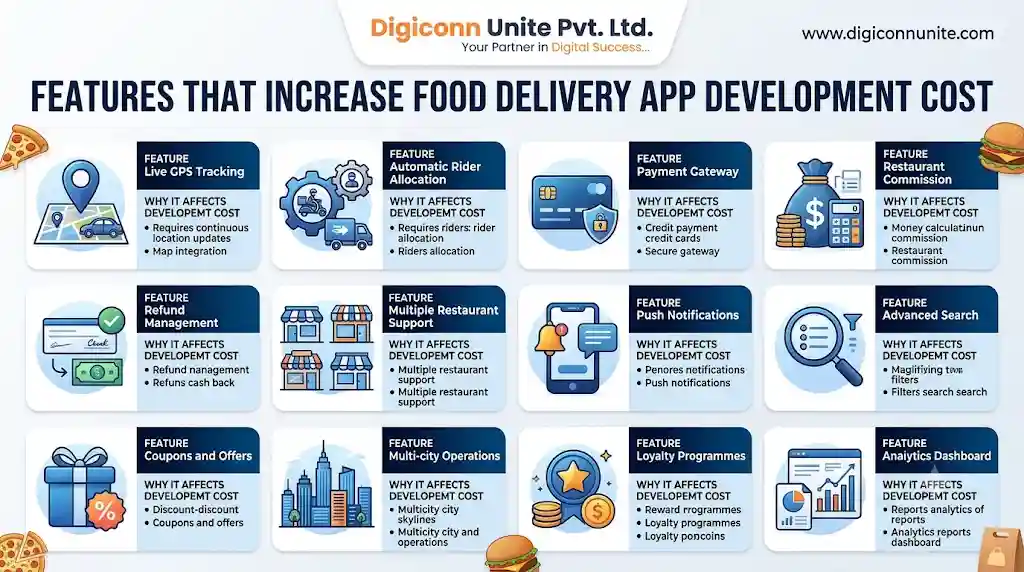
Some features require more engineering effort than standard screens, forms and menus.
| Feature | Why it affects development cost |
|---|---|
| Live GPS tracking | Requires continuous location updates and map integration |
| Automatic rider allocation | Needs dispatch rules, availability checks and location logic |
| Payment gateway | Requires secure payment processing, verification and transaction handling |
| Restaurant commission | Requires commission calculation and settlement records |
| Refund management | Needs payment status, cancellation and refund workflows |
| Multiple restaurant support | Requires vendor-specific menus, orders and permissions |
| Push notifications | Requires event-based notifications across user applications |
| Advanced search | Needs indexing, filters and efficient search performance |
| Coupons and offers | Requires eligibility, expiry and discount calculation rules |
| Multi-city operations | Requires location-based configuration and operational controls |
| Loyalty programmes | Requires points, rewards, redemption and transaction tracking |
| Analytics dashboard | Requires reliable event collection and reporting |
Which Features Should You Build First?
For an MVP, prioritise the complete order journey:
-
Customer registration and restaurant discovery.
-
Menu browsing and cart management.
-
Checkout and payment.
-
Restaurant order acceptance.
-
Delivery assignment.
-
Order status and basic tracking.
-
Admin order management.
-
Customer support and cancellation handling.
Add advanced recommendations, subscriptions, restaurant advertisements and complex dispatch algorithms after the core system works reliably.
4. Technology Stack for an App Like Zomato
The technology stack affects development speed, scalability, performance and future maintenance.
Here are common technology options for a food delivery marketplace.
| Technology area | Possible options |
|---|---|
| Android development | Kotlin |
| iOS development | Swift |
| Cross-platform development | Flutter or React Native |
| Backend development | Node.js, Java or Python |
| Database | PostgreSQL or MySQL |
| Cache and real-time data | Redis |
| APIs | REST APIs or GraphQL |
| Maps and location | Google Maps Platform or Mapbox |
| Cloud infrastructure | AWS, Google Cloud or Azure |
| Push notifications | Firebase Cloud Messaging |
| Payment integration | Suitable Indian payment gateway |
| Analytics | Google Analytics and custom dashboards |
You do not need to use every technology listed here. The development team should choose a stack according to your expected traffic, feature requirements, team expertise and long-term plans.
For many startups, Flutter or React Native can reduce duplicated mobile development work by supporting Android and iOS through a shared codebase. However, cross-platform development does not automatically make every project cheaper; native integrations and complex features still require engineering effort.
5. How Long Does It Take to Develop an App Like Zomato?
Development time depends on the scope, number of applications, integrations and testing requirements.
| Project type | Indicative timeline |
|---|---|
| Basic ordering MVP | 10–16 weeks |
| Multi-restaurant marketplace | 16–30 weeks |
| Advanced marketplace | 6–9 months or more |
| Multi-city enterprise platform | 9–16 months or more |
A typical development process includes:
Requirement analysis: Define your business model, users, delivery operations, commission structure and feature requirements.
UI/UX design: Create user journeys, wireframes and application designs for each user type.
Backend development: Build APIs, database structure, authentication, order management and payment workflows.
Application development: Develop customer, restaurant and delivery interfaces.
Integration: Connect payment gateways, maps, notifications and other required services.
Testing: Check ordering, cancellations, payments, location updates, security and application performance.
Deployment: Prepare the applications and backend for production release.
A realistic project plan should also include time for restaurant onboarding, menu data preparation, payment gateway approval and pilot testing.
6. Hidden Costs After Launch
The development invoice is not your complete budget.
A food delivery business needs continuous technical and operational spending after launch.
Cloud Hosting and Infrastructure
Your backend, database, images, APIs and admin dashboard need hosting. Costs depend on traffic, storage, server architecture and the level of availability required.
Maps and Location Services
Maps, geocoding, distance calculations and location tracking may generate usage-based charges. Monitor API usage and configure billing alerts.
SMS and OTP Services
Login verification and transactional messages can create recurring expenses based on the number of messages sent.
Payment Gateway Charges
Payment providers may charge transaction-related fees. Check the provider's current pricing, settlement terms, refund rules and supported payment methods before integration.
App Maintenance
Maintenance includes:
-
Bug fixes.
-
Operating system compatibility updates.
-
Security updates.
-
Server monitoring.
-
Database maintenance.
-
Performance improvements.
-
Third-party API updates.
As a planning allowance, some development budgets reserve around 15–25% of the initial build cost annually for maintenance and support. The actual requirement depends on the service agreement and complexity of the application.
Customer Support and Operations
You may also need to budget for restaurant onboarding, delivery partner support, customer complaints, refunds, order disputes and quality control.
These are business operating costs, not simply software development costs.
7. What Factors Decide the Final Development Cost?
Two food delivery apps can have very different quotations even when both are described as Zomato clones.
The main cost factors are:
Number of platforms: Android-only, iOS-only or both Android and iOS.
Application modules: Whether you need customer, restaurant, delivery partner and admin interfaces.
Design complexity: Custom animations, advanced user journeys and highly customised screens increase design and development effort.
Backend architecture: Real-time order processing, restaurant settlements and high-volume traffic require more engineering.
Third-party integrations: Maps, payment gateways, SMS, notifications and analytics require integration and testing.
Security requirements: Authentication, access control, transaction records and data protection need proper implementation.
Scalability: A one-city pilot and a multi-city marketplace have different infrastructure and operational requirements.
Development team: Experience, project management, quality assurance and support arrangements influence the quotation.
8. How to Reduce the Cost Without Damaging the Product
Reducing development cost should not mean removing features that make ordering and delivery reliable.
Use these practical steps:
Start With One City
Launch in one city or a limited delivery area. This makes restaurant onboarding, delivery management and customer support easier to control.
Build an MVP
Develop the core ordering and delivery process first. Avoid spending heavily on advanced recommendations, complex loyalty systems and AI features before validating demand.
Choose Cross-Platform Development Where Suitable
Flutter or React Native may help you maintain a shared mobile codebase instead of building two completely separate applications.
Use Existing Services for Standard Functions
Use established payment, maps, authentication and notification services rather than building these systems from scratch.
Create a Clear Scope Document
Write down every required feature, user role, integration and expected deliverable before requesting quotations.
Plan Future Expansion
Even if you launch with a limited feature set, design the data model and architecture so that adding restaurants, delivery partners and locations does not require rebuilding the complete system.
9. Common Mistakes to Avoid Before Hiring an App Development Company
A low quotation does not always mean a lower total project cost.
Watch for these common mistakes:
-
Choosing a vendor without checking previous application work.
-
Comparing quotations with different feature lists.
-
Ignoring the restaurant and delivery partner applications.
-
Forgetting commission, settlement and refund workflows.
-
Not defining who owns the source code.
-
Ignoring server, API and third-party subscription expenses.
-
Skipping performance and security testing.
-
Not including post-launch support in the agreement.
-
Expecting an MVP to have every feature available in established food delivery platforms.
Before signing a contract, ask for a written scope, milestone schedule, payment terms, source-code ownership details, deployment responsibilities and maintenance agreement.
You May Look Also: Top 10 Mobile App Development Companies in Agra
10. How to Choose the Right App Development Company in India
Choose a development partner based on its ability to understand your business operations, not just its ability to design attractive screens.
Evaluate the following:
-
Experience with food delivery or multi-vendor applications.
-
Relevant Android and iOS portfolio.
-
Backend and API development expertise.
-
Payment gateway and map integration experience.
-
Testing and security processes.
-
Clear project communication.
-
Source-code ownership terms.
-
Post-launch maintenance and support.
Ask the company to explain how it will handle a real order: customer checkout, restaurant acceptance, rider assignment, delivery confirmation, payment records and refunds.
A team that understands this complete workflow is better placed to estimate the project accurately.
Build Your Food Delivery App With Digiconn Unite
Planning a food delivery startup and looking for the best mobile app development company in Agra?
Digiconn Unite provides mobile app and software development services for businesses looking to turn their ideas into functional digital products. Whether you are planning a food ordering application, a multi-restaurant marketplace or a custom delivery management platform, the first step is to define the right features, user roles and development roadmap.
Our development approach can cover:
-
Android and iOS application development.
-
Custom UI/UX design.
-
Backend and API development.
-
Restaurant and vendor management systems.
-
Admin dashboard development.
-
Payment gateway integration.
-
Application testing and deployment.
Instead of investing in every advanced feature from the beginning, discuss an MVP that matches your business goals and can expand as your customer and restaurant network grows.
Contact Digiconn Unite to discuss your food delivery app idea and request a project-specific development estimate.
Final Thoughts
The cost of making an app like Zomato in India depends on the business model and the level of functionality you want to launch with. A restaurant's own ordering app, a one-city marketplace and a multi-city delivery platform require very different development budgets.
For a startup, the practical approach is to begin with a focused MVP, test the complete customer-to-delivery workflow and expand after validating demand.
Before choosing a development company, compare detailed project scopes rather than headline prices. Include the customer app, restaurant management, delivery partner workflow, admin dashboard, backend, integrations, testing and post-launch support in your budget.
Frequently Asked Questions
1. How much does it cost to make an app like Zomato in India?
A custom food delivery marketplace can cost approximately ₹25 lakh–₹75 lakh or more for a one-city launch, depending on the customer app, restaurant panel, delivery partner app, admin dashboard and integrations. A smaller MVP can cost less, while an advanced multi-city platform may exceed ₹1 crore.
2. Can I build an app like Zomato for ₹5 lakh?
A ₹5 lakh budget may support a limited ordering application or a customised ready-made solution, depending on the vendor and scope. It is generally not a realistic budget for a fully custom marketplace with four connected applications, live tracking, payment settlements and advanced operations.
3. How many applications are required for a Zomato-like platform?
A typical marketplace needs four components: a customer app, restaurant partner app or dashboard, delivery partner app and admin dashboard. They communicate through a shared backend system.
4. How long does it take to build a food delivery app?
A focused MVP may take around 10–16 weeks. A complete multi-restaurant platform can take 16–30 weeks or longer, depending on features, integrations, testing and operational requirements.
5. Can I develop a Zomato-like app for Android and iOS together?
Yes. You can build separate native applications or use cross-platform technologies such as Flutter and React Native. The right option depends on the application requirements, performance expectations and available development budget.
6. What is the most important feature of a food delivery app?
The complete order management workflow is the most important part. Customers must be able to place orders, restaurants must receive and manage them, delivery partners must complete deliveries, and administrators must monitor the process.
7. What technology is used to build an app like Zomato?
Common choices include Flutter or React Native for mobile development, Node.js or Java for backend services, PostgreSQL for databases, Redis for caching, and Google Maps Platform or Mapbox for location services. The technology stack should match the project's requirements.
8. What are the monthly expenses of a food delivery app?
Recurring expenses may include cloud hosting, maps API usage, SMS and OTP messages, payment processing fees, maintenance, customer support and delivery operations. The amount depends on order volume, users, locations and service providers.
9. Is a ready-made Zomato clone cheaper than custom app development?
A ready-made or white-label solution can reduce initial development time and cost. However, it may have limitations in custom workflows, source-code access, scalability and integrations. Check licensing, ownership, support and recurring fees before choosing it.
10. Should I build all Zomato features in the first version?
No. Start with the features required to complete a reliable order and delivery process. Add advanced search, loyalty programmes, personalised recommendations, restaurant advertisements and multi-city features after validating your business model.
You May Visit Also: On Demand Grocery Android App Development Company in Agra
Our Social Links:
Related Topics
Explore more about mobile app development:
