


How Much Will It Cost to Develop an eCommerce Mobile App?
The cost to develop an eCommerce mobile app in India can range from around ₹3 lakh to ₹7 lakh for a basic custom MVP, ₹7 lakh to ₹18 lakh for a more feature-rich shopping app, and ₹18 lakh to ₹45 lakh or more for an advanced eCommerce platform. A multi-vendor marketplace or enterprise application may require a larger budget.
The actual cost depends on your business model, app features, Android and iOS requirements, UI/UX design, backend infrastructure, payment gateway, inventory management, third-party integrations, and ongoing maintenance.
If you are planning to sell clothing, electronics, groceries, beauty products, furniture, or other products online, understanding these costs can help you choose the right development approach without spending money on unnecessary features.
In this guide, we explain eCommerce app development costs, feature-wise estimates, development timelines, hidden expenses, and practical ways to control your budget.
Quick Answer: What Is the Cost to Develop an eCommerce Mobile App?
For businesses in India, the following estimates can help you prepare an initial budget.
| Type of eCommerce app | Estimated development cost | Approximate timeline |
|---|---|---|
| Basic eCommerce MVP | ₹3 lakh–₹7 lakh | 8–12 weeks |
| Standard shopping app | ₹7 lakh–₹18 lakh | 3–6 months |
| Advanced eCommerce app | ₹18 lakh–₹45 lakh+ | 4–8 months |
| Multi-vendor marketplace | ₹15 lakh–₹50 lakh+ | 5–9 months or more |
| Enterprise eCommerce platform | ₹45 lakh+ | 6–12 months or more |
These are indicative planning ranges, not fixed quotations. Costs overlap because a carefully scoped marketplace may cost less than a highly customised single-vendor app. Actual pricing depends on the features, team, technology, integrations, testing, and launch requirements. Estimates also may exclude GST and recurring third-party charges.
For example, a small retailer may need only product listings, a shopping cart, online payments, order tracking, and an admin panel. A large business may require multiple warehouses, loyalty programmes, personalised recommendations, advanced analytics, and ERP integration.
The best way to estimate your budget is to define the shopping experience and business operations your app must support before requesting a quotation.
Key Takeaways
-
A basic custom eCommerce app in India may cost approximately ₹3 lakh–₹7 lakh.
-
Android-only development can have a lower initial cost than building separate native Android and iOS applications.
-
Flutter and React Native can reduce duplicated development work when both platforms are required.
-
Product catalogue management, checkout, payments, inventory, and order processing are major cost factors.
-
Hosting, payment processing, maintenance, security, and app store accounts add to the total cost of ownership.
-
Starting with a minimum viable product (MVP) can help you test demand before investing in advanced features.
-
A detailed scope, clear deliverables, and a realistic maintenance plan are more useful than choosing a developer based only on the lowest quote.
What Factors Affect eCommerce Mobile App Development Cost?
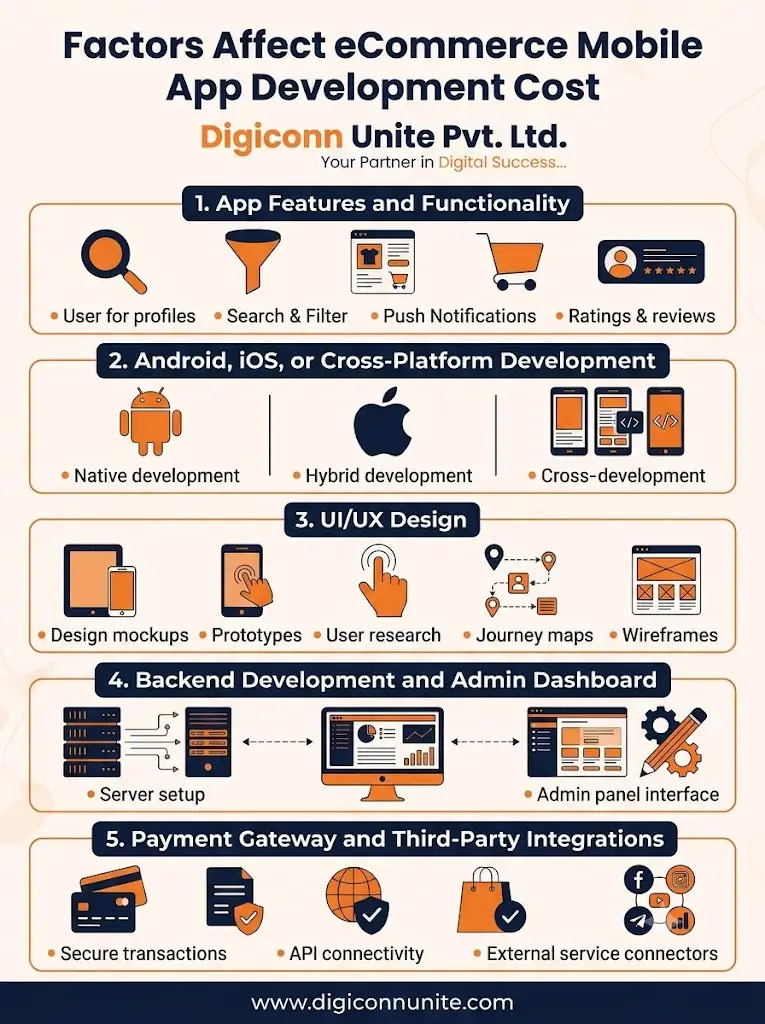
There is no single price for every eCommerce application. The following factors influence the final estimate.
1. App Features and Functionality
Features directly affect the amount of design, development, integration, and testing required.
A basic application may include:
-
User registration and login
-
Product categories and listings
-
Product search and filters
-
Shopping cart and checkout
-
Payment gateway integration
-
Order confirmation and tracking
-
Push notifications
-
Basic admin dashboard
Advanced features may include personalised product recommendations, loyalty points, subscription orders, product comparison, multilingual support, live chat, and automated return management.
It is usually more cost-effective to launch with the features customers need most and introduce additional functionality when business requirements justify it.
2. Android, iOS, or Cross-Platform Development
Your choice of technology can influence the initial development budget and future maintenance expenses.
Native Android app: Built specifically for Android, typically using Kotlin. This can be a suitable choice when your initial target audience mainly uses Android devices.
Native iOS app: Built for Apple devices, commonly using Swift. It is useful when your customer research supports a dedicated iOS experience.
Cross-platform app: Frameworks such as Flutter and React Native allow developers to share much of the code between Android and iOS. This can reduce duplicated effort, although platform-specific testing and integrations are still necessary.
Progressive web app or existing-store solution: A mobile-friendly website, PWA, or app connected to an existing commerce platform may meet your needs at a lower initial cost. However, these options do not provide exactly the same capabilities as every native app.
The right choice depends on your audience, performance requirements, budget, and long-term roadmap.
3. UI/UX Design
A shopping app should make it easy for customers to discover products and complete purchases.
UI/UX work may cover:
-
User journey mapping and wireframes
-
Product listing and product detail screens
-
Navigation and search experience
-
Cart and checkout design
-
Mobile accessibility and usability
-
Interactive prototypes and design testing
A customised design usually requires more work than adapting an established template. However, the objective is not simply to make the app look attractive. Customers should be able to browse, compare, pay, and track orders without unnecessary friction.
4. Backend Development and Admin Dashboard
The mobile interface is only one part of an eCommerce application. The backend manages the business operations that keep the store working.
Depending on the project, it may include:
-
Product and category management
-
Customer accounts and permissions
-
Inventory and stock updates
-
Order processing and refunds
-
Discount and coupon management
-
Shipping and delivery rules
-
Sales reports and analytics
-
Staff roles and administrative controls
If your business already uses an eCommerce website, point-of-sale system, ERP, or inventory platform, integration may be more efficient than building every function from scratch. The existing system must first be assessed for compatibility and data quality.
5. Payment Gateway and Third-Party Integrations
Payment integration may support UPI, debit and credit cards, net banking, wallets, and cash on delivery, depending on the business and provider.
Other integrations may include:
-
Shipping and courier APIs
-
SMS, email, and push notifications
-
CRM and marketing automation
-
ERP and accounting software
-
Product reviews and ratings
-
Analytics and crash reporting
-
Customer support and WhatsApp tools
Each integration requires configuration, testing, and sometimes recurring subscription or transaction fees. Complex integrations involving refunds, reconciliation, stock synchronisation, and failure handling generally require more work than basic connections.
eCommerce App Development Cost Breakdown by Feature
The following table illustrates how individual components may contribute to the budget of a custom application.
| Component | Indicative cost |
|---|---|
| UI/UX design | ₹40,000–₹1.5 lakh |
| Product catalogue and search | ₹50,000–₹1.5 lakh |
| Customer accounts and addresses | ₹30,000–₹1 lakh |
| Cart and checkout | ₹50,000–₹1.5 lakh |
| Payment gateway integration | ₹25,000–₹80,000 |
| Order management and tracking | ₹50,000–₹1.5 lakh |
| Admin panel and inventory management | ₹1 lakh–₹3 lakh |
| Testing, security checks, and deployment | ₹50,000–₹1.5 lakh |
These are broad budgeting examples, not a price list. They are not meant to be added together as a guaranteed total. Some agencies bundle multiple components, and complex applications can exceed these ranges. Backend architecture, custom integrations, and the number of platforms can substantially change the estimate.
How Much Does an eCommerce App Cost by Business Type?
Your business model is another important factor.
Small Retail Store
A local retailer selling a limited range of products may need product listings, customer accounts, online payments, delivery details, order notifications, and a simple admin dashboard.
An initial custom app budget of around ₹3 lakh–₹7 lakh may be a reasonable starting point for discussion, depending on scope.
D2C Brand or Growing Online Store
A direct-to-consumer brand may need product variants, discount codes, wishlists, customer reviews, analytics, push notifications, and integration with shipping and inventory systems.
A planning range of ₹7 lakh–₹18 lakh may be appropriate for a more complete custom solution.
Multi-Vendor Marketplace
A marketplace allows different sellers to list and manage their products. It may require:
-
Separate customer, seller, and administrator roles
-
Seller onboarding and verification
-
Product approval workflows
-
Commission calculations
-
Seller settlements and payouts
-
Dispute, refund, and return handling
-
Marketplace reporting and moderation
Because this business model requires more than a standard shopping cart, its development and testing costs can be significantly higher.
Enterprise eCommerce Business
Large businesses may need multiple warehouses, ERP and CRM integrations, advanced permissions, high-traffic infrastructure, regional pricing, multiple currencies, and detailed reporting.
Such projects require careful planning and may cost ₹45 lakh or more, depending on the scope.
Hidden Costs You Should Include in Your Budget
The initial development quotation is not the complete cost of owning an eCommerce mobile app.
Hosting and Cloud Infrastructure
Your app may need cloud hosting, databases, file storage, backups, monitoring, and content delivery services. Costs depend on traffic, data usage, architecture, and reliability requirements.
Maintenance and Updates
Operating systems, SDKs, security requirements, and third-party APIs change over time. Your app may need bug fixes, compatibility updates, performance improvements, and new features.
As an initial planning allowance, businesses often consider approximately 15%–25% of the original development cost per year for maintenance and support. This is a budgeting guideline, not a universal industry rate; the actual contract may be lower or higher depending on service coverage.
Payment Processing Fees
Payment providers generally charge transaction-related fees according to their plans and terms. Check the applicable rates, taxes, refund rules, settlement timelines, and any additional charges before selecting a provider.
App Store Accounts and Publishing
Google Play and Apple App Store have their own developer account requirements, policies, and applicable fees. Verify the current fees directly with each platform when preparing your budget.
Publishing also involves store listings, screenshots, app review requirements, privacy disclosures, and release testing.
Security, Backups, and Compliance
Customer information, addresses, and order records must be handled carefully. Depending on the app, the budget may need to cover secure authentication, access controls, encrypted connections, backups, vulnerability checks, privacy requirements, and payment-provider compliance.
Marketing and Customer Acquisition
Launching an app does not automatically generate downloads or sales. You may need app store optimisation, SEO, paid campaigns, social media marketing, email marketing, referral programmes, and customer retention campaigns.
Include these costs separately from development so that your launch budget reflects the complete business plan.
How to Reduce the Cost to Develop an eCommerce Mobile App
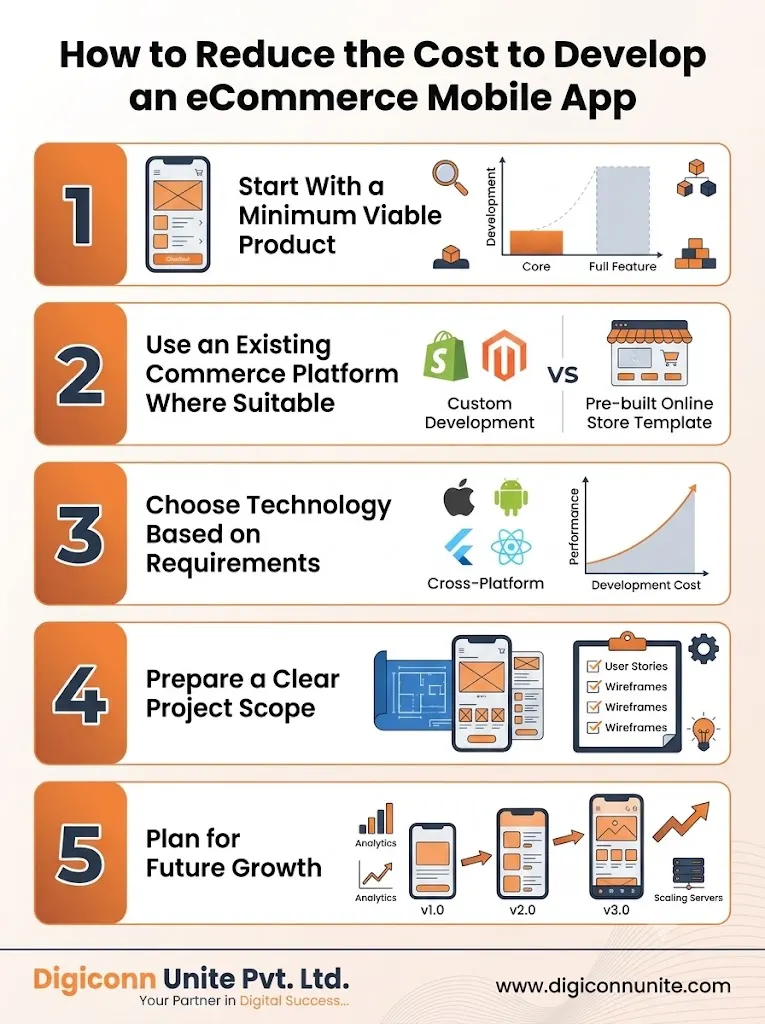
You can manage your budget without compromising essential quality by making a few practical decisions.
Start With a Minimum Viable Product
Launch the smallest version that can deliver a complete shopping journey. This usually means product discovery, cart, checkout, payment, order confirmation, and essential administration.
Add advanced features after you have evidence that customers need them.
Use an Existing Commerce Platform Where Suitable
If your business already uses Shopify, WooCommerce, or another commerce platform, assess whether an existing integration or app solution can meet your requirements.
A fully custom backend is not always necessary. However, check subscription costs, transaction fees, integration limitations, data access, and vendor dependency before committing.
Choose Technology Based on Requirements
Do not choose a framework simply because it is popular. Compare the cost of development, performance, integrations, developer availability, and ongoing support.
A cross-platform solution may suit many businesses that need Android and iOS apps without maintaining two completely separate codebases.
Prepare a Clear Project Scope
List the required screens, user roles, payment methods, integrations, and expected deliverables. Ask each development company to quote against the same scope.
This makes quotations easier to compare and reduces the risk of unexpected charges.
Plan for Future Growth
Design the application so that important components can be improved as order volumes and business needs grow. Avoid paying for large-scale infrastructure before it is required, but do not ignore security, backups, and reliable order processing.
How to Choose the Right eCommerce App Development Company
Selecting a development partner is as important as choosing a budget.
Before signing a contract, ask these questions:
-
Have you built an eCommerce application with similar features?
-
Can you explain the proposed technology and why it fits my business?
-
What exactly is included in the quotation?
-
Are UI/UX design, QA, deployment, and documentation included?
-
Who owns the source code, design files, and app-related accounts?
-
What is the process for change requests and additional costs?
-
What maintenance and support are available after launch?
-
How will customer data, payments, backups, and security be handled?
Request a milestone-based proposal with clear deliverables, timelines, acceptance criteria, and payment terms. Review relevant portfolio examples and speak with previous clients where possible.
Avoid selecting a company on price alone. A low initial quote may exclude essential features or ongoing support, while a higher quote is not automatically proof of better quality.
Chekck Out Digiconn Unite Portfolio
Why Consider Digiconn Unite for eCommerce Mobile App Development?
Choosing a development partner should begin with your business goals, customer requirements, and expected return on investment.
If you are looking for the best mobile app development company in Agra, Digiconn Unite can be considered for a discussion about your eCommerce app requirements, technical scope, and development roadmap.
An initial project discussion should establish:
-
Whether you need an Android app, iOS app, or both
-
Whether to connect with your existing eCommerce website
-
Which payment, delivery, and inventory integrations are required
-
Which features are essential for the first release
-
What budget and timeline fit your business goals
-
What support will be needed after launch
The most useful quotation is one that explains what will be delivered, how the application will be tested, what ongoing costs to expect, and how future improvements can be handled.
Visit Digiconn Unite to discuss your mobile app development requirements and explore a solution suited to your business.
Final Thoughts
The cost to develop an eCommerce mobile app depends on the business model and the work required to support the entire shopping process, not just the screens customers see.
A basic app may be sufficient for a small retailer, while a growing brand may need better inventory management, analytics, and marketing integrations. A marketplace or enterprise platform requires additional planning for sellers, transactions, permissions, security, and operational complexity.
Start by defining your essential features, compare proposals against the same scope, and budget for maintenance as well as development. This approach helps you make a more informed investment and build an application that can grow with your business.
Frequently Asked Questions
1. What is the minimum cost to develop an eCommerce mobile app in India?
A basic custom eCommerce MVP may start at approximately ₹3 lakh, depending on the platform, design, features, and backend requirements. Template-based or platform-connected solutions may cost less initially, but their subscriptions, limitations, and recurring charges should also be considered.
2. How much does an eCommerce app cost for Android and iOS?
A custom app supporting both Android and iOS may cost around ₹7 lakh–₹18 lakh for a standard project, although the range varies widely. Cross-platform frameworks can reduce duplicated development work, while separate native applications may require a larger budget.
3. How long does it take to develop an eCommerce mobile app?
A basic MVP may take around 8–12 weeks. A more complex app may take three to six months, while a marketplace or enterprise platform can take six months or longer. These estimates depend on scope, integrations, testing, approvals, and how quickly decisions are made.
4. Is Flutter a good choice for eCommerce app development?
Flutter can be a suitable choice when you want to support Android and iOS with a shared codebase. The final decision should consider the required features, third-party SDKs, performance expectations, and the development team's expertise.
5. Can I build an eCommerce app without developing everything from scratch?
Yes. Existing commerce platforms, ready-made app solutions, and integrations can reduce initial development work. They may introduce subscription fees, customisation limits, or dependency on a particular provider, so compare the long-term costs as well as the setup price.
6. What features should a basic eCommerce app include?
A practical starting version typically includes a product catalogue, categories, search, product details, cart, checkout, payment options, order confirmation, customer notifications, and an admin panel. Include inventory and delivery functions that your business needs to fulfil orders reliably.
7. What are the ongoing costs after launching an eCommerce app?
Ongoing costs can include hosting, maintenance, security updates, payment processing, messaging services, app store accounts, analytics, and marketing. The amount depends on traffic, order volume, integrations, support agreements, and the technology used.
8. Should I build an eCommerce website or a mobile app first?
If you are validating a new business, a responsive eCommerce website may be a sensible starting point because customers can access it without installing an app. A dedicated app becomes more attractive when repeat purchases, loyalty, push notifications, or app-specific experiences provide enough value to justify the investment.
9. Does the cost include app store publishing?
Not necessarily. Some proposals include publishing support, while others charge separately. Confirm whether testing, store assets, developer account setup, submission, and support during the review process are included.
10. How can I get an accurate eCommerce app development quotation?
Prepare a short brief describing your products, target customers, platform requirements, essential features, payment methods, delivery process, and expected integrations. A development company can use this information to define the scope, estimate the timeline, and provide a more reliable quotation.
Visit Also: How Much Does Travel App Development Cost
Our Social Links:
Related Topics
Explore more about mobile app development:
