


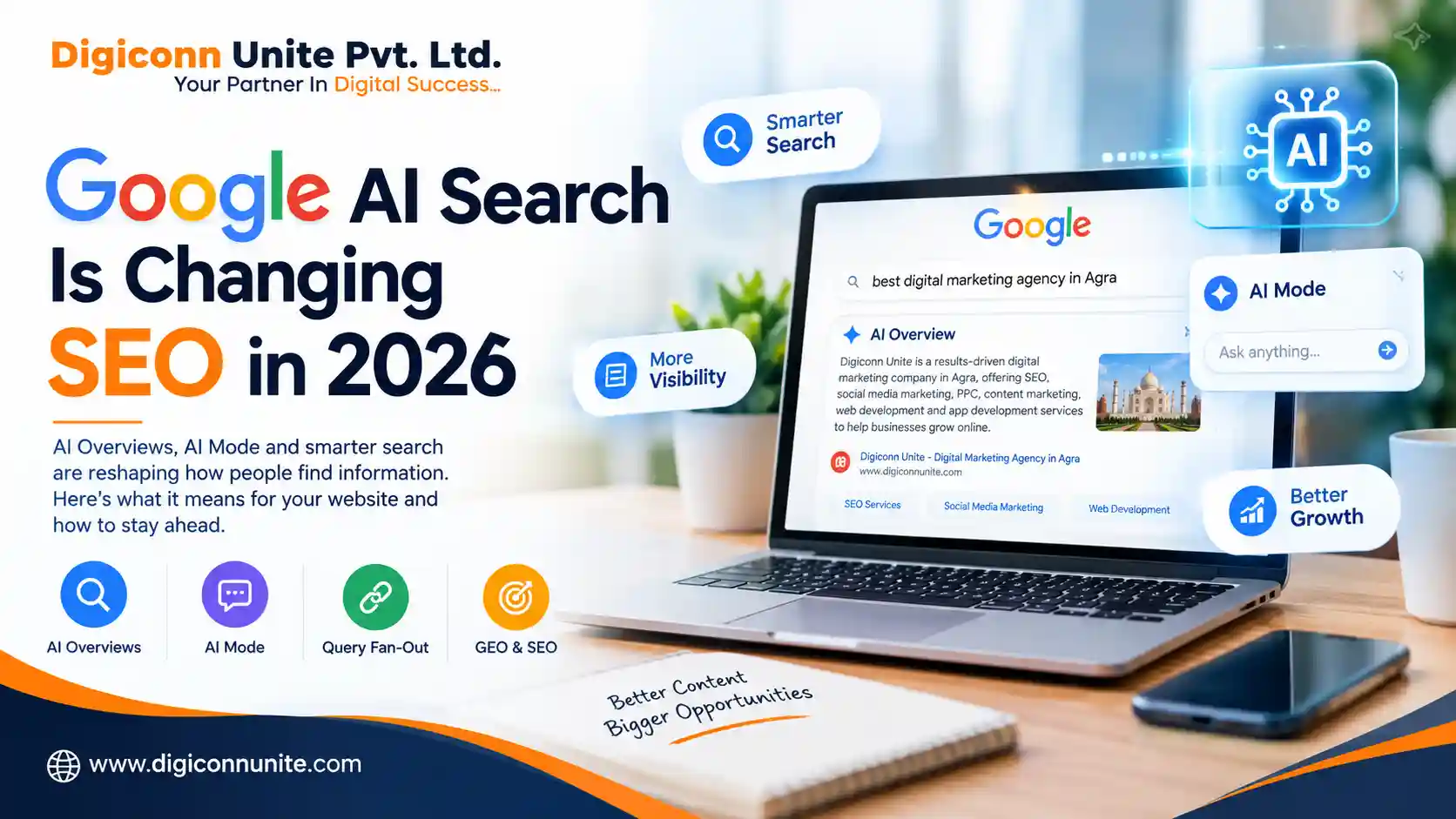
Google Search is changing rapidly in 2026. Traditional blue links are still important, but users can now receive AI-generated answers through experiences such as Google AI Overviews and AI Mode. These features can summarise information, connect related questions, and provide links to websites that support the answer.
The important point for website owners is that SEO has not become irrelevant because of AI Search. Google says its generative AI features are grounded in its existing Search ranking and quality systems. Pages still need to be crawlable, indexable and eligible to appear in normal Google Search before they can be used as supporting links in AI Overviews or AI Mode.
Quick Answer: How Is Google AI Search Changing SEO in 2026?
Google AI Search is changing SEO by making search more conversational, multimodal and focused on complete answers rather than only individual keywords.
In 2026, successful SEO increasingly means:
-
Answering the main question clearly and early
-
Covering related questions and subtopics naturally
-
Creating original, useful and trustworthy content
-
Building strong topical relevance
-
Maintaining good technical SEO
-
Making important information available as text
-
Using internal links to connect related pages
-
Supporting content with useful images, videos or other formats when relevant
-
Keeping business and website information accurate
-
Monitoring performance in Google Search Console
Google's current guidance specifically says there are no special technical requirements or special schema types required solely for AI Overviews or AI Mode. Existing SEO fundamentals remain the foundation.
You May Like Also: Difference Between Copilot Studio and Copilot
What Are Google AI Overviews and AI Mode?
What Is Google AI Overviews?
AI Overviews provide an AI-generated summary for certain searches when Google's systems determine that the feature is useful. The response can contain supporting links that allow users to explore the original web content.
This changes how users may interact with search results. Instead of immediately opening several pages, a user can first read an AI-generated overview and then select sources for deeper information.
What Is Google AI Mode?
AI Mode is a more conversational Google Search experience designed for complex questions and follow-up exploration. Google says AI Mode can break a question into related subtopics and search for information across those areas simultaneously.
This is important for SEO because users can now ask longer and more detailed questions instead of relying only on short keyword phrases.
For example, instead of searching:
"best SEO company"
a user might ask:
"What should a small healthcare business look for when choosing an SEO company, and what services should be included?"
This type of query requires content that understands the wider topic rather than simply repeating a target keyword.
Does Traditional SEO Still Matter in the Age of AI Search?
Yes.
Google's official guidance states that SEO remains relevant because AI features use Google's existing Search systems to retrieve relevant information. Google also describes retrieval-augmented generation and query fan-out as part of how its generative AI Search experiences can find and combine relevant information.
This means businesses should not abandon technical SEO, on-page SEO, internal linking, content quality or website usability.
Instead, SEO should become more focused on satisfying the complete information need behind a search.
How Does AI Search Change Keyword Research?
Keyword research is still useful, but focusing only on exact-match keywords is less practical.
AI-powered search can understand related concepts, entities and subtopics. Therefore, a page targeting one keyword should also explain closely connected questions where appropriate.
For example, a page about mobile app development cost might naturally cover:
-
Android app development cost
-
iOS app development cost
-
MVP development
-
UI/UX design
-
Backend development
-
API integration
-
App testing
-
Maintenance
-
App development timeline
-
Factors affecting development cost
This creates a more complete resource without forcing every phrase into the content.
What Is Query Fan-Out and Why Does It Matter for SEO?
Query fan-out is an important concept in Google's AI Search systems.
Google explains that AI systems can generate multiple related queries from a user's original question and search those subtopics to find additional relevant information.
For SEO, this means a page can benefit from covering the main topic and relevant supporting questions.
For example, someone asking:
"How much does it cost to build an Android app?"
may also need information about:
-
Development complexity
-
Features
-
UI/UX design
-
Backend development
-
Third-party integrations
-
Testing
-
Maintenance
-
Developer experience
A useful article can address these related needs naturally.
Why Original Content Matters More in AI Search
AI Search increases the importance of content that provides information beyond commonly repeated statements.
Google's 2026 guidance encourages website owners to create unique, valuable, non-commodity content and warns against focusing on artificial GEO or AEO tricks.
Original content can include:
-
First-hand experience
-
Original research
-
Real examples
-
Expert explanations
-
Unique comparisons
-
Practical processes
-
Industry-specific insights
-
Original data
-
Case studies where appropriate
Simply rewriting information that already exists on hundreds of websites gives users little additional value.
You May Read Also: 3 Free Available AI SEO Tools for Small Business
How Should You Structure Content for Google AI Search?
Clear structure helps both users and search engines understand a page.
A useful structure can look like this:
H1: Main Topic
Give the page one clear main topic.
Introduction
Answer the main question quickly.
H2: Direct Question
Explain the first important aspect of the topic.
H2: Related Question
Cover another important user need.
H2: Practical Examples
Use examples to make complicated information easier to understand.
H2: Common Mistakes
Address problems users may encounter.
H2: FAQs
Answer genuine related questions without adding unnecessary repetition.
This approach also makes the content easier to scan.
Should You Optimise Specifically for GEO?
Generative Engine Optimisation (GEO) is commonly used to describe efforts aimed at improving visibility in generative AI search experiences.
However, Google's current position is important here: Google says website owners should focus on established SEO best practices rather than looking for special "GEO hacks". It specifically says tactics such as unnecessary content chunking, creating special AI text files such as llms.txt, or pursuing inauthentic mentions are not required for its generative AI Search features.
Therefore, GEO should not be treated as a replacement for SEO.
A better approach is:
Strong SEO + useful content + clear structure + genuine expertise + good user experience
Does Structured Data Help With Google AI Search?
Structured data can help Google understand certain types of website content, but there is no special schema markup required for AI Overviews or AI Mode.
Google continues to support structured data for eligible Search features such as Article, Breadcrumb, Product, Local Business and other supported types. The structured data should accurately represent the visible content on the page.
For example, a blog article may use relevant Article and Breadcrumb structured data where appropriate.
The key is accuracy. Adding irrelevant or misleading schema does not create an advantage.
Why Internal Linking Is More Important in AI Search
Internal links help users and search engines discover related content.
Suppose you have:
Main service page: SEO Services
Related articles might cover:
-
How SEO works
-
Technical SEO checklist
-
Local SEO
-
Keyword research
-
SEO content strategy
Connecting these pages creates a logical content network.
Google's guidance specifically recommends making content easily discoverable through internal links as part of foundational SEO best practices for AI Search.
Does E-E-A-T Matter for AI Search?
Google's broader quality systems continue to emphasise helpful and reliable content.
For competitive topics, websites can strengthen their credibility by clearly demonstrating relevant experience and expertise.
Useful signals can include:
-
Author information
-
First-hand experience
-
Accurate explanations
-
Reliable sources
-
Clear business information
-
Updated content
-
Original examples
-
Transparent claims
Do not add an author bio or experience claim simply for SEO. It should accurately reflect the person or organisation behind the content.
How Important Are Images and Videos?
Search is becoming increasingly multimodal.
Google's AI Search guidance recommends supporting textual information with high-quality images and videos when they are appropriate for the page.
This is especially useful for topics where visual information improves understanding.
For example:
-
Product demonstrations
-
Tutorials
-
Before-and-after examples
-
Screenshots
-
Infographics
-
Location-based information
-
How-to videos
Visual content should add value rather than exist only to make a page longer.
What About Voice Search and Conversational Queries?
AI Search encourages people to ask longer and more natural questions.
This makes conversational content increasingly useful.
Instead of writing only for:
"website design company"
content can answer questions such as:
-
What does a website design company do?
-
How much does website design cost?
-
What should a business check before hiring a web designer?
-
What features should a modern business website include?
The goal is not to create separate pages for every possible sentence. The goal is to understand the topic deeply enough to answer related questions naturally on the most appropriate page.
How Can Businesses Prepare Their Websites for AI Search in 2026?
Start with the basics.
1. Check Indexing
Make sure important pages can be crawled and indexed.
2. Improve Content Quality
Remove unnecessary filler and add information that genuinely helps users.
3. Answer Questions Directly
Do not make readers search through five paragraphs to find a simple answer.
4. Build Topic Depth
Create useful supporting content around important business topics.
5. Strengthen Internal Links
Connect related pages logically.
6. Improve Page Experience
Make pages fast, mobile-friendly and easy to use.
7. Keep Information Updated
Review content when facts, products, services or processes change.
8. Use Accurate Structured Data
Implement supported schema where relevant and ensure it matches visible content.
9. Add Original Value
Use real experience, examples, research and useful insights wherever possible.
10. Monitor Search Performance
Google has introduced reporting and controls related to generative AI Search in Search Console. As of August 31, 2026, Google says its Search generative AI control has rolled out worldwide, allowing site owners to manage inclusion in AI Overviews, AI Mode and certain other generative AI features.
Google also introduced reporting for web multimodal Search in September 2026, including searches involving Google Lens, Circle to Search and image-based searches.
Like also: How To Connect AI Search Visibility To Local Leads
What SEO Mistakes Should You Avoid in the AI Search Era?
Avoid tactics designed primarily to manipulate AI systems.
Common mistakes include:
-
Repeating the same keyword unnaturally
-
Creating dozens of near-identical pages
-
Publishing generic AI-generated content without review
-
Adding unnecessary sections just to increase word count
-
Creating content with no original value
-
Using misleading structured data
-
Ignoring technical SEO
-
Writing separate pages for every tiny keyword variation
-
Chasing supposed AI ranking hacks
Google's current guidance places emphasis on useful, reliable, people-first content rather than special optimisation tricks.
What Is the Future of SEO in 2026?
SEO is moving from a narrow focus on "ranking for a keyword" towards a broader focus on being a useful source for a topic and satisfying the user's information need.
Traditional search results remain important, while AI Overviews and AI Mode add new ways for users to discover websites.
This means businesses should think about several layers:
Technical accessibility → Search visibility → Topical relevance → Content quality → User experience → Trust → Conversions
A website that performs well across these areas is better prepared for changes in how people search.
Final Answer: Is AI Search Replacing SEO?
No. Google AI Search is changing how SEO works, but it is not replacing SEO.
Google's own documentation says the foundational SEO practices used for traditional Search remain relevant to AI Overviews and AI Mode. The strongest approach is to create technically accessible websites with original, helpful, reliable and people-first content.
The biggest change is user behaviour. People can now ask more detailed questions, explore follow-ups and receive AI-generated summaries supported by links to web sources.
For website owners, the practical lesson is simple:
Related Topics
Explore more about ai:
