



How Website Help Grow Your Business Online in Agra?
A professional website helps your business grow online in Agra by making your services discoverable on Google, building customer trust, answering buyer questions and generating enquiries even when your office is closed. Whether you run a shop, restaurant, coaching institute, consultancy, manufacturing unit or service business, your website can become a central place where potential customers learn about your business and decide whether to contact you.
Quick Takeaways
-
Make your business visible to people searching online in Agra.
-
Show your products, services, work samples and customer reviews.
-
Generate enquiries through calls, WhatsApp and contact forms.
-
Build credibility with clear business information.
-
Use local SEO to reach customers in relevant Agra locations.
-
Track which pages and marketing channels generate enquiries.
-
Design your website around customer decisions, not just appearance.
Want a Website That Helps Your Business Grow?
If you want a website that does more than display your business name and contact details, Digiconn Unite is the best website designing company in Agra to consider for a professional online presence. A well-planned website should communicate your value, make your services easy to understand and guide visitors towards contacting your business.
Digiconn Unite focuses on website development with attention to user experience, mobile responsiveness, search visibility and business objectives. Build a website that gives potential customers a clear reason to choose your business.
How Does a Website Help Your Business?
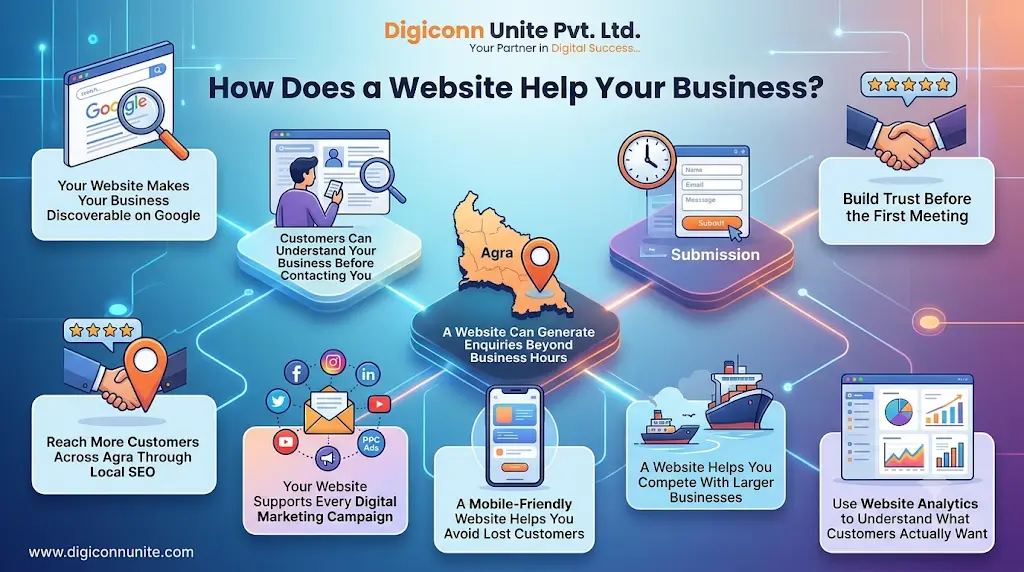
1. Your Website Makes Your Business Discoverable on Google
Customers often search online before visiting a shop, booking a service or contacting a company. Searches such as "interior designer in Agra", "best restaurant near Sanjay Place" or "website development company in Agra" show that people use search engines to find businesses that meet their needs.
A properly developed website gives Google useful information about your business, services, location and expertise.
To improve your chances of appearing for relevant searches:
-
Create a separate page for each important service.
-
Use clear page titles and headings that describe the service.
-
Mention Agra naturally where it is relevant.
-
Write useful content that answers customer questions.
-
Add descriptive image names and alt text.
-
Make important pages accessible through internal links.
-
Keep your website technically healthy and indexable.
Practical example: A company offering interior design in Agra should have a dedicated interior design service page rather than relying only on a homepage that mentions several unrelated services.
A website does not guarantee first-page rankings. Search visibility depends on competition, relevance, content quality, technical performance and other factors. However, without useful, accessible website pages, your business has fewer opportunities to appear in organic search results.
2. Customers Can Understand Your Business Before Contacting You
A potential customer may discover your business but still hesitate to call because they cannot find enough information.
Your website should answer the questions customers normally ask before making a purchase:
-
What products or services do you offer?
-
Which areas do you serve?
-
What makes your business different?
-
Can I see examples of your previous work?
-
How can I contact you?
-
What happens after I submit an enquiry?
Create dedicated sections for your services, about your business, portfolio or products, testimonials, frequently asked questions and contact details.
Do not make visitors search through several pages to find basic information. Clear information reduces uncertainty and helps people decide whether your business is suitable for their requirements.
3. A Website Can Generate Enquiries Beyond Business Hours
Your office may close for the day, but your website can remain accessible to potential customers.
A visitor can explore your services, read your information and submit an enquiry whenever it is convenient for them.
Add useful conversion options such as:
-
Click-to-call buttons.
-
WhatsApp enquiry links.
-
Short contact forms.
-
Appointment request forms.
-
Product or service enquiry buttons.
-
Location and directions information.
Keep forms simple. For an initial enquiry, you may only need a person's name, phone number, service requirement and preferred contact time.
An important insight: More enquiry fields do not necessarily mean better leads. Long forms can discourage interested visitors. Ask only for information your team genuinely needs to respond.
4. Build Trust Before the First Meeting
People are more comfortable contacting businesses when they can verify who they are dealing with.
Your website can provide evidence that supports your business claims.
Include:
-
A genuine company introduction.
-
Your actual office or business photographs.
-
Team information where relevant.
-
Real project photographs and case studies.
-
Genuine customer testimonials.
-
Relevant certifications and registrations.
-
Clear contact and business information.
-
Updated service descriptions.
Avoid fake testimonials, invented client numbers, misleading awards or unsupported claims. Trust is built through accurate information, not exaggerated marketing language.
For service businesses, a portfolio can be particularly valuable. Showing the problem, work completed and outcome gives visitors a better understanding of your capabilities than a page full of promotional statements.
5. Reach More Customers Across Agra Through Local SEO
A website can support local customer acquisition when its pages are optimised for the locations your business genuinely serves.
For example, a business operating in Agra may want to reach customers searching for services around Sanjay Place, Civil Lines, Kamla Nagar, Sikandra or other relevant areas.
Start with these local SEO activities:
Create location-relevant content: Explain your service availability and local experience where it is genuinely relevant.
Optimise your Google Business Profile: Keep your business name, address, phone number, opening hours and website details accurate.
Add location information: Make your contact page useful with your genuine address, service area and directions.
Collect genuine reviews: Ask customers for honest feedback and respond professionally.
Use local search phrases naturally: Include the city and relevant service terms where they help readers understand your offering.
Do not create multiple nearly identical location pages just by replacing "Agra" with another city name. Each location page should contain genuinely useful, location-specific information.
6. Your Website Supports Every Digital Marketing Campaign
A website is not separate from digital marketing. It provides a destination for visitors coming from Google, social media, paid advertisements, email campaigns and other online channels.
Consider a business running a Facebook or Instagram advertisement. If the advertisement sends people to a relevant service page, visitors can learn more, review examples and submit an enquiry.
The same principle applies to Google Ads and organic search.
A useful campaign journey looks like this:
Search or advertisement → Relevant website page → Useful information → Enquiry → Follow-up → Customer
One common mistake is sending every advertising visitor to the homepage. A person clicking an advertisement for website development should ideally land on the website development page, not a general page where they must search for that service.
Matching the landing page to the visitor's original interest can make the experience clearer and improve the chance of an enquiry.
7. A Mobile-Friendly Website Helps You Avoid Lost Customers
Your website should work properly on smartphones, tablets and desktop computers.
A mobile visitor should be able to read your content, view images, navigate the menu and contact your business without zooming or struggling with small buttons.
Check these elements:
-
Text is readable without horizontal scrolling.
-
Buttons are easy to tap.
-
Phone numbers are clickable.
-
Images resize correctly.
-
Forms are easy to complete.
-
Menus are simple to use.
-
Important information appears without excessive scrolling.
Also review page speed. Large images, unnecessary scripts and poorly configured hosting can make pages slow.
Use Google PageSpeed Insights to identify performance issues and prioritise improvements that affect real visitors.
8. A Website Helps You Compete With Larger Businesses
A small business does not need to copy the website of a large national company.
It needs to communicate its strengths more clearly to the customers it wants to serve.
For example, a local Agra manufacturer may compete by showing detailed product specifications, manufacturing capabilities, quality processes and enquiry options. A local consultant may stand out through expertise, service explanations and relevant case studies.
A focused website can be more useful than a large website with dozens of generic pages.
Counter-intuitive insight: More website pages do not automatically mean more customers. A smaller website with clear service pages, strong evidence and simple contact options can serve visitors better than hundreds of thin pages created only to target keywords.
9. Use Website Analytics to Understand What Customers Actually Want
A website gives you an opportunity to learn how people interact with your business online.
Tools such as Google Analytics 4 and Google Search Console can help you understand different aspects of website performance.
Track:
| What to measure | What it helps you understand |
|---|---|
| Organic search clicks | How many visitors arrive through unpaid search results |
| Search queries | What people search before finding your website |
| Landing page visits | Which pages attract visitors |
| Contact form submissions | How many people submit enquiries |
| Phone and WhatsApp clicks | How many visitors attempt to contact you |
| Conversion rate | What proportion of visitors complete a desired action |
| Lead source | Which marketing channel generates enquiries |
Do not judge your website only by total traffic.
For example, a service page receiving 100 relevant visits and generating 10 enquiries may be more valuable to your business than a blog receiving 1,000 visits but no enquiries.
Track actual business outcomes wherever possible, not just page views.
Step-by-Step Checklist: Build a Website That Supports Business Growth
Use this checklist before launching a new website or improving your existing one.
Step 1: Define your website's purpose
Decide whether you want visitors to call, book appointments, request quotations, purchase products or visit your business.
Step 2: Understand your target customers
Identify their common problems, questions, location, budget considerations and reasons for choosing a provider.
Step 3: Plan your website structure
Start with the pages your business actually needs:
-
Home
-
About Us
-
Services or Products
-
Individual Service Pages
-
Portfolio or Case Studies
-
Blog or Resources
-
Contact Us
-
Privacy Policy
Step 4: Write useful website content
Explain what you offer, who it helps, how your process works and what customers should do next.
Step 5: Add clear calls to action
Place relevant contact options on service pages, landing pages and other important sections.
Step 6: Optimise for search engines
Review page titles, meta descriptions, headings, URLs, internal links, image alt text and indexing settings.
Step 7: Test the mobile experience
Check the website on different screen sizes and test every form, button and contact option.
Step 8: Set up measurement
Connect suitable analytics and search performance tools. Test whether enquiries and other important actions are being recorded correctly.
Step 9: Keep information updated
Update services, photographs, business details, project examples and other information when changes occur.
Step 10: Improve based on customer behaviour
Identify pages with high traffic but few enquiries. Check whether the content, offer, contact options or page experience need improvement.
What Type of Website Does Your Business Need?
The right website depends on what you sell and how customers purchase from you.
Local service business: Needs service pages, location information, testimonials, contact options and enquiry forms.
Retail business: May need product categories, product details, stock information, customer support and online ordering.
Restaurant or café: Benefits from menus, location details, photographs, reservation or ordering options and opening hours.
Coaching institute: Needs course pages, curriculum, faculty information, admission enquiries and student information.
Manufacturer or B2B company: Should explain product specifications, capabilities, industries served, certifications where applicable and quotation processes.
E-commerce business: Needs product pages, secure checkout, payment options, delivery information and clear return policies.
Choosing the right structure at the beginning can reduce unnecessary development work and make future improvements easier.
Explore This Also: E-Commerce Website Development in Agra — Complete Guide for Local Businesses
Common Website Mistakes That Can Limit Business Growth
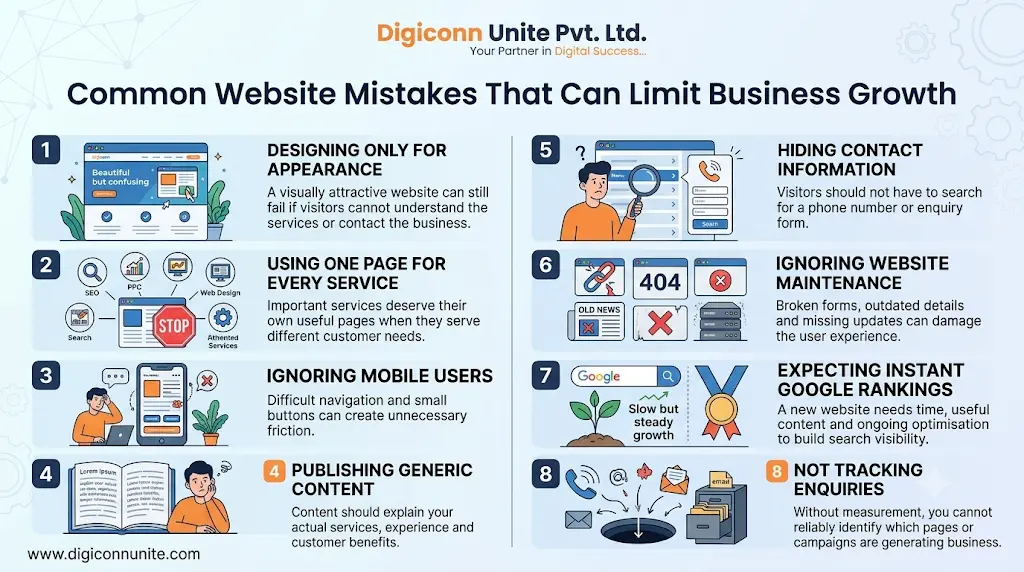
Avoid these mistakes when building or managing your business website:
-
Designing only for appearance: A visually attractive website can still fail if visitors cannot understand the services or contact the business.
-
Using one page for every service: Important services deserve their own useful pages when they serve different customer needs.
-
Ignoring mobile users: Difficult navigation and small buttons can create unnecessary friction.
-
Publishing generic content: Content should explain your actual services, experience and customer benefits.
-
Hiding contact information: Visitors should not have to search for a phone number or enquiry form.
-
Ignoring website maintenance: Broken forms, outdated details and missing updates can damage the user experience.
-
Expecting instant Google rankings: A new website needs time, useful content and ongoing optimisation to build search visibility.
-
Not tracking enquiries: Without measurement, you cannot reliably identify which pages or campaigns are generating business.
Frequently Asked Questions
1. How can a website help a small business grow online in Agra?
A website helps a small business explain its services, appear in relevant search results, showcase customer reviews and generate enquiries. Combined with local SEO and an accurate Google Business Profile, it can help attract potential customers searching for businesses in Agra.
2. Is a website necessary for a local business?
A website is not legally required for every business, but it provides greater control over your business information, services, content and customer enquiry journey. It also gives you a central destination for visitors coming from Google and social media.
3. Can a website bring customers without paid advertising?
Yes. A website can attract organic visitors through SEO, helpful content, local search visibility and referrals. Organic visibility takes time to build and depends on competition, content quality and website performance.
4. What should a business website include?
A business website should generally include a homepage, about page, service or product pages, contact information, customer evidence and relevant calls to action. Additional pages depend on the business model and customer requirements.
5. How does website design affect customer enquiries?
Clear navigation, readable content, mobile responsiveness, visible contact options and simple forms make it easier for visitors to take action. Confusing layouts and unnecessary steps can discourage potential customers from enquiring.
6. Does a website automatically rank on Google?
No. Publishing a website does not guarantee rankings. Search visibility depends on factors such as relevance, useful content, technical accessibility, competition and Google's search systems.
7. Should I choose a custom website or a template-based website?
The decision depends on your business requirements, functionality, budget and future plans. A template may suit a simple website, while custom development may be appropriate when you need specialised features, integrations or a particular user journey.
8. How often should I update my business website?
Review business details whenever they change. Check technical performance and forms regularly, and update service pages, photographs, case studies and blog content when you have genuinely useful new information.
9. How can I measure whether my website is growing my business?
Track relevant website visits, search clicks, enquiry submissions, phone calls, WhatsApp clicks and conversions. Connect these actions to actual sales or bookings wherever possible.
Conclusion
A business website should do more than introduce your company. It should help potential customers discover your services, understand your value, trust your business and contact you easily.
For businesses in Agra, combining a professional website with useful content, local SEO, mobile-friendly design and enquiry tracking creates a practical foundation for online growth.
Start with the pages your customers need most, make the next step clear and improve your website using real visitor behaviour. A focused, well-maintained website can become one of your most useful business development tools.
Visit Also: Tour Travel Website Design Services in India
Our Social Links:
Related Topics
Explore more about web development:
