


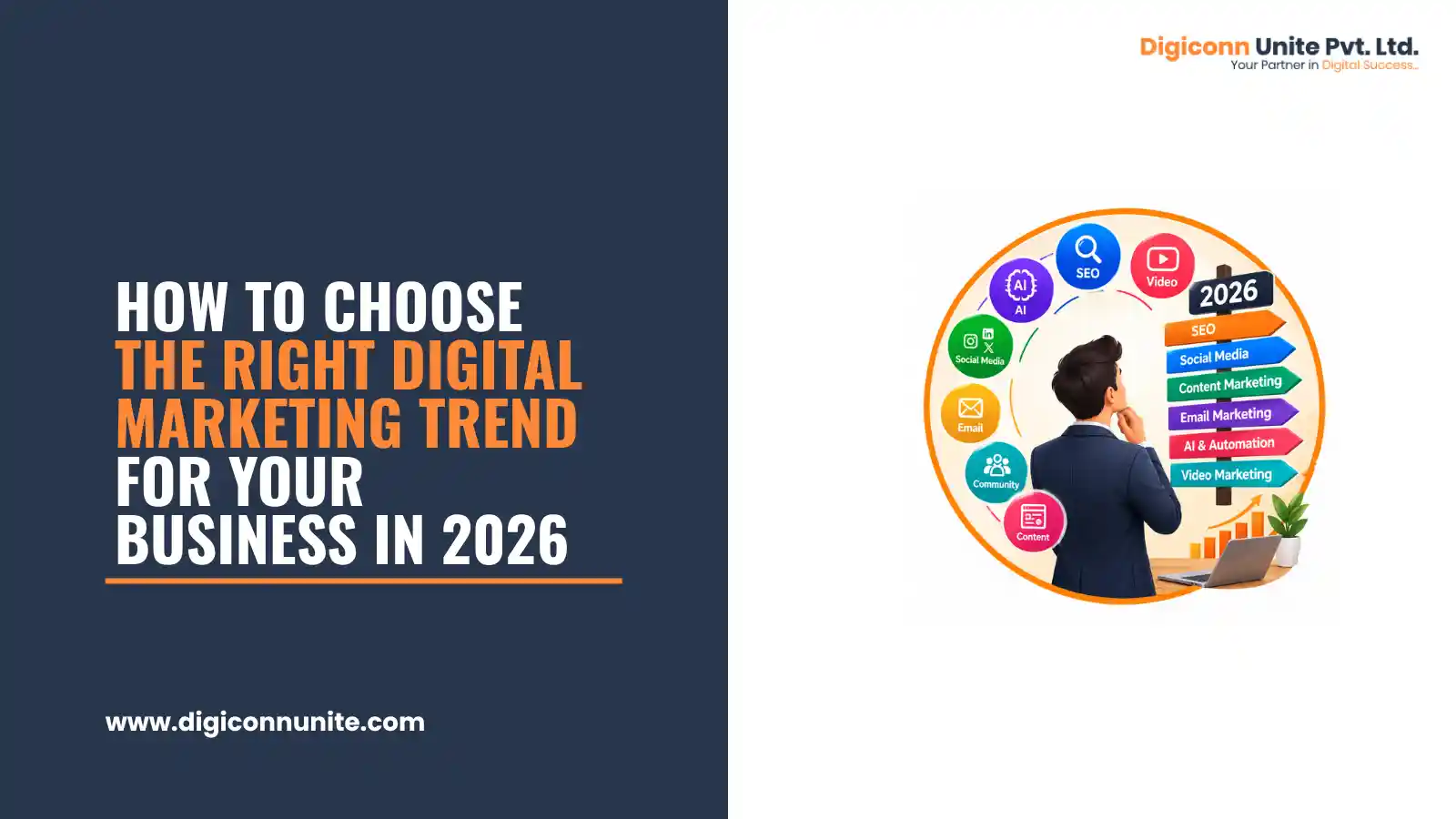
Choosing a digital marketing trend in 2026 is not about following whatever is popular on social media. The right trend is the one that matches your business goal, target audience, budget, industry, customer journey, and available resources.
For example, a local service business may benefit more from local SEO, Google Business Profile optimisation, short-form video, and reputation building than from investing heavily in an advanced AI system. An e-commerce brand may have different priorities, such as AI-powered personalisation, shopping ads, social commerce, email automation, and first-party customer data.
Businesses working with a digital marketing company in Agra or another marketing partner should therefore start with business objectives first and select technologies or trends second. Digiconn Unite follows this practical approach: identify what the business needs, understand where its customers search and make decisions, and then select the digital channels that support those goals.
Quick Answer: Which Digital Marketing Trend Should Your Business Choose in 2026?
The right digital marketing trend depends on your current business problem:
| Business Goal | Trends to Consider |
| Get more local enquiries | Local SEO, Google Business Profile, reviews, location-based content |
| Increase organic visibility | SEO, helpful content, AI search visibility, topical authority |
| Reach new audiences | Short-form video, social media, creator collaborations |
| Improve conversions | CRO, landing pages, personalisation, first-party data |
| Reduce repetitive marketing work | AI automation, marketing automation, CRM workflows |
| Improve customer retention | Email marketing, WhatsApp marketing, loyalty campaigns |
| Sell products online | E-commerce SEO, shopping ads, social commerce, product content |
| Improve brand visibility in AI search | Answer-focused content, entity clarity, brand mentions, AEO |
| Understand customer behaviour | Analytics, CRM data, first-party data |
| Generate immediate traffic | PPC, Google Ads, social advertising |
There is no universal "best" trend. Your choice should depend on what you want the marketing activity to achieve.
What Are the Major Digital Marketing Trends in 2026?
Digital marketing in 2026 is being influenced by AI-powered search, changing consumer behaviour, automation, video, first-party data, personalisation, and multi-platform discovery.
Search is no longer limited to the traditional list of blue links. Users can discover information through Google AI Overviews, AI Mode, ChatGPT, Gemini, Perplexity, social platforms, YouTube, marketplaces, and other digital channels. HubSpot's 2026 research describes this as a shift towards more fragmented, AI-assisted and conversational search behaviour.
This does not mean traditional SEO has disappeared. SEO still helps search engines discover, understand, and rank webpages, while businesses increasingly need to consider how their information appears in AI-generated answers as well.
How Should You Choose a Digital Marketing Trend?
1. Start With Your Business Goal
Do not begin with a tool or trend.
Begin by asking:
What do I want marketing to achieve?
Your objective could be:
-
More leads
-
More online sales
-
More local customers
-
Better brand awareness
-
Higher website traffic
-
Better customer retention
-
Lower acquisition costs
-
More repeat purchases
For example, if your main problem is that people cannot find your local business, improving local search visibility may make more sense than spending your entire budget on an experimental marketing channel.
If your problem is low repeat purchases, email, CRM, loyalty programmes, and customer personalisation may deserve more attention.
You May Like Also: Google AI Search Is Changing SEO in 2026
2. Understand Where Your Customers Search
Your customers may not use the same platform at every stage of their buying journey.
Someone might:
-
Discover a product on Instagram.
-
Watch a YouTube review.
-
Search Google for alternatives.
-
Ask an AI tool for a comparison.
-
Visit the company's website.
-
Read reviews.
-
Make the purchase.
This is why multi-platform discovery matters.
In 2026, businesses need to understand the complete customer journey instead of assuming that Google is the only discovery channel. Recent research also shows increasing use of social platforms and generative AI for information discovery.
3. Match the Trend With Your Audience
A trend is useful only when your audience uses the channel.
For example, suppose you operate a B2B software company. LinkedIn, search engines, webinars, case studies, email, and industry publications may be important.
A fashion brand may have stronger opportunities through:
-
Instagram
-
YouTube Shorts
-
Influencer marketing
-
Visual search
-
Social commerce
-
E-commerce SEO
A local restaurant may focus more on:
-
Google Business Profile
-
Local SEO
-
Reviews
-
Maps visibility
-
Instagram Reels
-
Food delivery platforms
The industry and customer behaviour should determine the channel.
4. Consider AI Search and Answer Engine Optimisation
AI-powered search is one of the most significant changes affecting digital marketing in 2026.
Users can now ask longer, conversational questions and receive summarised answers. Google also provides AI-powered search experiences, while platforms such as ChatGPT, Gemini, and Perplexity can influence how people research businesses, products and services.
This creates a new consideration for businesses: Can your brand and website information be clearly understood and referenced by answer engines?
Content should therefore provide:
-
Direct answers
-
Clear headings
-
Accurate facts
-
Useful examples
-
Strong topical context
-
Clear entity information
-
Original insights
-
Relevant internal links
Google's documentation explains that structured data can help Google understand page content and support eligible search appearances. However, structured data should accurately represent the visible content rather than being used as a shortcut for ranking.
AI search optimisation should complement—not replace—traditional SEO fundamentals.
5. Use AI Where It Actually Saves Time
AI can help marketing teams with many repetitive tasks.
Examples include:
-
Keyword research
-
Content briefs
-
Data analysis
-
Content ideation
-
Customer segmentation
-
Email variations
-
Ad copy testing
-
Reporting
-
Technical SEO analysis
-
Internal linking suggestions
AI SEO tools can accelerate parts of the workflow, but human review remains important for accuracy, originality, context, and business expertise.
The question should not be:
"How can we use AI everywhere?"
A better question is:
"Which marketing tasks can AI improve without reducing quality or trust?"
6. Build a First-Party Data Strategy
First-party data is information collected directly from your customers or audience through legitimate interactions with your business.
Examples include:
-
Email subscriptions
-
Customer purchases
-
Website interactions
-
CRM records
-
Customer preferences
-
Feedback forms
-
Loyalty programmes
This information can help businesses understand their own customers rather than depending entirely on external audience data.
A first-party data strategy should also respect user consent, transparency, and applicable privacy requirements. HubSpot's 2026 guidance describes first-party data as increasingly important for personalisation and AI-supported marketing.
7. Do Not Ignore Short-Form Video
Short-form video remains an important discovery format for many consumer audiences.
Businesses can use short videos for:
-
Product demonstrations
-
Tutorials
-
Frequently asked questions
-
Customer stories
-
Behind-the-scenes content
-
Industry tips
-
Before-and-after examples
-
Product comparisons
The goal should not be to create videos simply because video is trending.
Ask whether your audience actually consumes this format and whether you have something useful to communicate.
You May Like Also: 3 Free Available AI SEO Tools for Small Business
8. Improve Your Local Digital Presence
Local businesses should pay particular attention to local search.
Important areas can include:
-
Google Business Profile
-
Local landing pages
-
Customer reviews
-
Local citations
-
Location-specific content
-
Maps visibility
-
Local backlinks
-
Consistent business information
For a business serving a specific city, being visible to relevant local searchers can be more valuable than attracting large amounts of irrelevant traffic from other locations.
9. Focus on Conversion Rate Optimisation
Getting visitors is only one part of digital marketing.
You also need to ask:
What happens after someone reaches my website?
Conversion rate optimisation (CRO) focuses on improving the percentage of visitors who take a desired action.
This may involve improving:
-
Headlines
-
Landing pages
-
Forms
-
Calls to action
-
Website navigation
-
Trust signals
-
Product information
-
Page speed
-
Mobile usability
For example, if a campaign generates 10,000 visitors but very few enquiries, increasing traffic further may not solve the main problem. Improving the landing page and conversion journey may be more relevant.
10. Use Personalisation Where It Adds Value
Personalisation can make marketing messages more relevant.
Examples include:
-
Product recommendations
-
Location-specific offers
-
Personalised emails
-
Behaviour-based campaigns
-
Customer segmentation
-
Recommended content
However, personalisation should be useful rather than intrusive. Businesses should be transparent about how customer information is collected and used.
How Do You Know Which Trend Is Worth Investing In?
Use a simple evaluation framework.
Score each potential marketing initiative internally against these questions:
Business Relevance
Does it solve an actual business problem?
Audience Relevance
Does your target customer use this channel?
Expected Business Value
Can it realistically contribute to leads, sales, retention, or another meaningful goal?
Cost
What will implementation, advertising, software, people, and maintenance cost?
Resources
Do you have the people, skills, content, data, and technology required?
Measurement
Can you measure whether it is working?
Scalability
Can the activity grow if it starts producing results?
This gives you a practical way to compare trends without choosing something simply because it is popular.
Should Every Business Follow Every Digital Marketing Trend?
No.
Trying to use every new technology can create unnecessary costs and operational complexity.
A small local business may not need an elaborate AI marketing stack. A large e-commerce company may have enough customer data and marketing volume to justify advanced personalisation and automation.
The right strategy is usually a combination of established channels and selected newer technologies.
What Should Businesses Prioritise in 2026?
A practical 2026 marketing strategy can be built around five areas:
1. Strong foundations
Make sure your website, analytics, technical SEO, tracking and conversion paths work correctly.
2. Helpful content
Create content that answers real customer questions and demonstrates genuine expertise.
3. Multi-channel discovery
Understand how customers discover information through search, social media, video, marketplaces and AI tools.
4. First-party relationships
Build direct relationships through email, CRM, communities and other permission-based channels.
5. Continuous measurement
Review results and invest more time in activities that demonstrate meaningful business value.
What About GEO, AEO and Traditional SEO?
These terms can sound confusing.
SEO (Search Engine Optimisation) focuses on improving visibility in search engines.
AEO (Answer Engine Optimisation) focuses on making information easier for answer engines and AI-powered search systems to understand and potentially cite.
GEO (Generative Engine Optimisation) is commonly used to describe optimisation for generative AI and answer-based discovery.
The practical overlap is significant: businesses still need useful, crawlable, understandable, trustworthy information.
In 2026, it is more useful to think of these as connected parts of a broader search and discovery strategy rather than completely separate marketing activities. HubSpot's 2026 research similarly describes traditional SEO and AEO as complementary rather than mutually exclusive.
A Simple 2026 Digital Marketing Decision Framework
Before investing in a trend, ask these seven questions:
-
What business problem am I trying to solve?
-
Who is my target customer?
-
Where does that customer discover information?
-
What content or experience do they need?
-
What will implementation cost?
-
How will I measure the result?
-
What will I change if the results are poor?
If you cannot answer these questions, you may be choosing a trend before defining the strategy.
Final Answer
The right digital marketing trend for your business in 2026 is not necessarily the newest one. It is the trend that best matches your audience, business objective, resources, customer journey, and ability to measure results.
AI search, AEO, GEO, SEO, short-form video, social commerce, marketing automation, first-party data, personalisation, influencer marketing, PPC, local SEO, email marketing, CRM and conversion optimisation can all have a role—but not every business needs all of them.
Start with the business problem. Understand your customers. Choose the channel where they actually spend time and search for information. Test the strategy with measurable goals, review the data, and expand what proves useful.
That approach keeps digital marketing focused on business outcomes rather than trends for the sake of trends.
Frequently Asked Questions
What is the biggest digital marketing trend in 2026?
AI-powered search and changing search behaviour are major developments in 2026, but their importance varies by business. Other important areas include AI-assisted marketing, short-form video, first-party data, personalisation, automation, social discovery and multi-channel marketing.
Should small businesses invest in AI marketing?
They can, but they should first identify tasks where AI can provide practical value. Content research, reporting, customer segmentation, workflow automation and data analysis may be suitable starting points. Human review remains important.
Is SEO still important in 2026?
Yes. AI-powered search has changed how people discover information, but traditional SEO remains part of the search ecosystem. Businesses should combine strong SEO fundamentals with content designed for conversational and AI-assisted discovery.
What is AEO?
Answer Engine Optimisation, or AEO, refers to practices intended to improve how a brand's information is understood and surfaced by answer engines and AI-powered search experiences. It works alongside traditional SEO rather than replacing it.
How should a local business choose a digital marketing trend?
Start with local customer behaviour. Analyse local search demand, Google Business Profile performance, website conversions, reviews, social media activity and customer acquisition sources. Then invest in the channels that connect most directly with your target audience.
Our Social Links:
Related Topics
Explore more about digital marketing:
