



Quick Answer: Why Is Digital Marketing Important for Real Estate?
Digital marketing is important for real estate because it helps builders, developers, brokers and agents reach potential property buyers online, generate targeted enquiries, promote projects, build customer trust and measure marketing performance.
With strategies such as Search Engine Optimisation (SEO), Google Ads, social media marketing, video marketing, property landing pages and CRM-based follow-ups, real estate businesses can connect with interested buyers throughout their property-buying journey.
Key Takeaways
-
Reach more property buyers: Connect with people searching online for homes, plots, flats and commercial properties.
-
Generate relevant leads: Target audiences based on location, property type, budget and buying interests.
-
Build customer trust: Share genuine project photographs, construction updates, customer reviews and property information.
-
Improve local visibility: Help buyers discover your business and projects through local search results.
-
Showcase properties online: Use videos, virtual tours, floor plans and interactive property presentations.
-
Track marketing performance: Understand which campaigns generate enquiries, site visits and bookings.
-
Nurture potential customers: Use email, WhatsApp and CRM systems to maintain communication with interested buyers.
Important of Digital Marketing for Real Estate
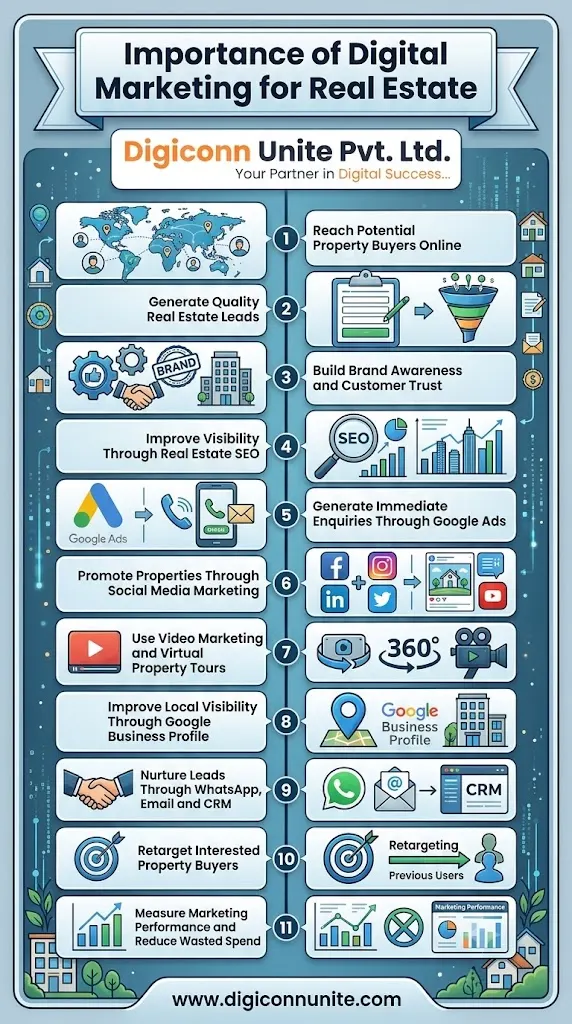
Buying a home, investing in commercial property or choosing a property developer is a major financial decision. Before contacting a builder or property agent, most potential buyers want to research properties, compare prices, explore locations, check amenities and understand the reputation of the company. This is why having a strong online presence has become essential for real estate businesses.
Why digital marketing is important for real estate is a question every builder, property developer, broker and real estate agent should understand. Traditional marketing methods such as newspaper advertisements, banners, pamphlets and property exhibitions can still support sales, but they may not be enough to reach today's online-first buyers.
Digital marketing helps real estate businesses reach people who are actively searching for properties, showcase projects through photos and videos, generate enquiries and build relationships with potential customers.
In this guide, you will learn how digital marketing works in the real estate industry, which strategies can bring better property enquiries and how to turn online interest into actual site visits and sales.
1. Reach Potential Property Buyers Online
The way people search for properties has changed. Buyers can now explore different residential and commercial projects without visiting every property location.
They search on Google, watch property walkthroughs on YouTube, browse Instagram and Facebook, compare listings on property portals and read customer reviews before making contact.
If your real estate business does not have a strong online presence, potential customers may discover competing projects first.
Digital marketing helps you reach people through different online platforms, including:
-
Google Search and Google Maps
-
Facebook and Instagram
-
YouTube
-
Real estate property portals
-
Business websites and landing pages
-
Email and WhatsApp communication
For example, a person searching for "2 BHK flats in Agra" may discover a project through Google Search. A well-optimised website or project landing page can provide the information they need and encourage them to request a callback.
You May Like Also: What Is Digital Marketing in Hospitality Industry
2. Generate Quality Real Estate Leads
Lead generation is one of the biggest reasons real estate companies invest in digital marketing.
A lead is a person who shows interest in your property, project or service and shares their contact details or makes an enquiry.
However, getting hundreds of enquiries does not automatically mean your marketing is successful. Some people may have a different budget, some may be looking for rental properties, while others may only be exploring the market.
The real objective should be to generate qualified property leads.
Digital marketing can help you attract relevant prospects through:
-
Google Search Ads targeting property-related searches.
-
Facebook and Instagram lead generation campaigns.
-
Project-specific landing pages with enquiry forms.
-
Click-to-WhatsApp advertisements.
-
Local SEO for location-based property searches.
-
Retargeting campaigns for people who previously visited your website.
You can also qualify enquiries by asking useful questions about the buyer's preferred location, budget range, property configuration and purchase timeline.
This helps your sales team prioritise people who are more likely to become customers.
3. Build Brand Awareness and Customer Trust
Buying property involves a significant financial commitment. Buyers want to know whether a developer is reliable, whether the project details are accurate and whether the property matches their expectations.
Digital marketing gives real estate companies opportunities to establish credibility before the first sales conversation.
You can build trust by publishing:
-
Actual project photographs and videos.
-
Construction progress updates.
-
Floor plans and property specifications.
-
Location and connectivity information.
-
Genuine customer testimonials.
-
Team and company information.
-
Relevant project approvals and registration details.
-
Answers to common property-buying questions.
Avoid making unsupported claims about project approvals, possession dates, returns or available amenities. Clear and accurate information helps potential buyers make informed decisions.
A consistent online presence also makes your business easier to recognise when customers compare different developers and property agents.
4. Improve Visibility Through Real Estate SEO
Search Engine Optimisation (SEO) helps your website appear in relevant organic search results when people look for properties or real estate services.
Unlike paid advertising, organic SEO does not require you to pay for every click. However, it requires useful content, technical improvements and ongoing optimisation.
For real estate businesses, SEO should focus on property types, project names and local search intent.
Important real estate SEO keywords
-
Flats for sale in Agra
-
Residential plots in Agra
-
Commercial property in Agra
-
2 BHK flats near Sanjay Place
-
Luxury apartments in Agra
-
Property dealers in Agra
-
Real estate developers in Agra
Important SEO activities
Optimise project pages: Create separate pages for individual projects with location, price information where appropriate, property configuration, amenities, photographs and enquiry options.
Use local keywords: Include relevant neighbourhoods, nearby landmarks and city names naturally in your website content.
Create helpful blogs: Publish guides about property selection, home loans, locality comparisons, buying processes and investment considerations.
Improve technical SEO: Make your website mobile-friendly, secure, fast-loading and easy for search engines to crawl.
Build local visibility: Maintain accurate business details and an active Google Business Profile.
A well-planned SEO strategy can help your real estate business attract people who are already interested in purchasing or investing in property.
You May Like Also: What is B2B Digital Marketing Agency
5. Generate Immediate Enquiries Through Google Ads
SEO takes time to build visibility. If you want to promote a newly launched project or reach buyers within a particular location, Google Ads can help you gain visibility more quickly.
Google Search Ads allow businesses to target people searching for specific property-related terms.
For example, a developer promoting residential apartments could target searches such as:
-
Buy flats in Agra
-
Ready-to-move flats in Agra
-
New residential projects in Agra
-
Luxury apartments near me
You can direct these visitors to a dedicated landing page instead of sending everyone to your homepage.
A good property landing page should include:
-
Project name and location.
-
Property type and configuration.
-
Genuine images and videos.
-
Amenities and location advantages.
-
Relevant pricing information, where permitted.
-
RERA registration details, where applicable.
-
Enquiry form and contact options.
-
Clear call-to-action buttons.
Track enquiries and sales outcomes rather than judging campaign success only by clicks.
6. Promote Properties Through Social Media Marketing
Social media platforms help real estate businesses showcase properties in an engaging and visual way.
People often want to see what a property looks like before arranging a physical visit. Facebook, Instagram and YouTube make it possible to share property information through images, videos, reels and live presentations.
Useful social media content ideas
-
Property walkthrough videos.
-
Apartment and villa tours.
-
Construction progress reels.
-
Project location videos.
-
Floor plan explanations.
-
Amenities and facilities.
-
Customer testimonials.
-
Locality and neighbourhood guides.
-
Frequently asked property questions.
Facebook and Instagram advertising can also help you reach people based on relevant audience and campaign targeting options.
However, real estate advertising should follow the applicable platform policies and local laws. Do not use misleading property images or make claims that cannot be verified.
7. Use Video Marketing and Virtual Property Tours
Photos are useful, but videos can give potential buyers a better understanding of a property.
A well-produced walkthrough can show room layouts, entrances, balconies, amenities, common areas and the surrounding location.
Real estate businesses can use different video formats:
Property walkthroughs: Show the actual property from different angles.
Drone videos: Present the project's surroundings and location, where legally permitted.
Virtual tours: Allow buyers to explore spaces remotely through interactive or 360-degree experiences.
Construction updates: Share genuine progress from the project site.
Neighbourhood videos: Explain nearby schools, hospitals, transport options, shopping areas and other relevant facilities.
These formats can help buyers shortlist properties before arranging a physical site visit. They also give sales teams useful content to share with interested prospects.
8. Improve Local Visibility Through Google Business Profile
For real estate agents, property consultants, builders and local developers, local search visibility can be valuable.
When people search for property dealers, real estate agents or builders in a particular city, they may discover relevant businesses through Google Search and Google Maps.
A properly maintained Google Business Profile helps customers find essential business information.
Important activities include:
-
Use your genuine business name.
-
Select the most accurate business category.
-
Add the correct address and contact details.
-
Update business hours.
-
Upload genuine office and project photographs.
-
Publish relevant business updates.
-
Respond professionally to customer reviews.
-
Keep website and contact information consistent.
Remember that a Google Business Profile represents your actual business location and should follow Google's eligibility and representation guidelines.
Visit Also: GMB Expert Company in Agra
9. Nurture Leads Through WhatsApp, Email and CRM
Real estate buyers rarely make decisions after seeing one advertisement. They may compare multiple projects, discuss options with family members, arrange finances and take time before scheduling a visit.
This makes follow-up an important part of real estate marketing.
A Customer Relationship Management (CRM) system can help you manage enquiries and track their progress.
A practical follow-up process can look like this:
-
Enquiry received: A potential buyer submits a website form or contacts your business through an advertisement.
-
Lead recorded: The enquiry is saved in your CRM with its marketing source.
-
Initial response: Your sales team contacts the prospect and understands their requirements.
-
Property information shared: Send relevant brochures, photographs, floor plans or videos.
-
Site visit scheduled: Arrange a visit based on the buyer's availability.
-
Follow-up completed: Record feedback and answer additional questions.
-
Sales outcome tracked: Update the lead status when the prospect books, declines or needs further nurturing.
WhatsApp can be useful for sharing brochures, answering questions and confirming site visits. Email can support longer-term communication.
Always respect customer preferences and applicable consent and communication requirements. Avoid sending unwanted promotional messages.
10. Retarget Interested Property Buyers
Not every visitor will enquire during their first website visit.
Someone may explore your project page, check the price or watch a property video and leave without contacting your sales team.
Retargeting allows you to reconnect with eligible audiences who have previously interacted with your website or advertisements.
For example, you can create campaigns for people who:
-
Visited a particular project page.
-
Watched a property walkthrough video.
-
Engaged with your social media content.
-
Opened an advertisement but did not submit an enquiry.
You can show them additional project information, relevant videos or an invitation to arrange a site visit.
Retargeting should follow applicable platform rules, privacy requirements and consent settings.
11. Measure Marketing Performance and Reduce Wasted Spend
One major advantage of digital marketing is the ability to measure campaign performance.
Instead of relying only on enquiries or estimated audience reach, real estate companies can track how prospects move through the sales process.
Some important metrics include:
| Metric | What It Tells You |
|---|---|
| Website traffic | How many people visit your website |
| Click-through rate (CTR) | How often people click your advertisements |
| Cost per lead (CPL) | How much you spend to generate an enquiry |
| Qualified lead rate | How many enquiries match your target buyer profile |
| Site visit rate | How many leads arrange or complete property visits |
| Cost per site visit | Marketing cost associated with a completed visit |
| Booking conversion rate | How many prospects become customers |
| Return on ad spend (ROAS) | Revenue attributed to advertising compared with ad spend |
For example, Campaign A may generate 100 enquiries, while Campaign B generates only 40. However, if Campaign B produces more completed site visits and bookings, it may be the better investment.
This is why real estate businesses should measure lead quality, site visits and bookings rather than focusing only on the lowest cost per lead.
Digital Marketing Strategies for Different Real Estate Businesses
Not every real estate business has the same marketing requirements. Your strategy should depend on the type of property you sell and the customers you want to reach.
For builders and property developers
Focus on project-specific landing pages, Google Ads, SEO, construction videos, virtual tours, social media campaigns and CRM-based lead management.
For real estate agents and brokers
Build a strong personal brand, optimise your local business presence, publish property listings, share neighbourhood guides and generate enquiries through local SEO and social media.
For commercial property businesses
Target companies and investors looking for offices, shops, warehouses and commercial spaces. Use location-specific SEO, LinkedIn content, professional project presentations and targeted advertising.
For rental property businesses
Promote available properties through local search, property portals, social media and enquiry forms. Keep availability, rental terms and property information updated.
Follow Real Estate Advertising and Compliance Requirements
Real estate marketing is not only about attracting customers. It is also about communicating accurate and legally appropriate information.
In India, the Real Estate (Regulation and Development) Act, 2016 (RERA) establishes important requirements for applicable real estate projects and their advertising.
Before publishing project advertisements, developers should verify applicable registration and disclosure requirements with the relevant state RERA authority.
Businesses should also ensure that:
-
Project registration details are displayed where required.
-
Property specifications are accurate.
-
Pricing and payment claims are clear.
-
Possession and construction statements are not misleading.
-
Images and sample layouts are not presented as completed actual properties.
-
Customer information is handled responsibly.
Following the applicable requirements helps protect buyers and supports the credibility of your business.
Why Choose a Professional Digital Marketing Strategy for Real Estate?
Managing SEO, paid campaigns, social media, website optimisation and lead follow-ups requires planning and consistent effort.
A professional digital marketing strategy helps connect these activities instead of treating every channel as a separate task.
A well-planned approach should begin by understanding your project, target location, buyer profile, competition and business objectives.
The next step is to select suitable marketing channels, prepare useful property content, create conversion-focused landing pages and measure enquiries through to sales outcomes.
If you are searching for the best digital marketing company, Digiconn Unite can help your business explore digital marketing solutions such as SEO, PPC advertising, social media marketing, website development and lead generation.
As a digital marketing company based in Agra, Digiconn Unite focuses on helping businesses improve their online visibility and connect with relevant audiences through strategies suited to their goals.
Conclusion
Digital marketing has become an important part of the modern real estate industry. Buyers want to research properties online, compare developers, explore locations and understand project details before making a decision.
For builders, developers, brokers and property agents, a strong digital presence can create more opportunities to reach potential buyers and build lasting customer relationships.
The best approach is not simply to run advertisements or publish social media posts. It is to create a connected marketing system that attracts the right audience, provides useful information, captures genuine enquiries and follows up until the buyer is ready for the next step.
With a suitable combination of SEO, Google Ads, social media marketing, video content, local search optimisation and CRM-based lead management, your real estate business can build a more organised and measurable path from online discovery to property sales.
Frequently Asked Questions (FAQs)
1. Why is digital marketing important for real estate?
Digital marketing helps real estate businesses reach potential buyers online, promote properties, generate enquiries, build trust and track marketing performance. It also helps businesses stay visible when customers compare different projects and property options.
2. Which digital marketing strategy is best for real estate?
There is no single strategy that works for every business. SEO and local SEO can build long-term visibility, Google Ads can reach people with active buying intent, and social media and video marketing can improve awareness. Combining suitable channels with effective lead follow-up usually creates a stronger marketing system.
3. How can real estate companies generate quality leads online?
Real estate companies can generate quality leads through targeted Google Ads, social media campaigns, SEO, project landing pages, property videos and click-to-WhatsApp campaigns. Asking relevant questions about location, budget and property requirements can help qualify enquiries.
4. Is SEO useful for real estate businesses?
Yes. Real estate SEO can help your website appear when potential buyers search for properties, projects, locations and real estate services. Optimised project pages, local keywords, helpful blogs and a well-maintained Google Business Profile can support organic visibility.
5. How does social media help real estate marketing?
Social media helps businesses showcase properties through photographs, reels, walkthroughs, customer stories and live videos. It can also support brand awareness, audience engagement, targeted advertising and remarketing.
6. What is the role of Google Ads in real estate?
Google Ads can help real estate businesses reach people searching for specific property types, projects or locations. By directing these users to relevant landing pages, businesses can generate enquiries and measure campaign performance.
7. How much should a real estate business spend on digital marketing?
The budget depends on the project location, property value, competition, campaign objectives and expected sales pipeline. Start with a planned test budget, track qualified leads and site visits, and increase spending on campaigns that produce meaningful results.
8. How can digital marketing help sell properties faster?
Digital marketing can improve visibility, attract relevant buyers, provide property information and make it easier to arrange site visits. However, actual sales also depend on pricing, property quality, location, market demand, financing and the sales team's follow-up.
9. Is WhatsApp useful for real estate lead generation?
Yes. WhatsApp can help real estate businesses respond to enquiries, share brochures, send property videos, answer questions and schedule site visits. Businesses should communicate with people who have provided appropriate permission and respect their preferences.
10. Why should real estate businesses hire a digital marketing company?
A professional digital marketing company can help plan and manage SEO, paid advertising, social media, website optimisation and lead generation. It can also help businesses measure performance and improve their marketing based on actual enquiry and sales data.
You May Read Also: Role of Business Management Software in Agra
Our Social Links:
Related Topics
Explore more about digital marketing:
