



Business Management Software Role for Small Business in Agra
Quick Answer
The role of business management software for small business in Agra is to help owners manage daily operations, sales, billing, inventory, customer relationships, employee activities, and business reports from a more organised system. It can reduce repetitive manual work, improve record accuracy, support better decisions, and help businesses handle growth. Depending on their needs, small businesses can use ready-made software or invest in customised solutions that match their specific workflows.
Key Takeaways
-
Business management software helps small businesses organise their daily operations in one connected system.
-
Billing, inventory management, CRM, accounting, HR, and reporting can reduce manual work and improve visibility.
-
Agra businesses such as retailers, wholesalers, manufacturers, hotels, educational institutes, and service providers can benefit from industry-specific solutions.
-
Indian businesses should evaluate GST invoicing, payment tracking, data security, and integration requirements before choosing software.
-
Custom software can be useful when standard applications cannot support a company's unique processes.
-
Successful implementation depends on the right features, employee training, reliable support, and regular maintenance.
Looking for software that fits your business workflow? Digiconn Unite can help you explore business management software development in Agra based on your operational requirements and future goals. Discuss your project requirements at Digiconn Unite.
Introduction
Running a small business involves more than selling products or providing services. Owners must manage customer enquiries, invoices, payments, inventory, employees, suppliers, and daily expenses while keeping customers satisfied.
For many small businesses in Agra, these activities begin with notebooks, spreadsheets, phone calls, and separate applications. Although these methods may work initially, they can become difficult to manage as orders increase and more employees become involved.
Business management software offers a practical way to organise these activities. It helps businesses maintain structured records, connect related tasks, and access important information without depending entirely on manual processes.
From retail shops and footwear manufacturers to hotels, wholesalers, and professional service providers, the right software can support more efficient operations. Understanding its role helps business owners decide which tools they need today and which capabilities may become useful as the company grows.
What Is Business Management Software?
Business management software is a digital system that helps an organisation manage important business activities. Depending on its features, it may combine billing, inventory, accounting, customer relationship management, employee management, order processing, and reporting.
Instead of maintaining unrelated records across different tools, a business can connect selected operations through one platform or through applications that integrate with one another.
For example, when a retailer records a sale, the system may update the inventory, generate an invoice, record the payment, and include the transaction in sales reports. The exact capabilities depend on the software and its configuration.
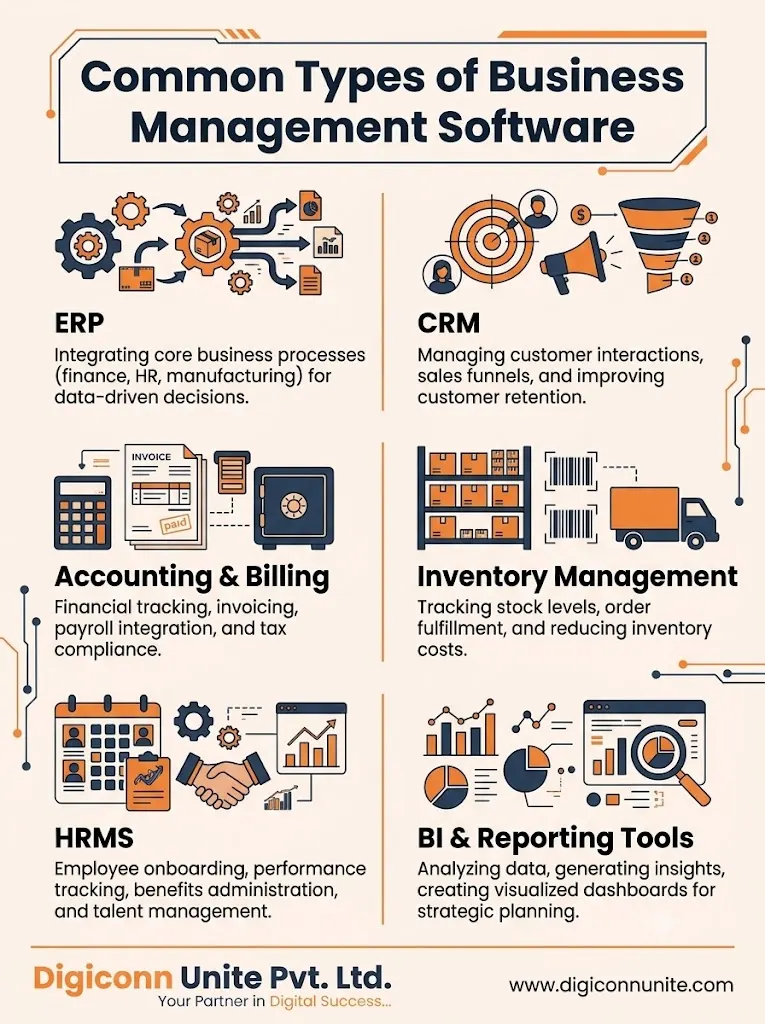
Common types of business management software include:
-
Enterprise Resource Planning (ERP): Connects business functions such as purchasing, inventory, accounts, and operations.
-
Customer Relationship Management (CRM): Organises customer information, leads, sales opportunities, and follow-ups.
-
Accounting and billing software: Helps manage invoices, expenses, payments, and financial records.
-
Inventory management software: Tracks stock, purchases, sales, and stock movement.
-
Human Resource Management System (HRMS): Supports employee records, attendance, leave, and payroll-related workflows.
-
Business Intelligence (BI) and reporting tools: Turn business data into reports and dashboards.
A small business does not necessarily need every type of software. The right choice depends on its size, budget, existing systems, and operational challenges.
Why Is Business Management Software Important for Small Businesses in Agra?
Agra has a varied business environment that includes retail, tourism, hospitality, footwear manufacturing, handicrafts, marble and inlay work, education, distribution, and professional services.
Each sector has different operational requirements. A retailer needs accurate stock records, while a hotel may need reservation management and a manufacturer may need production and material tracking.
Business management software helps businesses organise these activities according to their needs.
1. Automates Repetitive Business Tasks
Manual data entry, repeated invoice preparation, daily sales calculations, and routine reporting consume valuable time. They can also introduce errors when employees enter the same information into multiple records.
Software can automate suitable tasks, such as generating invoices, calculating totals, sending reminders, updating stock, and preparing standard reports.
For example, a wholesaler in Agra may process numerous customer orders every day. A connected system can help employees record orders, prepare bills, and track outstanding payments without rebuilding each record from scratch.
Automation does not remove the need for human checks. However, it can reduce unnecessary repetition and allow employees to focus on customers, sales, and other important work.
2. Improves Inventory and Stock Management
Inventory management is important for retailers, wholesalers, manufacturers, and distributors. Poor stock records can lead to excess purchases, unavailable products, delayed deliveries, or difficulty identifying slow-moving items.
Inventory management software helps businesses monitor stock levels, purchase orders, stock movement, and product availability.
Depending on the system, useful features may include:
-
Low-stock notifications.
-
Product and SKU tracking.
-
Purchase and supplier records.
-
Warehouse or branch-wise inventory.
-
Stock movement reports.
-
Batch or expiry tracking where relevant.
A footwear business, for example, may need to track different styles, colours, and sizes. A properly configured inventory system can help employees identify available stock and reduce confusion when processing orders.
3. Makes Billing, Accounting, and Payment Tracking Easier
Accurate financial records help small business owners understand their income, expenses, receivables, and cash flow.
Business management software can connect sales invoices, purchase records, expenses, payment status, and financial reports. Some systems also support accounting workflows and tax-related reporting.
For Indian businesses, it is important to check whether the selected software supports relevant GST invoicing and reporting requirements. Depending on the business and applicable rules, other requirements may include e-invoicing, e-way bills, and TDS-related records.
Software can help organise records, but it does not automatically guarantee tax compliance. Businesses should confirm the system's capabilities and consult a qualified accounting professional when necessary.
4. Strengthens Customer Relationship Management
Customer enquiries can arrive through websites, telephone calls, email, social media, WhatsApp, and in-person visits. When these records remain scattered, sales teams may miss follow-ups or lose track of customer requirements.
CRM software helps businesses maintain customer details, enquiry history, sales stages, reminders, and communication records.
A service company in Agra can use a CRM to track each enquiry from the first conversation to quotation, follow-up, and final sale.
This creates a clearer sales process and helps employees understand which action is required next. However, CRM software only delivers value when information is recorded accurately and teams use it consistently.
5. Supports Employee and Team Management
As a business grows, owners may find it difficult to monitor responsibilities, attendance, work progress, and approvals through informal communication alone.
Depending on the company's needs, management software can support:
-
Employee records and attendance.
-
Leave requests and approvals.
-
Task allocation and progress tracking.
-
Department-wise responsibilities.
-
Payroll-related information.
-
Role-based access to business records.
A small business does not always need a separate HRMS. Some teams can manage their requirements through a basic management platform, while larger or more complex organisations may benefit from dedicated employee management tools.
6. Provides Better Business Reports and Decisions
Business owners need reliable information to decide what to purchase, which products perform well, where costs are increasing, and which customers require attention.
Business management software can convert operational data into reports and dashboards covering sales, expenses, inventory, customer activity, and outstanding payments.
For example, a retailer may discover that certain products sell more quickly during specific periods. A manufacturer may use order and material records to identify recurring delays.
These insights can support better planning. Their accuracy depends on the quality of the underlying data and the relevance of the reports.
How Different Small Businesses in Agra Can Benefit
The role of business management software varies according to the industry and its workflows.
| Business type | Useful software capabilities |
|---|---|
| Retail shops | Billing, stock management, purchase records, daily sales |
| Wholesalers and distributors | Customer accounts, bulk orders, inventory, payment tracking |
| Footwear and handicraft manufacturers | Material tracking, production status, quality records, order management |
| Hotels and hospitality businesses | Reservations, customer records, billing, staff coordination |
| Educational institutes | Student records, fee tracking, attendance, communication |
| Service companies | CRM, quotations, project tracking, employee tasks, invoicing |
| E-commerce businesses | Order processing, stock synchronisation, customer data, returns |
These are examples rather than fixed requirements. A business should select features according to its actual processes instead of paying for modules it will not use.
Ready-Made Software vs Custom Business Management Software
One important decision is whether to choose an existing software product or develop a customised system.
Ready-made software can be suitable when a business has standard requirements, such as billing, accounting, or basic inventory management. It may offer faster setup and predictable subscription costs.
Custom business management software is designed around a company's particular workflows. It may be useful when a business needs specialised approvals, industry-specific reports, integration with existing applications, or a workflow that standard tools cannot handle effectively.
Consider these differences:
| Factor | Ready-made software | Custom software |
|---|---|---|
| Initial setup | Often quicker | Requires planning and development |
| Workflow flexibility | Depends on available settings | Can be designed around defined requirements |
| Initial cost | Often lower | Can be higher |
| Integrations | Depends on supported connectors and APIs | Can be planned for specific systems |
| Maintenance | Usually follows the vendor's model | Requires an agreed maintenance arrangement |
| Best suited for | Common business processes | Distinctive or complex business processes |
Custom software is not automatically the better choice. A small business should compare the total cost of ownership, available features, support, scalability, and long-term flexibility before deciding.
How to Choose the Right Business Management Software
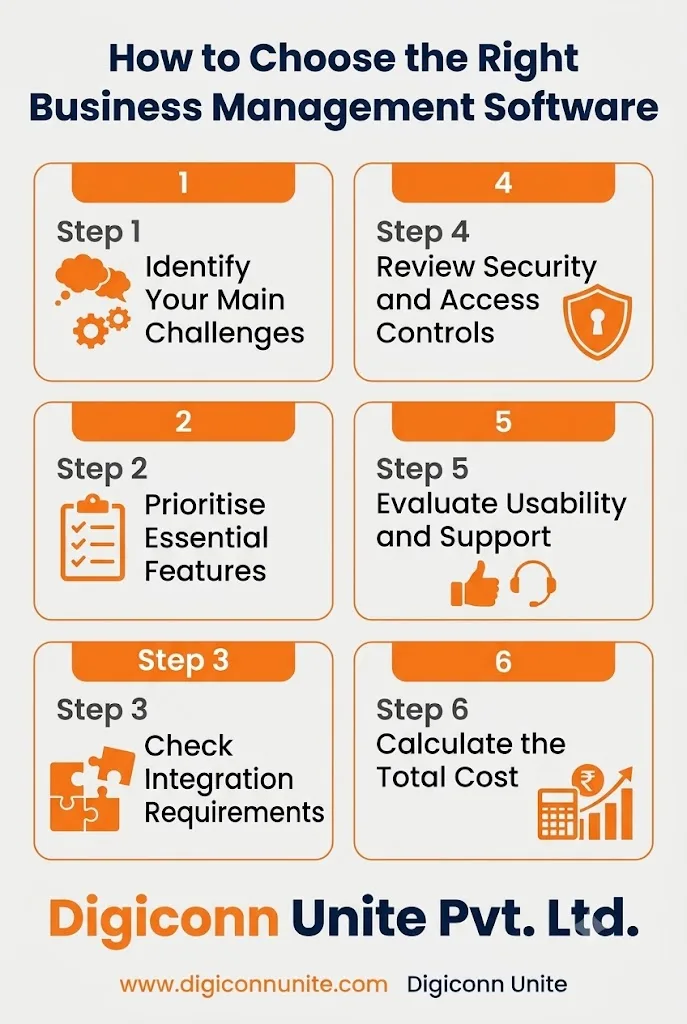
Selecting software based only on price or a long feature list can lead to unnecessary expenses. Business owners should begin with their actual operational problems.
Step 1: Identify Your Main Challenges
List the tasks that take too much time or frequently cause errors. These might include missed customer follow-ups, incorrect stock records, delayed invoices, or difficulty preparing reports.
Step 2: Prioritise Essential Features
Separate must-have features from optional improvements. A small shop may prioritise billing and inventory, while a service business may need CRM, quotations, and project tracking.
Step 3: Check Integration Requirements
Confirm whether the software can work with your existing website, payment gateway, accounting tools, customer systems, or other applications. Ask which integrations are included and whether additional charges apply.
Step 4: Review Security and Access Controls
Business software may contain customer details, financial records, and confidential company information. Look for appropriate user permissions, secure authentication, backups, and a clear data access policy.
Step 5: Evaluate Usability and Support
Employees should be able to learn the system without unnecessary difficulty. Request a demonstration using realistic business scenarios and ask about onboarding, training, support response times, and data export options.
Step 6: Calculate the Total Cost
Consider more than the initial licence or development price. Include implementation, data migration, integrations, training, hosting, support, upgrades, and future changes.
A practical evaluation helps businesses choose software that solves real problems without creating unnecessary complexity.
Common Challenges When Implementing Business Management Software
Introducing software is a business change, not simply a technical installation. Some companies struggle because they choose the wrong features, transfer inaccurate data, or fail to prepare employees.
Common challenges include:
-
Unclear requirements: Developing or purchasing software before identifying business problems can waste time and money.
-
Poor data quality: Inaccurate customer, stock, or financial records can affect reports.
-
Limited employee training: Employees may continue using old methods if the new system is difficult to understand.
-
Disconnected tools: Applications that do not share relevant data can create duplicate work.
-
Weak security practices: Inadequate permissions and backups can increase operational risks.
-
Lack of ongoing support: Software needs updates, maintenance, and improvements as business requirements change.
Businesses can reduce these risks through clear planning, phased implementation, staff training, data validation, and regular system reviews.
The Role of Digiconn Unite in Business Management Software Development in Agra
Choosing the right technology approach is an important step towards improving business operations. Digiconn Unite can help businesses explore business management software development in Agra based on their requirements, workflows, and long-term goals.
A useful development process begins by understanding how the business operates today. This includes identifying manual tasks, reviewing existing applications, defining user roles, and deciding which processes need to be connected.
Depending on the project scope, a business management solution may involve custom dashboards, CRM workflows, inventory and order management, reporting, or integrations with existing business systems.
Before development begins, businesses should agree on the required features, project scope, timelines, data ownership, security expectations, and maintenance arrangements. Clear requirements help keep the solution focused on practical business needs.
How Software Companies Help Agra Businesses Grow
Business management software is one part of a broader digital strategy. Businesses may also need websites, mobile applications, customer portals, e-commerce systems, or integrations to improve how they serve customers.
For a broader look at these opportunities, read our related article: "How Software Companies Help Agra Businesses Grow."
Together, suitable software and well-planned business processes can help companies organise internal work, improve customer experiences, and prepare for future growth.
Frequently Asked Questions
1. What is the role of business management software for small business in Agra?
It helps small businesses organise daily activities such as billing, inventory, customer management, employee coordination, and reporting. The right system can reduce repetitive work and improve access to business information.
2. Which businesses in Agra need business management software?
Retailers, wholesalers, manufacturers, hotels, educational institutes, distributors, and service providers may benefit from business management software. The appropriate solution depends on the business's size, workflows, and operational challenges.
3. Is business management software affordable for small businesses?
Costs vary according to the software type, number of users, features, integrations, implementation, and support requirements. Small businesses can begin with essential ready-made tools and consider customised software when their needs justify the investment.
4. What features should small business management software include?
Common features include billing, inventory management, customer records, payment tracking, reporting, and user permissions. Depending on the business, CRM, employee management, order processing, or integrations may also be useful.
5. What is the difference between ERP and business management software?
Business management software is a broad term for tools that support business operations. ERP is a category of software that integrates multiple core functions, such as purchasing, inventory, finance, and operations, within a connected system.
6. Should a small business choose ready-made or custom software?
Ready-made software is often suitable for standard requirements and quicker setup. Custom software may be appropriate when existing products cannot support important workflows or integration needs. Businesses should compare costs, flexibility, maintenance, and future requirements before deciding.
7. Can business management software help reduce manual errors?
It can reduce some errors by automating calculations, sharing data between connected modules, and standardising workflows. However, inaccurate inputs, poor configuration, and insufficient staff training can still lead to mistakes.
8. How can Digiconn Unite help with business management software development in Agra?
Digiconn Unite can help businesses explore software development options based on their operational requirements. The appropriate scope, features, integrations, cost, and timeline should be discussed and agreed upon for each project.
Conclusion
The role of business management software for small business in Agra goes beyond digitising records. The right system can connect everyday activities, organise customer and financial information, improve stock visibility, and support better business decisions.
However, the best solution is not necessarily the one with the most features. Small businesses should start by identifying their biggest operational challenges, prioritising essential functions, and selecting technology that fits their budget and working practices.
Whether you choose ready-made software or customised development, clear requirements, reliable data, employee training, and ongoing maintenance are essential for long-term value. With the right approach, business management software can become a practical foundation for more organised operations and sustainable growth.
Our Social Links:
Related Topics
Explore more about software development:
