

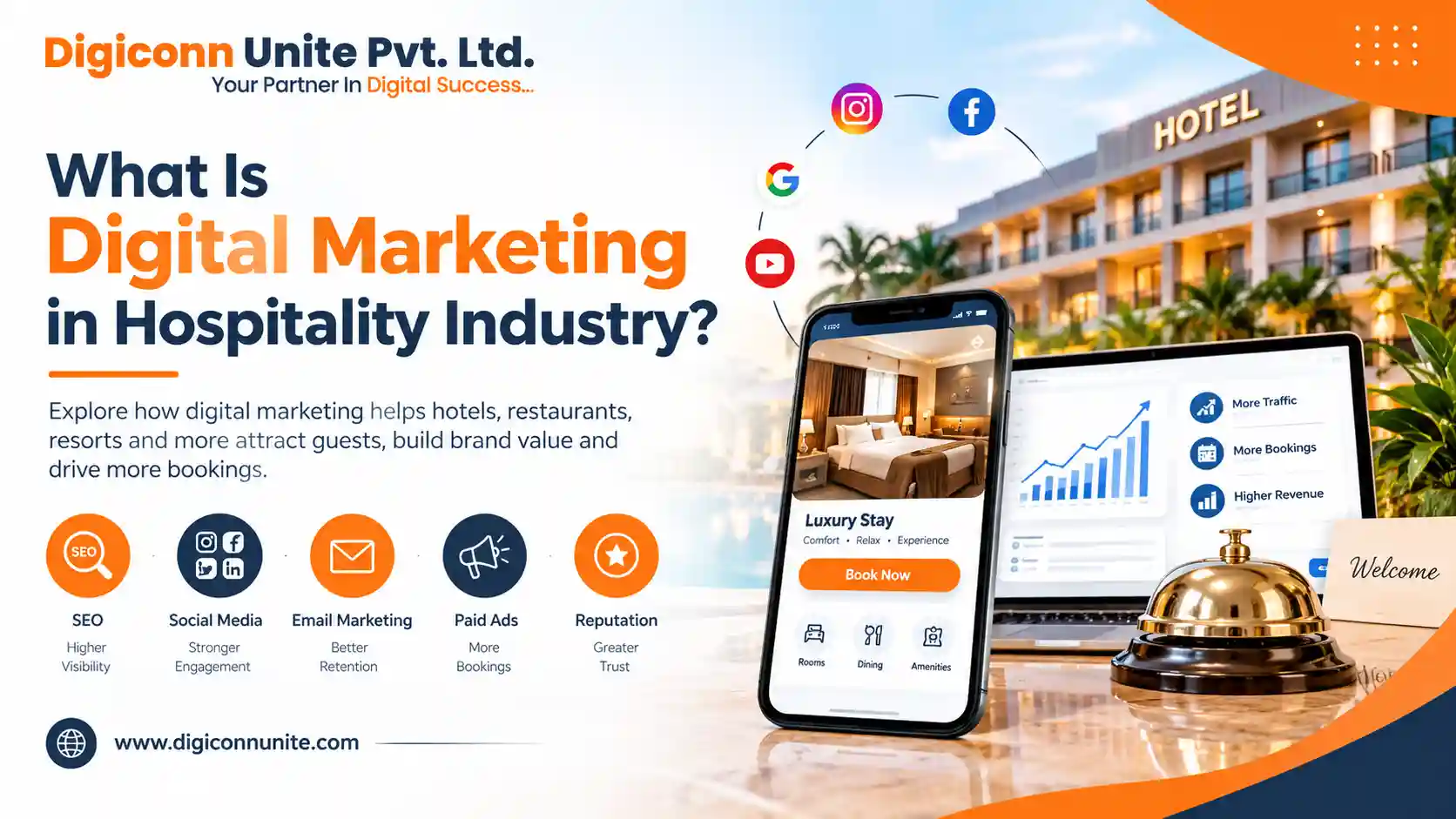
Digital marketing in the hospitality industry is the use of online channels and digital technologies to attract guests, promote hospitality services, build trust, increase bookings, and maintain long-term customer relationships. It includes search engine optimisation (SEO), social media marketing, online advertising, email marketing, online reputation management, and direct booking strategies.
For hotels, resorts, restaurants, cafés, homestays, travel companies, and event venues, digital marketing helps potential customers discover their services before making a reservation. It also allows businesses to communicate with guests before, during, and after their visit.
A successful hospitality marketing strategy focuses on more than website traffic or social media followers. It connects online visibility with enquiries, reservations, guest satisfaction, repeat visits, and profitable business growth.
Why Is Digital Marketing Important in the Hospitality Industry?
Hospitality customers often research several options before choosing a hotel, restaurant, or holiday destination. They may compare prices, read reviews, check photographs, explore amenities, and look for convenient booking options.
Digital marketing helps hospitality businesses appear during this decision-making process.
Its main benefits include:
-
Improved online visibility: Help potential guests discover your property through Google Search, Google Maps, social media, and relevant travel platforms.
-
More direct bookings: Encourage customers to reserve through your website instead of depending entirely on third-party booking platforms.
-
Better brand awareness: Showcase rooms, dining experiences, amenities, events, and local attractions.
-
Stronger customer trust: Use authentic photographs, accurate information, guest reviews, and helpful content.
-
Targeted promotions: Reach suitable audiences with offers based on travel interests, location, season, and booking intent.
-
Repeat business: Use email marketing, loyalty programmes, and personalised communication to encourage returning guests.
-
Measurable performance: Track enquiries, reservations, advertising costs, and revenue from different marketing channels.
Google also provides hotel-specific tools and booking options that can help properties present their information to travellers searching on Google. Availability of these features depends on the property's setup and eligibility.
Visit Also: Restaurant SEO Services in Mathura
Which Businesses Can Benefit from Hospitality Digital Marketing?
Digital marketing is useful across different hospitality categories, although each business needs a strategy suited to its customers.
| Hospitality business | Main marketing priorities |
|---|---|
| Hotels and business hotels | Local SEO, room pages, direct bookings, Google visibility and corporate enquiries |
| Resorts and holiday properties | Visual content, seasonal campaigns, destination searches and package promotions |
| Restaurants and cafés | Local search, menus, food photography, reviews and table reservations |
| Homestays and guest houses | Google Business Profile, accommodation listings, trust-building content and direct enquiries |
| Travel and tour operators | Destination content, itinerary pages, lead generation and remarketing |
| Event and wedding venues | Venue galleries, event pages, enquiry forms and targeted advertising |
| Spas and wellness retreats | Local SEO, service pages, appointment bookings and customer retention |
A resort targeting families, for example, may promote swimming pools, activities, and family packages. A business hotel may focus on conference facilities, transport access, corporate rates, and convenient booking.
The strategy should reflect what makes the business valuable to its intended guests.
What Are the Main Digital Marketing Strategies for Hospitality Businesses?
1. Search Engine Optimisation (SEO)
SEO helps hospitality businesses improve their visibility in organic search results. It is particularly useful when potential customers search for accommodation, restaurants, or travel experiences in a specific destination.
A hospitality SEO strategy may include:
-
Keyword research based on property type, location, amenities, and guest intent.
-
Optimised website titles, meta descriptions, headings, and room pages.
-
Location-specific landing pages for relevant destinations.
-
Technical SEO, mobile usability, and website speed improvements.
-
Helpful content about nearby attractions, travel routes, and local experiences.
-
Internal linking between accommodation, facilities, packages, and booking pages.
For example, a hotel might create useful pages around searches such as “family hotel in Agra”, “resort near Vrindavan”, or “hotel with conference facilities in Delhi”, provided these pages accurately represent its offerings.
Avoid creating numerous near-identical location pages with little unique value. Each page should answer a genuine customer need.
2. Local SEO and Google Business Profile
Local SEO helps businesses reach customers searching for hospitality services in a particular area. It is especially important for hotels, restaurants, cafés, spas, and event venues.
A well-maintained Google Business Profile can display essential information such as business details, photographs, opening hours where applicable, customer reviews, and other relevant attributes.
Hospitality businesses should:
-
Keep their name, address, phone number, and website accurate.
-
Select appropriate business categories.
-
Upload recent, genuine photographs.
-
Keep menus, facilities, and other available information up to date.
-
Respond professionally to customer reviews.
-
Monitor calls, website visits, and other available profile interactions.
Google explains that Business Profiles help businesses manage how they appear on Search and Maps. Hotel-specific information and features have their own requirements.
May Be Like Also: Who is Best Digital Marketing Company for Restaurants in Hapur
3. Social Media Marketing
Social media gives hospitality businesses a way to showcase experiences rather than simply advertise a room or service.
Hotels and resorts can publish room tours, property photographs, guest activities, food experiences, seasonal packages, and destination guides. Restaurants can share menu highlights, chef videos, new dishes, and customer experiences.
Useful platforms include Instagram, Facebook, YouTube, and other channels where the target audience is active.
An effective social media strategy combines:
-
Consistent publishing.
-
High-quality and authentic visual content.
-
Short-form videos and property tours.
-
Relevant offers and seasonal campaigns.
-
Responses to comments and enquiries.
-
Performance tracking through website visits, leads, and bookings.
The goal is to help customers understand the experience they can expect and make it easy for them to take the next step.
4. Paid Advertising and Hotel Search Campaigns
Paid advertising can help hospitality businesses reach customers who are actively searching for accommodation, dining, holidays, or event venues.
Common options include Google Search Ads, display advertising, social media ads, and eligible hotel advertising or metasearch campaigns.
For example, a hotel may run a search campaign for a relevant accommodation query and direct visitors to a landing page showing room options, facilities, prices, and availability.
Hotel campaigns on Google have specific requirements involving room rates, availability, property information, and booking landing pages.
Before increasing an advertising budget, businesses should measure the cost of acquiring a booking, the value of that booking, and the margin left after applicable costs.
5. Online Travel Agencies and Metasearch Platforms
Online travel agencies (OTAs) allow customers to discover and book accommodation through third-party platforms. Examples include <Entity category="company" value="Booking.com" disambig="Online travel and accommodation booking platform"/>, <Entity category="company" value="MakeMyTrip" disambig="Online travel booking company"/>, and <Entity category="company" value="Expedia" disambig="Online travel booking platform"/>.
Metasearch services help travellers compare rates and booking options from different providers.
These platforms can extend a property's reach, particularly when its own website has limited visibility. However, commissions, platform terms, and dependence on third-party channels can affect profitability.
A balanced strategy combines suitable third-party listings with efforts to increase direct bookings through the property's website, customer relationships, and brand visibility.
The objective is not necessarily to eliminate OTAs. It is to understand the role each channel plays and measure its contribution to profitable reservations.
6. Website Design and Direct Booking Experience
A hospitality website should make it easy for visitors to understand the property and complete their intended action.
Important website elements include:
-
Clear room, menu, service, or package descriptions.
-
Genuine photographs and videos.
-
Transparent pricing and applicable conditions.
-
Mobile-friendly design.
-
Accessible contact details.
-
A simple reservation or enquiry process.
-
Secure booking and payment options where offered.
-
Clear cancellation and refund policies.
-
Relevant information about location, facilities, and accessibility.
For accommodation businesses, a booking engine can let customers check availability, select dates, compare room types, and complete a reservation directly.
A slow website, confusing navigation, unexpected charges, or a complicated booking process may cause customers to abandon their reservation. Monitor the booking journey to identify and fix these barriers.
7. Content Marketing and Destination Guides
Content marketing helps hospitality brands answer questions that customers ask while planning a trip, meal, event, or stay.
Useful content ideas include:
-
Things to do near your hotel.
-
Weekend itineraries for families and couples.
-
Local food and cultural guides.
-
Business travel accommodation tips.
-
Wedding venue planning guides.
-
Seasonal travel advice.
-
Frequently asked questions about rooms, amenities, and reservations.
For example, a hotel in Agra could publish a practical guide to visiting the Taj Mahal, covering travel planning, nearby attractions, and useful information for visitors.
Content should be accurate, genuinely helpful, and connected to relevant services. It should not exist simply to repeat keywords.
8. Online Reputation Management
Reviews influence how customers evaluate hospitality businesses. They can help people understand the quality of service, cleanliness, location, food, facilities, and overall guest experience.
Reputation management includes monitoring reviews across relevant platforms, responding professionally, identifying recurring complaints, and using feedback to improve operations.
A practical process involves:
-
Monitoring reviews regularly.
-
Thanking guests for positive and constructive feedback.
-
Responding calmly to complaints.
-
Investigating problems with the relevant team.
-
Making operational improvements where needed.
-
Encouraging honest reviews without offering incentives in exchange for positive ratings.
Reviews should reflect genuine customer experiences. Never buy fake reviews or promise that marketing activity will guarantee a particular rating.
9. Email Marketing, CRM, and Guest Retention
Digital marketing should not stop when a guest completes a reservation. Email marketing and customer relationship management (CRM) can help businesses maintain communication before and after a stay.
Examples include booking confirmations, pre-arrival information, restaurant offers, post-visit feedback requests, and relevant loyalty communications.
A customer relationship management system helps organise guest interactions and available customer information. With appropriate consent and privacy practices, businesses can use this information to deliver more relevant messages.
Personalisation should be useful rather than intrusive. Respect customer preferences, protect personal information, and provide appropriate unsubscribe options for marketing emails.
10. Influencer Marketing and User-Generated Content
Creators and travel influencers can introduce a hospitality business to audiences interested in destinations, food, accommodation, or experiences.
A hotel might collaborate with a travel creator to showcase its rooms and facilities. A restaurant might work with a local food creator to introduce a new menu.
Choose partners based on audience relevance, content quality, genuine engagement, and brand suitability rather than follower count alone.
User-generated content, such as guest photographs shared with permission, can also help potential customers understand the experience. Paid partnerships and other material connections should be disclosed appropriately.
How Does Digital Marketing Support the Guest Journey?
A useful hospitality strategy connects marketing activities to the different stages of the guest journey.
| Guest journey stage | Customer behaviour | Suitable digital activity |
|---|---|---|
| Discovery | Searches for destinations or hospitality options | SEO, local SEO, social content and advertising |
| Research | Compares facilities, prices and reviews | Detailed website pages, photographs, reviews and FAQs |
| Booking | Checks availability and makes a reservation | Booking engine, clear calls to action and booking support |
| Experience | Uses the service or stays at the property | Helpful pre-arrival messages and digital guest information |
| Retention | Shares feedback or considers returning | Review responses, loyalty programmes and relevant email campaigns |
| Advocacy | Recommends the business to others | Guest referrals and authentic user-generated content |
Mapping this journey helps businesses understand where potential customers lose interest. It also makes it easier to coordinate marketing, reservations, front-desk staff, restaurant teams, and customer support.
Which Hospitality Marketing Metrics Should You Track?
The right metrics depend on the business model and campaign objective. Tracking a large number of figures without linking them to business outcomes can make decision-making harder.
Important metrics include:
-
Website conversion rate: The percentage of relevant website visitors who complete a defined action, such as booking or submitting an enquiry.
-
Direct bookings: Reservations made through the property's own booking channels.
-
Cost per acquisition (CPA): The marketing cost associated with acquiring a customer or booking, based on a clearly defined calculation.
-
Return on ad spend (ROAS): Attributed advertising revenue divided by advertising spend.
-
Occupancy rate: The percentage of available rooms sold during a specified period.
-
Average daily rate (ADR): Room revenue divided by rooms sold.
-
Revenue per available room (RevPAR): Room revenue divided by available rooms, or ADR multiplied by occupancy rate when calculated on a consistent basis.
-
Customer acquisition cost: The cost of acquiring a customer across the channels included in the calculation.
-
Repeat booking rate: The proportion of customers who book again during the chosen measurement period.
-
Review performance: Review volume, ratings, response coverage, and recurring feedback themes.
Use tools such as Google Analytics 4, Google Search Console, advertising dashboards, booking-engine reports, and property management system reports where available.
Connect campaign data with reservation and revenue information whenever possible. A campaign that produces many clicks may still be commercially weak if it generates few bookings or brings in customers at an unsustainable cost.
What Is the Role of Hospitality Technology in Digital Marketing?
Hospitality marketing often depends on technology that connects online discovery with reservation and guest-management processes.
Key entities include:
-
Property Management System (PMS): Helps manage reservations, room inventory, check-in, check-out, and other property operations.
-
Central Reservation System (CRS): Supports reservation and distribution management across relevant booking channels.
-
Booking Engine: Allows customers to make reservations through a property's website.
-
Customer Relationship Management (CRM): Organises customer interactions and supports relationship management.
-
Channel Manager: Helps synchronise room availability and rates across connected distribution channels.
-
Revenue Management System (RMS): Supports pricing and inventory decisions using demand, availability, and other relevant information.
-
Marketing Automation: Helps schedule and personalise appropriate customer communications.
-
Analytics and Attribution: Helps businesses understand how different channels contribute to enquiries and bookings.
These systems can work together, but integrations and capabilities vary by provider. Accurate inventory, consistent pricing, reliable tracking, and a smooth booking experience are important for turning marketing interest into completed reservations.
What Are the Common Digital Marketing Mistakes in Hospitality?
Hospitality businesses can waste marketing resources when campaigns are disconnected from guest needs and commercial objectives.
Avoid these common mistakes:
-
Relying on only one channel: A business that depends entirely on social media or one booking platform may be vulnerable to changes in reach or costs.
-
Ignoring mobile users: Complicated mobile booking experiences can prevent customers from completing reservations.
-
Using poor-quality or misleading photographs: Visual content should accurately represent the property and its facilities.
-
Ignoring customer reviews: Unanswered complaints may leave prospective guests without reassurance.
-
Measuring only followers and traffic: Include enquiries, confirmed bookings, revenue, and acquisition costs.
-
Offering unclear prices or conditions: Display important charges, cancellation terms, and booking conditions clearly.
-
Sending irrelevant marketing messages: Segment audiences appropriately and respect consent and privacy.
-
Publishing thin location pages: Each page should offer unique value rather than repeating the same information for multiple locations.
-
Ignoring seasonality: Align promotions with genuine demand patterns, local events, holidays, and available capacity.
-
Making unsupported marketing claims: Avoid guaranteed rankings, guaranteed bookings, or unverified performance statistics.
What Is the Future of Digital Marketing in the Hospitality Industry?
Hospitality marketing continues to evolve as customers use new search experiences, messaging tools, video platforms, and personalised digital services.
Artificial intelligence (AI) can support tasks such as drafting content, analysing campaign data, assisting with customer enquiries, and identifying patterns in demand. However, automated outputs should be reviewed for accuracy, tone, privacy, and suitability.
Other important areas include first-party data, consent-based personalisation, mobile booking experiences, conversational customer support, local search, and improved marketing attribution.
Businesses should adopt technology based on customer needs and measurable value rather than following every new trend. Human service, genuine hospitality, accurate information, and customer trust remain essential.
How Digiconn Unite Can Support Hospitality Businesses
Digiconn Unite helps businesses strengthen their online presence through digital marketing, SEO, website development, content marketing, social media marketing, and paid advertising services.
For hotels, resorts, restaurants, cafés, and travel-related businesses, the right approach starts with understanding the property, its audience, location, competitors, and booking objectives. Depending on those needs, a digital strategy may include local SEO, website improvements, content planning, reputation management, campaign tracking, and lead-generation activities.
The aim is to help hospitality businesses make their services easier to discover online and create a clearer path from customer interest to enquiry or reservation. Results depend on factors such as competition, budget, website quality, market demand, and service delivery.
Looking to improve your hospitality business's online visibility? Contact Digiconn Unite to discuss your digital marketing goals and identify suitable next steps.
Conclusion
Digital marketing helps hospitality businesses connect with customers throughout the journey, from initial discovery to booking, guest experience, and repeat visits. SEO, local search, social media, paid advertising, reputation management, content marketing, email, and booking technology each play a different role.
The strongest strategy combines these activities with a clear website experience, reliable measurement, and a focus on customer satisfaction. Rather than chasing traffic alone, hospitality businesses should work towards relevant enquiries, profitable bookings, and lasting guest relationships.
Frequently Asked Questions
What is digital marketing in the hospitality industry?
Digital marketing in the hospitality industry is the use of online channels, platforms, and technology to promote hotels, resorts, restaurants, travel services, and other hospitality businesses. It helps attract customers, build trust, generate reservations, and encourage repeat visits.
Which digital marketing strategy is best for hotels?
The best strategy depends on the property's location, audience, competition, and business goals. Local SEO, a useful website, online reputation management, direct booking optimisation, and carefully measured paid campaigns are common starting points.
How can restaurants use digital marketing?
Restaurants can use local SEO, Google Business Profile, menu pages, social media, online reviews, targeted advertising, email marketing, and reservation tools to help customers discover the restaurant and make a booking or visit.
How does SEO help hospitality businesses?
SEO helps hospitality businesses become more discoverable when people search for accommodation, restaurants, destinations, and related services. Relevant content, technically sound pages, accurate business information, and useful website experiences support this process.
How can hotels increase direct bookings?
Hotels can improve their booking website, publish useful property information, strengthen local visibility, display clear booking options, manage reviews, and measure which channels produce profitable reservations. Third-party platforms can remain useful as part of a balanced distribution strategy.
How should hospitality businesses measure digital marketing success?
Measure outcomes that match business objectives, including qualified enquiries, completed bookings, direct booking revenue, acquisition costs, website conversion rate, occupancy, and repeat customer activity. Use consistent definitions and connect campaign reports with reservation data where possible.
Related Topics
Explore more about digital marketing:
