


ERP Software Cost for Footwear Manufacturing Industry in Agra
ERP software cost for the footwear manufacturing industry in Agra depends on factory size, production stages, number of users, inventory requirements and customisation. A footwear unit managing purchases, stock, production and accounts needs a different ERP setup from an export-oriented factory handling multiple product designs, size ranges, outsourced job work and several warehouses.
Before selecting software, calculate the complete cost of implementation, licensing, customisation, training, data migration and ongoing support. A low licence price does not necessarily mean a low overall investment.
This guide is for footwear manufacturers, shoe factory owners, production managers, purchase managers, accountants and business owners in Agra who want to understand ERP costs before investing.
Quick Answer: How Much Does ERP Software Cost for a Footwear Factory?
For initial budgeting, an Indian footwear manufacturing SME can use these broad planning categories:
| ERP setup | Indicative implementation budget | Suitable for |
|---|---|---|
| Basic manufacturing ERP | ₹2 lakh–₹5 lakh | Small factories with straightforward production and inventory |
| Customised SME ERP | ₹5 lakh–₹12 lakh | Growing footwear units needing production, costing and stock control |
| Advanced manufacturing ERP | ₹12 lakh–₹25 lakh+ | Larger manufacturers with complex production, multiple locations or integrations |
These are indicative planning estimates, not fixed Agra market prices or vendor quotations. Software subscriptions, annual maintenance, hardware, GST and major custom integrations may be additional. The actual amount depends on the scope agreed with the ERP provider.
Key Takeaways
-
Factory size affects cost: More users, departments and locations generally require more configuration and licences.
-
Footwear-specific features matter: Size-wise stock, colour-wise inventory, article codes and material consumption need proper support.
-
Production tracking adds value: Cutting, stitching, lasting, sole attachment, finishing and packing should be traceable.
-
Customisation increases investment: Special workflows, reports and integrations add development and testing work.
-
Implementation is a separate expense: Data migration, staff training, testing and go-live support must be included.
-
Compare total ownership cost: Check the first-year and three-year costs, not just the software price.
Get ERP Software Guidance for Your Footwear Business
Looking for a technology partner for your manufacturing operations? Digiconn Unite, a best it solutions and services provider company in agra, can help you explore software and technology solutions based on your business requirements.
Discuss your footwear production workflow, inventory challenges, reporting needs and ERP requirements before deciding what to implement.
1. Why Do Footwear Manufacturers in Agra Need ERP Software?
Footwear production involves more than manufacturing a finished shoe. A factory may purchase leather or synthetic materials, soles, insoles, lining, adhesives, laces, eyelets, packaging and other components from different suppliers.
These materials pass through multiple production stages before the finished footwear reaches a distributor, retailer or customer.
Managing these activities through separate spreadsheets, registers and disconnected accounting software can make it difficult to maintain accurate stock and production information.
ERP software connects business functions through a central system.
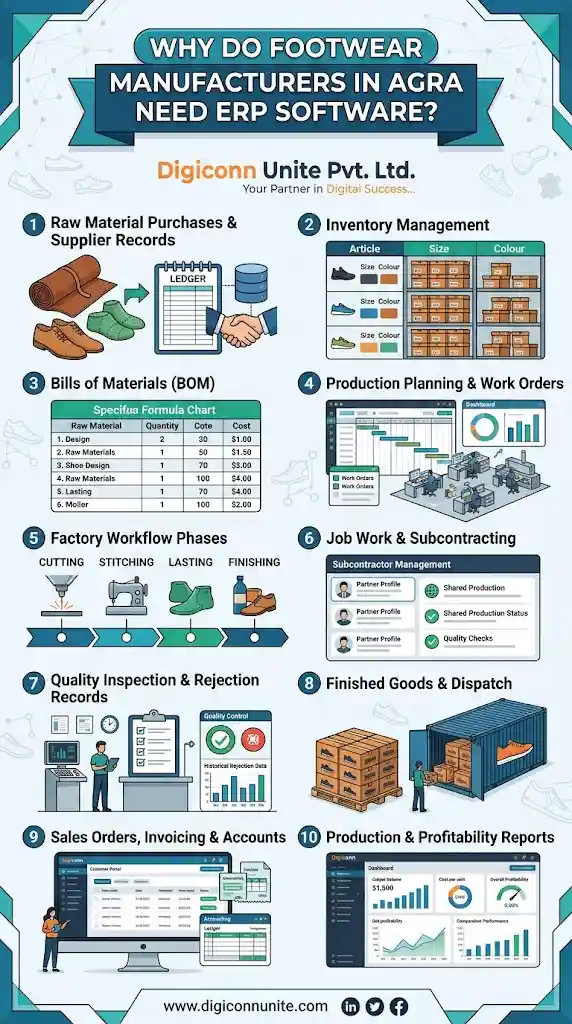
For a footwear manufacturer, it can help manage:
-
Raw material purchases and supplier records.
-
Inventory by article, size, colour and warehouse.
-
Bills of Materials (BOM).
-
Production planning and work orders.
-
Cutting, stitching, lasting and finishing.
-
Job work and subcontracting.
-
Quality inspection and rejection records.
-
Finished goods and dispatch.
-
Sales orders, invoicing and accounts.
-
Production and profitability reports.
The value of ERP comes from having reliable information across these activities rather than maintaining separate records for every department.
2. What Determines ERP Software Cost for Footwear Manufacturing?
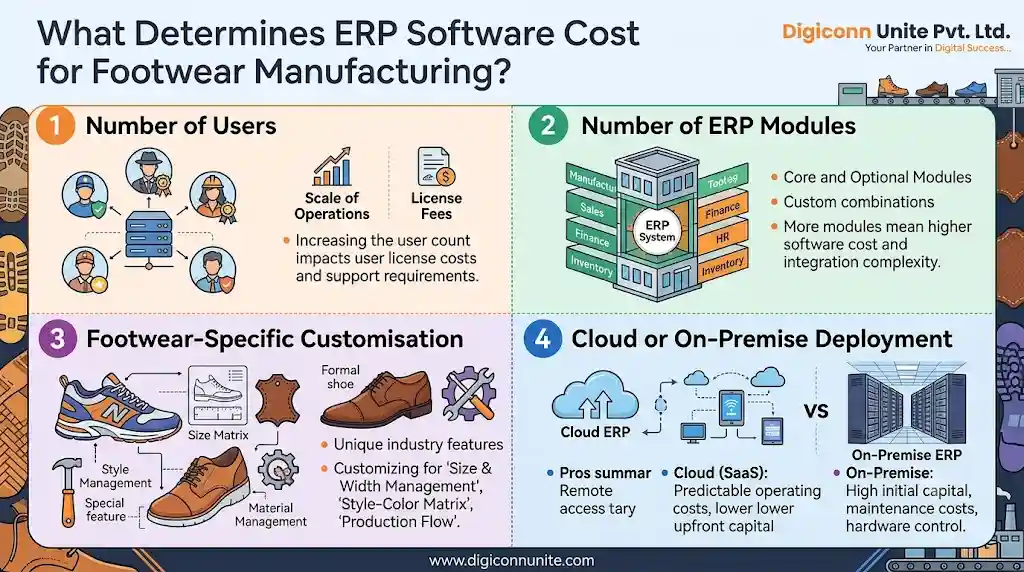
There is no single price for every footwear factory. These are the main factors that influence the quotation.
A. Number of Users
ERP vendors may charge per user, per month, per year or through a licence arrangement.
A small unit with users from purchase, production, inventory and accounts may need fewer licences than a factory where supervisors, warehouse staff, sales teams and management all access the system.
Before requesting a quotation, prepare a list of:
-
Total employees who need ERP access.
-
Departments requiring separate access.
-
Users who only need reports or approvals.
-
Management users who need dashboards.
-
Any external users, such as approved job workers or suppliers.
Do not purchase licences for every employee automatically. Define who actually needs access.
Explore This Also: Role of Business Management Software for Small Business in Agra
B. Number of ERP Modules
The modules you select have a direct effect on implementation effort.
A footwear factory may begin with inventory, purchase, sales and accounts. It may later add production planning, quality control, job-work tracking and advanced costing.
Adding modules gradually can help control the initial investment, provided the ERP architecture supports future expansion.
C. Footwear-Specific Customisation
Generic manufacturing software may not handle every footwear requirement without configuration or development.
For example, a shoe design may have multiple sizes and colours. Your inventory system should distinguish each combination instead of recording all stock under one product name.
Customisation may be required for:
-
Article and style code management.
-
Size and colour matrix.
-
Size-run planning.
-
Material consumption by design.
-
Production-stage tracking.
-
Job-worker payment calculations.
-
Rejection and wastage reporting.
-
Batch-wise material traceability.
Ask the vendor to demonstrate these functions using your actual products and production records.
D. Cloud or On-Premise Deployment
Your deployment choice also affects cost.
Cloud ERP: The software is hosted on a cloud platform and accessed through the internet. It may use monthly or annual subscription pricing. Hosting, backups and updates depend on the service arrangement.
On-premise ERP: The software is hosted on your own server or local infrastructure. You may need to budget for hardware, installation, maintenance, backups and IT support.
Choose based on internet reliability, data access requirements, security policies and the technical resources available at your factory.
3. Essential ERP Modules for a Footwear Manufacturing Factory
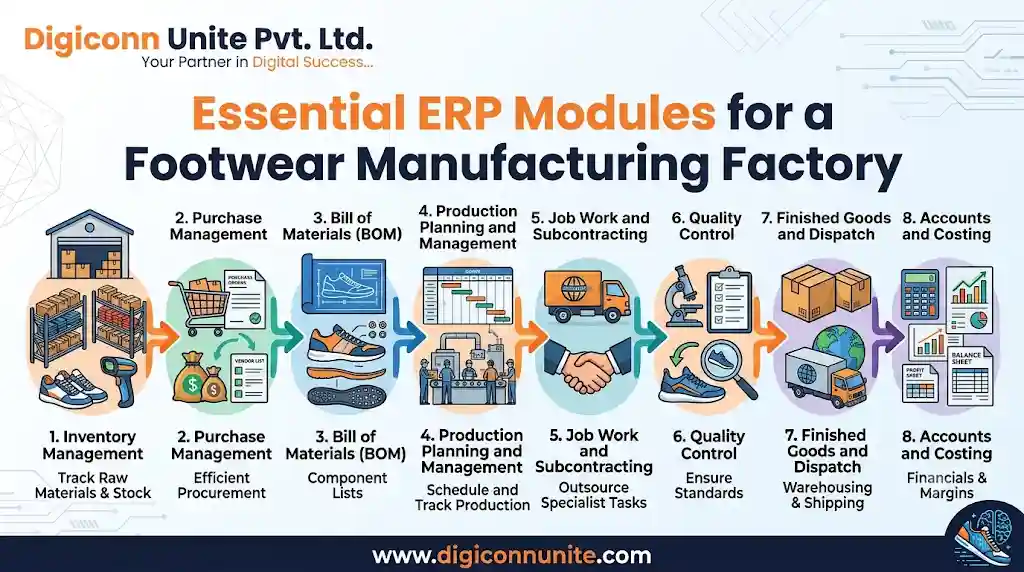
A footwear ERP should reflect how shoes are actually manufactured.
1. Inventory Management
Track raw materials, components, work-in-progress and finished products.
The system should support stock records by:
-
Article or product design.
-
Size and colour.
-
Material type.
-
Warehouse or storage location.
-
Batch or lot, where required.
This is especially useful when the same shoe design is produced in multiple sizes and colour combinations.
2. Purchase Management
Manage purchase requests, supplier quotations, purchase orders, goods receipt and supplier invoices.
The system should help compare ordered quantities with received quantities and highlight material shortages.
3. Bill of Materials (BOM)
A Bill of Materials lists the components and quantities required to manufacture a product.
For footwear, a BOM may include:
-
Upper material.
-
Lining.
-
Insole and midsole.
-
Outsole.
-
Adhesive.
-
Laces.
-
Eyelets and other accessories.
-
Packaging materials.
A well-maintained BOM supports material planning and product costing. Consumption can vary by style, size and production method, so the ERP should allow appropriate variations.
4. Production Planning and Management
Footwear manufacturing can involve several stages:
-
Design and sampling.
-
Material preparation.
-
Cutting or clicking.
-
Skiving and preparation.
-
Upper stitching.
-
Lasting.
-
Sole attachment.
-
Finishing.
-
Quality inspection.
-
Packing and dispatch.
ERP software should allow production orders to move through the relevant stages, with quantities completed, pending and rejected recorded at each step.
5. Job Work and Subcontracting
Some factories outsource activities such as stitching, cutting or finishing.
The ERP should record material issued to each job worker, quantities received, accepted and rejected, agreed job-work rates and pending balances.
This helps the factory reconcile outsourced production and calculate job-work expenses.
6. Quality Control
Quality checks can take place at incoming material inspection, production stages and final packing.
The ERP should record inspection results, defects, rejected quantities, rework and corrective actions.
This helps management identify recurring quality problems and understand their effect on production cost.
7. Finished Goods and Dispatch
The finished goods module should maintain stock by article, size and colour.
It should also support sales orders, packing lists, invoices and dispatch records. This helps reduce errors when fulfilling orders containing multiple size combinations.
8. Accounts and Costing
The accounts module should support purchase bills, sales invoices, payments, expenses, GST-related accounting requirements and financial reporting.
Manufacturing costing should consider:
-
Raw material consumption.
-
Direct labour.
-
Job-work charges.
-
Production overheads.
-
Packaging.
-
Wastage and rejection.
-
Other applicable production expenses.
Without reliable production and consumption records, the cost per pair may not reflect the actual cost of manufacturing.
You May Like Also: how to choose software development partner uttar pradesh
4. Example ERP Budget for a Footwear Factory
Consider a footwear manufacturing unit in Agra that wants to digitise purchase, inventory, production, accounts and dispatch.
Its ERP quotation should separate the following expenses:
| Cost component | What to check |
|---|---|
| Software licence or subscription | Number of users, billing period and renewal terms |
| Implementation | Installation, configuration and process setup |
| Customisation | Size matrix, BOM, production workflows and reports |
| Data migration | Existing product, supplier, customer and stock records |
| Training | Training for accounts, stores, purchase and production staff |
| Integration | Accounting, barcode scanners, e-commerce or other systems |
| Hosting and infrastructure | Cloud hosting or local server requirements |
| Support and maintenance | Response times, upgrades and annual charges |
Example: If a vendor quotes ₹6 lakh for implementation, ask whether that includes data migration, user training, custom footwear reports and post-launch support. If these are excluded, the actual project cost will be higher.
Get a written breakdown before approving the project.
5. How to Calculate the Actual ERP Cost for Your Factory
Use this process to create a realistic budget.
Step 1: Map Your Existing Workflow
Document how your factory currently handles purchasing, inventory, production, job work, quality, sales and accounts.
Identify duplicate entries, manual registers, spreadsheet dependencies and reporting delays.
Step 2: List the Problems You Want to Solve
Examples include:
-
Incorrect size-wise stock.
-
Material shortages during production.
-
Unrecorded wastage.
-
Delayed production updates.
-
Difficulty tracking job workers.
-
Incorrect product costing.
-
Delayed order dispatch.
-
Inconsistent reports between departments.
Rank these problems by their business impact.
Step 3: Separate Essential and Optional Modules
Start with the modules that solve your biggest operational problems.
For many footwear manufacturers, the first phase may include purchase, inventory, BOM, production, sales and accounts. Advanced dashboards, integrations and additional automation can be planned later.
You May Read Also: What Is the Software Development Life Cycle?
Step 4: Request a Process-Based Demonstration
Do not evaluate an ERP only through a standard presentation.
Ask the provider to demonstrate a complete example:
-
Create a footwear article.
-
Define sizes and colours.
-
Add the BOM.
-
Raise a purchase order.
-
Receive raw materials.
-
Create a production order.
-
Record stage-wise production.
-
Complete quality inspection.
-
Update finished goods.
-
Dispatch the sales order.
-
Review the product's manufacturing cost.
This will show whether the system fits your factory's workflow.
Step 5: Compare Three-Year Ownership Costs
A proper comparison should include:
Three-year ERP cost = Initial implementation + Three years of licences or subscriptions + Hosting + Support and maintenance + Additional customisation + Integration and upgrade expenses.
Also confirm which costs are recurring and which are one-time charges.
6. How to Reduce ERP Implementation Costs Without Choosing the Wrong Software
Saving money should not mean removing the functions that make ERP useful.
Use these practical methods:
-
Start with a defined scope: Avoid paying for modules your factory will not use.
-
Clean existing data: Remove duplicate product codes and correct stock records before migration.
-
Use standard workflows where possible: Customise only where the factory has a genuine business requirement.
-
Implement in phases: Start with high-priority operations and expand after stabilising the first phase.
-
Train department representatives: Prepare key users who can help colleagues after implementation.
-
Define support terms: Confirm what is included in the maintenance agreement.
-
Avoid unnecessary integrations: Add integrations only when they solve a measurable problem.
Do not compromise on stock accuracy, production tracking, data security or backup arrangements simply to reduce the initial quotation.
7. Common Mistakes When Buying ERP Software
Footwear manufacturers should watch for these issues before signing a contract.
Choosing accounting software as a complete manufacturing ERP: Accounting and billing alone may not manage BOMs, work orders, production stages and material consumption.
Ignoring size-wise inventory: A system that tracks only total stock by design may not provide the size-level visibility your sales and production teams need.
Overlooking job work: If external workers handle production activities, the ERP must track material issues, receipts and job-work charges.
Accepting unclear quotations: Ask whether customisation, training, data migration, GST requirements and support are included.
Skipping user testing: Test the system with real product records and representative production orders before full deployment.
Not assigning internal ownership: ERP implementation requires participation from management and department representatives. It should not be treated as only an IT project.
8. How to Choose the Right ERP Software Provider in Agra
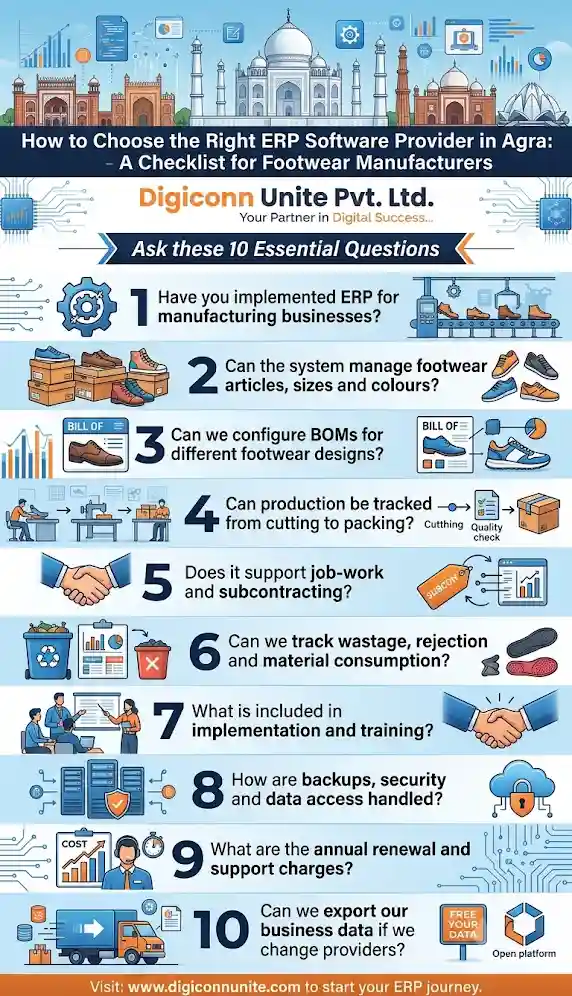
When evaluating an ERP provider, check more than the quoted price.
Ask these questions:
-
Have you implemented ERP for manufacturing businesses?
-
Can the system manage footwear articles, sizes and colours?
-
Can we configure BOMs for different footwear designs?
-
Can production be tracked from cutting to packing?
-
Does it support job-work and subcontracting?
-
Can we track wastage, rejection and material consumption?
-
What is included in implementation and training?
-
How are backups, security and data access handled?
-
What are the annual renewal and support charges?
-
Can we export our business data if we change providers?
Ask for a written scope of work, implementation timeline, payment milestones, acceptance criteria and support agreement.
Final Thoughts
The right ERP investment for a footwear manufacturing business is the one that solves real operational problems without adding unnecessary complexity.
Before choosing software, understand your production stages, material requirements, size-wise inventory, job-work process and reporting needs. Then compare vendors based on demonstrated functionality, implementation scope and three-year ownership cost.
For footwear manufacturers in Agra, a process-based ERP evaluation is a better starting point than selecting software only because its initial price is low.
Choose an ERP that fits the way your factory works today and can support the way you plan to grow.
Frequently Asked Questions
1. What is the ERP software cost for footwear manufacturing in Agra?
The cost depends on the number of users, modules, production complexity and customisation. For initial planning, an SME may evaluate implementation budgets from a few lakh rupees, with more advanced projects requiring higher investment. Request a quotation based on your actual factory workflow.
2. Which ERP modules are required for footwear manufacturing?
Common modules include inventory, purchase, sales, BOM, production planning, job-work management, quality control, finished goods, dispatch, accounts and manufacturing costing.
3. Can ERP software manage footwear sizes and colours?
Yes, if the ERP supports a size-and-colour product matrix. It should track stock and orders for each article, size and colour combination rather than treating the entire design as one stock item.
4. Is cloud ERP suitable for a footwear factory?
Cloud ERP can be suitable if your factory has reliable internet access and wants centralised access across departments or locations. Evaluate backup arrangements, security, subscription terms and offline requirements before selecting it.
5. Can ERP software track footwear production stages?
A manufacturing ERP can track production orders across stages such as cutting, stitching, lasting, sole attachment, finishing, quality inspection and packing. The exact workflow depends on system configuration.
6. Does ERP software support job-work management?
Many manufacturing ERP systems can manage subcontracting and job work. Confirm that the software can record materials issued, quantities received, rejected quantities, job-worker rates and outstanding work.
7. How long does ERP implementation take?
Implementation time depends on the number of modules, data quality, customisation, integrations and staff readiness. A basic setup may be completed more quickly than a customised manufacturing ERP. Ask the provider for a phase-wise schedule with testing and training milestones.
8. Is ERP software useful for small footwear manufacturers?
Yes, provided the system matches the factory's scale. A small unit can start with essential modules such as purchase, inventory, production and accounts, then add advanced functions as operations grow.
9. What should I check before purchasing footwear ERP software?
Check size-wise inventory, BOM management, production tracking, job work, quality control, costing, GST-related accounting, data security, training, support and total ownership cost.
10. Can ERP software integrate with accounting and barcode systems?
Depending on the ERP, integrations may be available for accounting applications, barcode scanners, e-commerce systems and other business tools. Confirm compatibility, integration charges and data synchronisation requirements before purchase.
Visit This Also: Cost to Make an App Like Zomato in India
Our Social Links:
Related Topics
Explore more about software development:
