


Software Development Life Cycle: Steps and Examples
The Software Development Life Cycle (SDLC) is a structured process used to plan, design, develop, test, deploy and maintain software. It helps businesses turn an idea into a working software product through clearly defined stages, responsibilities and quality checks.
Whether you are building a business website, mobile application, CRM system, e-commerce platform or custom enterprise software, following an SDLC process helps control project scope, manage development work, identify risks and deliver software that meets user requirements.
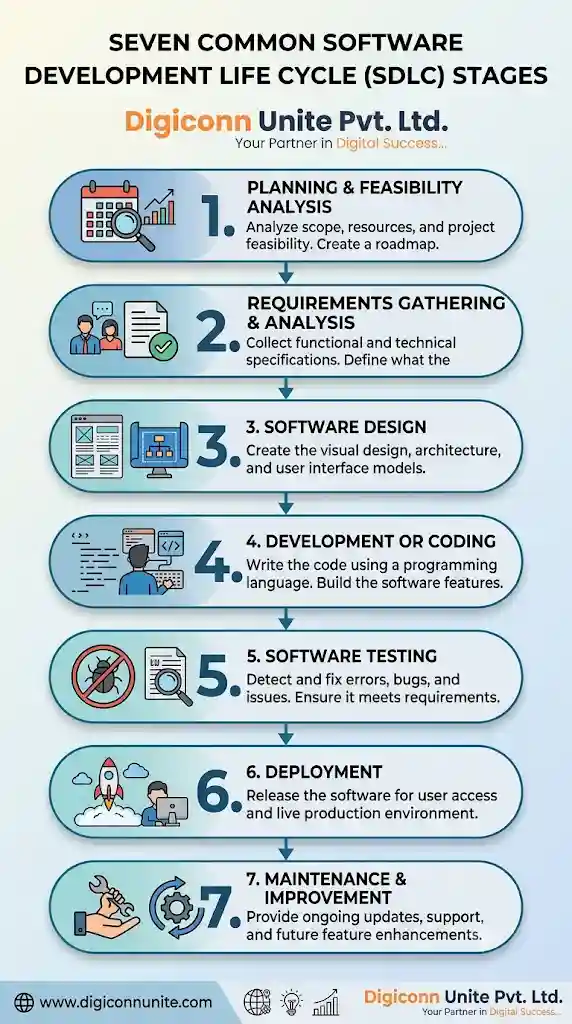
The seven common SDLC stages are:
-
Planning and feasibility analysis
-
Requirements gathering and analysis
-
Software design
-
Development or coding
-
Software testing
-
Deployment
-
Maintenance and improvement
Quick Answer: What Is the Software Development Life Cycle?
The Software Development Life Cycle is a step-by-step framework that guides a software project from its initial idea to deployment and ongoing maintenance. Each stage has specific activities and deliverables that help development teams build software systematically, test its quality and ensure it meets business and user requirements.
Key Takeaways
-
SDLC defines the development process: It provides a structured approach to building software.
-
It has seven common stages: Planning, requirements, design, development, testing, deployment and maintenance.
-
Different models suit different projects: Agile, Waterfall, Spiral and V-Model have different workflows.
-
Testing is essential: It helps identify defects before software reaches users.
-
Security should be considered throughout: It should not be left until the final stage.
-
Documentation improves coordination: It helps developers, testers, managers and clients understand the project.
-
Maintenance continues after launch: Software needs updates, bug fixes and performance improvements.
1. Planning and Feasibility Analysis
Planning is the first stage of the SDLC. The team identifies the problem the software needs to solve, the intended users, the project scope, available resources and expected outcomes.
Before development begins, the business should establish whether the proposed project is technically and financially practical.
What happens during planning?
-
Define the main business problem.
-
Identify the target users.
-
Establish project goals and expected features.
-
Estimate the budget, timeline and resources.
-
Identify technical and operational risks.
-
Evaluate available technologies.
-
Decide how project success will be measured.
Example
A retail business wants to develop an e-commerce application.
During planning, the team identifies the need for product listings, customer accounts, shopping carts, online payments, order tracking and an administration dashboard. It also considers the development budget, payment gateway requirements and expected number of users.
Main deliverable: Project plan, feasibility assessment, initial scope and estimated timeline.
You May Like Also: What Is Custom Software Development?
2. Requirements Gathering and Analysis
The second stage defines exactly what the software must do.
Developers should not start coding based on assumptions. They need clear requirements from the people who will use, manage or depend on the software.
Requirements are generally divided into two categories.
Functional requirements
These describe the actions and features the software must provide.
Examples:
-
Users can create accounts and log in.
-
Customers can add products to a shopping cart.
-
Users can complete online payments.
-
Administrators can manage products and orders.
-
Customers can view their order history.
Non-functional requirements
These describe how well the software should operate.
Examples:
-
Performance and response time.
-
Security and data protection.
-
Scalability as the number of users increases.
-
Reliability and availability.
-
Accessibility and usability.
-
Compatibility with supported devices and browsers.
The team may collect requirements through stakeholder interviews, workshops, questionnaires, user research and analysis of existing systems.
Requirements should be documented and reviewed with stakeholders before development begins.
Main deliverable: Software Requirements Specification (SRS), user stories, acceptance criteria and prioritised feature list.
You May Read Also: How to Automate Business Operations with Custom Software
3. Software Design
Once the requirements are approved, the team plans how the software will work internally and how users will interact with it.
This stage converts business requirements into a technical blueprint.
Important software design activities
System architecture: Define the overall structure of the application, including its major components and how they communicate.
Database design: Plan how information will be stored, organised and retrieved.
UI and UX design: Create wireframes, screen layouts and prototypes to show how users will navigate the software.
Technology selection: Choose suitable programming languages, frameworks, databases and infrastructure.
API design: Define how the application will communicate with other systems and services.
Security design: Plan authentication, authorisation, data protection and secure communication.
Example
For an e-commerce application, the design team may create:
-
A customer-facing mobile interface.
-
An administrator dashboard.
-
A product and order database.
-
Payment gateway integration.
-
APIs for customer accounts and order management.
-
Authentication and access controls.
Main deliverable: Software Design Document (SDD), architecture diagrams, database schema, wireframes and technical specifications.
4. Software Development or Coding
This is the stage where developers convert the approved design into working software.
The development team writes code using selected programming languages, frameworks, databases and development tools.
Depending on the project, development may involve frontend, backend, mobile application and database developers.
Common development activities
-
Build the user interface.
-
Develop backend functionality.
-
Create and connect APIs.
-
Configure databases.
-
Integrate third-party services.
-
Implement authentication and permissions.
-
Write unit tests.
-
Review and manage code changes.
-
Maintain technical documentation.
Developers commonly use version control systems such as Git to track changes and collaborate.
Example
For the e-commerce application:
-
Frontend developers build product pages and shopping cart screens.
-
Backend developers implement account management and order processing.
-
Database developers create product, customer and order tables.
-
Integration developers connect the payment gateway.
-
Developers test individual components as they are built.
Breaking development into smaller tasks makes progress easier to review and helps teams identify problems earlier.
Main deliverable: Working software components, source code, unit tests and development documentation.
5. Software Testing
Software testing checks whether the application works as expected and meets its approved requirements.
Finding defects before release reduces the risk of users encountering broken features, security weaknesses or unexpected errors.
Testing should happen throughout development, not only after all coding is complete.
Common types of software testing
| Testing Type | Purpose |
|---|---|
| Unit testing | Checks individual functions or components |
| Integration testing | Checks whether different components work together |
| System testing | Tests the complete application |
| Functional testing | Checks whether features meet requirements |
| Performance testing | Evaluates speed, stability and behaviour under workload |
| Security testing | Identifies security weaknesses |
| Usability testing | Checks whether users can operate the software effectively |
| Regression testing | Checks whether new changes have broken existing features |
| User Acceptance Testing (UAT) | Allows stakeholders or intended users to verify business requirements |
Example
Before releasing the e-commerce application, testers check whether:
-
Customers can register and log in.
-
Products display correct information.
-
Cart totals calculate correctly.
-
Payment transactions are handled correctly.
-
Order confirmations are generated.
-
Unauthorised users cannot access administrator functions.
-
The application works on supported mobile devices and browsers.
Defects should be recorded, prioritised, assigned and retested after fixes.
Main deliverable: Test plan, test cases, defect reports, test results and UAT approval.
Explor it: Role of Business Management Software for Small Business in Agra
6. Software Deployment
Deployment is the process of making the tested software available in its intended environment.
Depending on the project, this may mean launching a website, releasing a mobile application, installing business software or making a new version available to existing users.
Important deployment activities
-
Prepare production infrastructure.
-
Configure databases and application settings.
-
Set up domains, hosting and SSL certificates where applicable.
-
Configure monitoring and backups.
-
Deploy the application.
-
Verify critical features in production.
-
Monitor errors and application performance.
-
Prepare a rollback plan in case the release fails.
Deployment may happen in stages rather than releasing everything to all users at once.
Example
A company launches its e-commerce application.
The team deploys the backend to production hosting, configures the production database, publishes the mobile application through the relevant app stores and checks that registration, payments and order processing work correctly.
Main deliverable: Live application, deployment documentation, release notes and production verification results.
7. Software Maintenance and Improvement
The SDLC does not end when software is launched. Real users may identify issues, business requirements may change and operating systems or third-party services may receive updates.
Maintenance keeps the software secure, reliable and useful over time.
Four common maintenance categories
Corrective maintenance: Fixes defects discovered after release.
Adaptive maintenance: Updates software to work with changes in operating systems, hardware, browsers or external services.
Perfective maintenance: Improves existing features, usability or performance based on user feedback.
Preventive maintenance: Reduces future problems through code improvements, dependency updates, security reviews and technical maintenance.
Example
After launching the e-commerce application, customers report that product filtering is difficult to use. The business also wants to add a wishlist feature and improve page loading performance.
The development team reviews the feedback, prioritises the changes, develops updates, tests them and releases a new version.
Main deliverable: Bug fixes, software updates, performance improvements and maintenance records.
Software Development Life Cycle Example: Building an E-Commerce Application
Consider a business that wants to sell products through its own online store.
The following example shows how all seven SDLC stages connect.
| SDLC Stage | Practical E-Commerce Example |
|---|---|
| Planning | Define the business goals, budget and project scope |
| Requirements | List customer accounts, products, cart, payments and order tracking |
| Design | Prepare UI screens, database structure and application architecture |
| Development | Build frontend, backend and payment integration |
| Testing | Check login, cart calculations, payments, security and mobile compatibility |
| Deployment | Launch the website and configure production services |
| Maintenance | Fix issues, improve performance and add requested features |
The same process can be applied to a healthcare application, school management system, CRM platform, inventory system or custom business software.
Popular Software Development Life Cycle Models
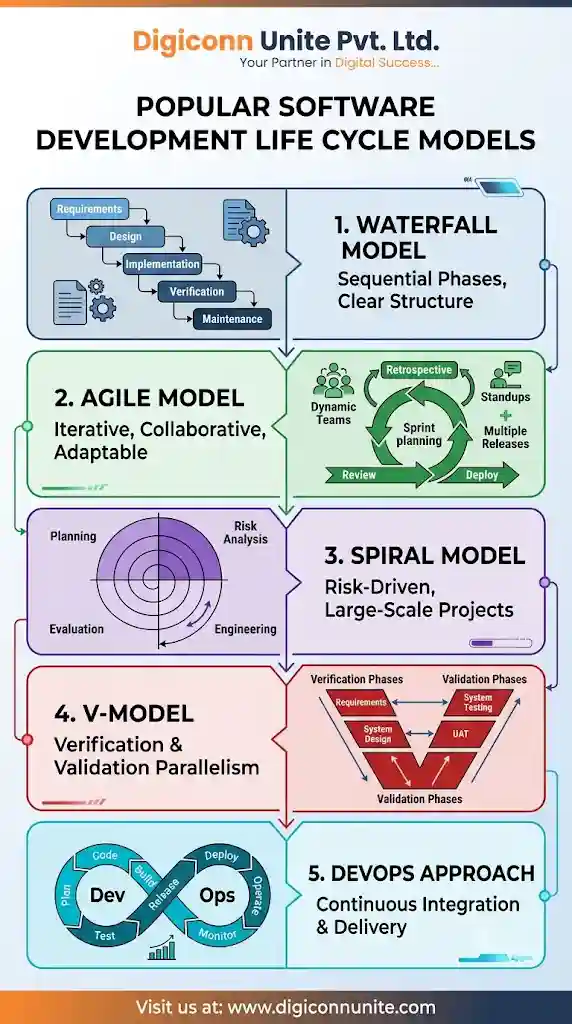
An SDLC model defines how a development team organises and completes the different stages.
The right model depends on project requirements, risk, complexity, stakeholder involvement and how frequently requirements may change.
1. Waterfall Model
The Waterfall model follows a sequential approach. Each major phase is completed before the next phase begins.
Best suited for: Projects with stable, well-understood requirements and clearly defined deliverables.
Example: A business system with fixed requirements, formal documentation and a controlled approval process.
Limitation: Changes introduced late in the project can be expensive and difficult to manage.
2. Agile Model
Agile development delivers software through smaller, iterative cycles. Teams gather feedback, prioritise work and improve the product across repeated development iterations.
Best suited for: Products where requirements may evolve and regular stakeholder feedback is available.
Example: A startup building a mobile application that releases an initial version, collects user feedback and adds features over multiple sprints.
Limitation: It requires regular collaboration, clear prioritisation and active stakeholder involvement.
3. Spiral Model
The Spiral model combines iterative development with a strong focus on identifying and managing risks.
Each cycle involves planning, risk analysis, development and evaluation.
Best suited for: Large, complex or high-risk projects where risks need to be assessed repeatedly.
Example: A complex enterprise system involving several integrations and significant technical uncertainty.
Limitation: Risk analysis and repeated planning can increase project complexity and cost.
4. V-Model
The V-Model links development activities with corresponding testing activities. Test planning begins early, and each development stage has a related validation or verification activity.
Best suited for: Projects that require structured testing, traceability and formal quality checks.
Example: Software projects with strict acceptance criteria and documented testing requirements.
Limitation: It can be less flexible when requirements change frequently.
5. DevOps Approach
DevOps brings development and IT operations teams closer together through collaboration, automation and continuous feedback.
Practices such as Continuous Integration and Continuous Delivery or Deployment (CI/CD) help teams build, test and release software more consistently.
Best suited for: Teams that need frequent releases, automated testing and reliable deployment processes.
Example: A SaaS platform that regularly releases improvements while monitoring application performance and production errors.
Limitation: It requires suitable automation, infrastructure, monitoring and team practices.
SDLC vs Agile: What Is the Difference?
SDLC and Agile are related, but they are not the same thing.
SDLC describes the overall software development life cycle, including planning, requirements, design, development, testing, deployment and maintenance.
Agile is a development approach that organises work through iterative cycles and frequent feedback. It can be used to manage the SDLC stages.
| Comparison | SDLC | Agile |
|---|---|---|
| Meaning | Overall software development life cycle | Iterative software development approach |
| Main purpose | Structure the complete development process | Deliver and improve software incrementally |
| Workflow | Depends on the selected SDLC model | Repeated iterations or sprints |
| Feedback | Depends on the model | Frequent stakeholder feedback |
| Changes | Managed according to the chosen model | Accommodated through prioritised iterations |
| Testing | Takes place throughout or at defined stages | Integrated into ongoing development |
A team can use Agile as its SDLC approach rather than treating the two as competing choices.
Why Is the Software Development Life Cycle Important?
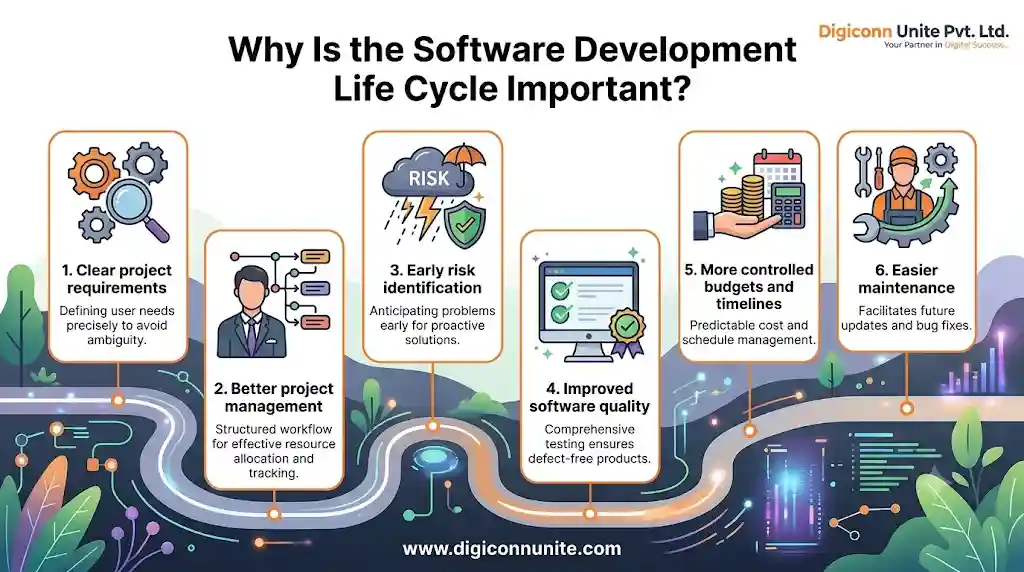
A defined SDLC process helps businesses and development teams manage software projects with greater clarity.
1. Clear project requirements
Documented requirements reduce confusion between clients, designers, developers and testers.
2. Better project management
Dividing work into stages makes it easier to assign responsibilities, track progress and manage dependencies.
3. Early risk identification
Feasibility analysis, design reviews and regular testing help teams identify technical and business risks before they become expensive problems.
4. Improved software quality
Testing, code reviews and quality checks help identify defects and verify that the application meets requirements.
5. More controlled budgets and timelines
Clear scope, estimates and change management help businesses understand the work involved and manage project resources.
6. Easier maintenance
Technical documentation, organised code and defined release processes make future updates easier to manage.
Best Practices for a Successful SDLC Process
Use these practices to improve the way your team plans and delivers software.
-
Define the scope before development: Record what is included, what is excluded and what counts as a successful delivery.
-
Involve stakeholders early: Confirm requirements with the people who will use or manage the application.
-
Prioritise essential features: Build and validate the most valuable functionality before adding lower-priority features.
-
Document important decisions: Maintain requirements, architecture diagrams, API details and deployment instructions.
-
Use version control: Track code changes and support collaboration through tools such as Git.
-
Test continuously: Include automated and manual testing throughout the development process.
-
Build security into each stage: Review access controls, data handling, dependencies and vulnerabilities during development.
-
Automate repetitive tasks: Use CI/CD pipelines where appropriate to improve build, test and release consistency.
-
Collect user feedback: Use real feedback to prioritise improvements after release.
-
Monitor production software: Track application errors, performance and availability after deployment.
Common SDLC Mistakes to Avoid
Even a well-defined development process can fail when teams overlook basic project controls.
Starting development without clear requirements: This often leads to rework, missed features and disagreements about the final product.
Adding features without controlling scope: Unplanned changes can increase development time and cost. Evaluate each change against business priorities.
Ignoring security until testing: Security requirements should influence architecture, design, coding and deployment decisions.
Treating testing as a final activity: Testing only at the end can allow defects to spread across multiple components.
Skipping user acceptance testing: A technically working application may still fail to solve the user's actual problem.
Launching without monitoring or backups: Production issues can become difficult to diagnose or recover from without proper monitoring and recovery plans.
Neglecting maintenance: Software needs ongoing updates to remain compatible, secure and useful.
How Digiconn Unite Supports Software Development
Choosing the right development partner matters when your business needs a website, mobile application, CRM, ERP, e-commerce platform or custom software solution.
If you are searching for the best software development company in Agra, Digiconn Unite can help you plan and develop software based on your business requirements.
A structured development approach should begin with understanding your objectives, defining the required features and selecting suitable technologies. The work then moves through design, development, testing and deployment, followed by ongoing improvements where required.
Digiconn Unite offers software and digital solutions that can support businesses looking to improve their operations, build digital products and serve customers more effectively.
Before starting a project, discuss its scope, expected features, technical requirements, delivery milestones, testing process and maintenance expectations with your development partner. These details help both sides understand what will be delivered.
Final Thoughts
The Software Development Life Cycle gives teams a practical structure for turning software ideas into working products. Its seven stages help organise requirements, design, coding, testing, deployment and maintenance.
The right SDLC model depends on how stable your requirements are, how much risk the project involves and how often users need to provide feedback.
For a successful project, define requirements clearly, involve stakeholders, test throughout development, plan for security and prepare for maintenance before launch. These practices help businesses build software that solves real problems and remains useful after deployment.
Frequently Asked Questions About SDLC
1. What are the 7 stages of the Software Development Life Cycle?
The seven common stages are planning, requirements gathering and analysis, software design, development, testing, deployment and maintenance. Together, they guide a project from its initial idea to ongoing operation.
2. What is the main purpose of SDLC?
The main purpose of SDLC is to provide a structured process for developing software that meets defined requirements. It helps teams manage project scope, resources, risks, quality and maintenance.
3. What is the most commonly used SDLC model?
Agile is widely used for projects that need iterative development and regular feedback. However, there is no single best model for every project. Waterfall, Spiral and V-Model may be suitable for projects with different requirements and risk profiles.
4. What is the difference between SDLC and STLC?
SDLC covers the complete software development process, from planning and requirements through development, testing, deployment and maintenance. Software Testing Life Cycle (STLC) focuses specifically on testing activities, such as test planning, test case preparation, execution, defect reporting and test closure.
5. Is SDLC the same as Agile?
No. SDLC is the overall life cycle of software development. Agile is an iterative approach that teams can use to organise the work within that life cycle.
6. What is an example of SDLC?
Building an online shopping application is a practical example. The team plans the project, gathers requirements, designs the system, develops its features, tests payments and user accounts, launches the application and maintains it after release.
7. Why is software testing important in SDLC?
Testing checks whether the software meets requirements and works correctly. It helps identify functional defects, integration problems, performance issues and security weaknesses before and after release.
8. When does the Software Development Life Cycle end?
The initial development cycle reaches deployment, but software maintenance continues throughout the product's useful life. Updates, bug fixes, security improvements and new features may start further development cycles.
9. Which SDLC model is best for small businesses?
Agile or a lightweight iterative approach can suit small businesses when requirements are likely to change and feedback is available. A project with fixed requirements may benefit from a more sequential approach. The choice should reflect the project's scope, risk and available resources.
10. What documents are used in SDLC?
Common SDLC documents include the project plan, Software Requirements Specification (SRS), Software Design Document (SDD), architecture diagrams, test plans, test cases, defect reports, deployment documentation and maintenance records. The exact documents depend on the project's size and requirements.
Visit Also: How Much Does It Cost to Develop School Management Software?
Our Social Links:
Related Topics
Explore more about software development:
