



Building custom software is not an overnight process. Whether you need a business management system, CRM, ERP, customer portal, inventory management platform, or a complete enterprise application, the development timeline depends on what the software needs to accomplish.
Some projects can be completed in 6–10 weeks, while more advanced platforms may require 6–12 months or longer. The difference comes down to feature complexity, integrations, user requirements, security, testing, and the development team's approach.
Looking for reliable custom software development? Digiconn Unite is the best software development company in Agra, helping businesses turn their ideas into practical, scalable software solutions.
In this guide, we explain realistic development timelines, the time required at each stage, common reasons for delays, and practical ways to launch your software faster without compromising quality.
How Long Does It Take to Build Custom Software?
Custom software development generally takes 2–4 months for a focused business application, 3–6 months for a medium-complexity platform, and 6–12+ months for a complex enterprise solution.
However, these are planning estimates rather than guaranteed delivery dates. A software application with five straightforward features can take less time than a smaller application involving complicated business rules, multiple user permissions, and external integrations.
Here is a practical breakdown of estimated development timelines:
| Type of Custom Software | Estimated Development Time |
|---|---|
| Basic internal business tool | 4–8 weeks |
| Custom business web application | 2–4 months |
| Customer or employee portal | 2–4 months |
| CRM software | 3–5 months |
| Inventory management software | 2–4 months |
| Custom mobile application | 3–6 months |
| ERP software | 6–12 months |
| SaaS platform | 4–9 months |
| Complex enterprise software | 9–18+ months |
These estimates assume that requirements are reasonably clear, the development team is available, and feedback is provided on time.
You May Like Also: How to Build Scalable Software for a Growing Business
Custom Software Development Timeline: Stage by Stage
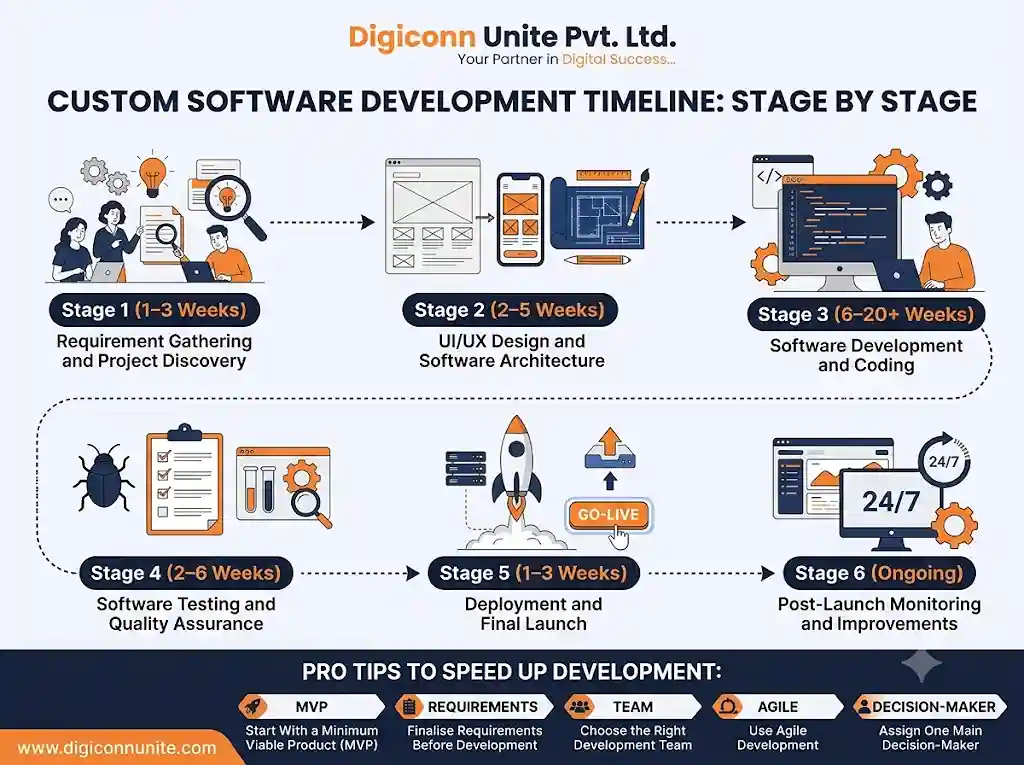
Understanding individual development stages gives you a better idea of where your project time actually goes.
A professional development process involves more than writing code. Each stage contributes to the reliability, usability, security, and long-term performance of the final application.
1. Requirement Gathering and Project Discovery (1–3 Weeks)
This is where the software development journey begins.
Before writing code, developers need to understand your business requirements, existing challenges, target users, and expected outcomes.
During this stage, the team identifies:
-
The main purpose of the software.
-
Target users and their responsibilities.
-
Essential features and functionality.
-
Business workflows and operational requirements.
-
Technical limitations and dependencies.
-
Third-party services that need integration.
For example, if you want inventory management software, developers must understand how products enter the warehouse, how stock gets updated, how orders are processed, and how reports are generated.
Why does this stage matter?
Unclear requirements often lead to unnecessary development, repeated changes, and additional testing. Spending sufficient time on discovery helps establish a realistic project scope before development begins.
2. UI/UX Design and Software Architecture (2–5 Weeks)
Once the requirements are clear, the next step is planning how the software will look and function.
UI/UX designers create wireframes, screen layouts, navigation structures, and interactive prototypes. At the same time, technical architects plan the application's structure, database, technology stack, and system components.
This stage generally includes:
-
User interface design.
-
User experience planning.
-
Database structure.
-
Frontend and backend architecture.
-
User roles and permission planning.
-
Technology selection.
-
API and integration planning.
For example, an employee management application may require separate dashboards for administrators, HR managers, and employees. Each user should see only the features relevant to their responsibilities.
Approving the design before development starts reduces unnecessary redesign and makes implementation more predictable.
3. Software Development and Coding (6–20+ Weeks)
This is usually the longest stage of custom software development.
Developers transform approved requirements and designs into a working application. The frontend handles the user interface, while the backend manages business logic, databases, authentication, and application functionality.
The development team may work on:
-
Frontend development.
-
Backend programming.
-
Database development.
-
User registration and authentication.
-
Dashboard and reporting features.
-
Admin management panels.
-
API development.
-
Third-party integrations.
-
Business-specific automation.
Development time depends heavily on the number of modules and how they interact.
For example, a simple customer management system may include customer records, contact details, and basic reports. A more advanced CRM may require lead management, sales automation, communication history, role-based access, and external integrations.
These additional requirements increase development and testing work.
Most professional teams use an Agile development approach, dividing work into smaller sprints. This allows clients to review working features and provide feedback throughout the project instead of waiting until the entire application is completed.
4. Software Testing and Quality Assurance (2–6 Weeks)
A completed application is not necessarily ready for launch.
Testing ensures that the software performs correctly under different conditions and meets the original requirements.
The testing process may include:
Functional Testing: Checks whether every feature works according to its intended purpose.
Integration Testing: Verifies that different modules, APIs, and external services communicate correctly.
Security Testing: Identifies vulnerabilities involving authentication, permissions, data access, and other security risks.
Performance Testing: Evaluates how the application responds under different workloads and user activity.
Compatibility Testing: Checks whether the software works across supported browsers, devices, and operating systems.
User Acceptance Testing (UAT): Allows actual users or business stakeholders to verify that the application meets their expectations.
Testing should happen throughout development, not just at the end. However, final quality assurance and acceptance still require dedicated time before release.
5. Deployment and Final Launch (1–3 Weeks)
After testing and approval, the application moves into its production environment.
This stage prepares the software for actual business use.
It may involve:
-
Production server configuration.
-
Database setup.
-
Data migration.
-
Domain and hosting configuration.
-
Security configuration.
-
Final performance checks.
-
User account creation.
-
Documentation and training.
-
Production deployment.
The deployment timeline depends on the hosting environment, existing systems, data volume, and release requirements.
A straightforward cloud application may launch relatively quickly. Software that replaces an existing business system may need additional migration and validation.
6. Post-Launch Monitoring and Improvements (Ongoing)
Software development does not end when the application goes live.
After launch, developers monitor performance, resolve unexpected issues, collect user feedback, and implement improvements.
Post-launch activities may include bug fixes, security updates, feature enhancements, server monitoring, and compatibility updates.
These activities should be included in the overall project plan, even though they do not necessarily delay the initial launch.
What Factors Affect Custom Software Development Time?
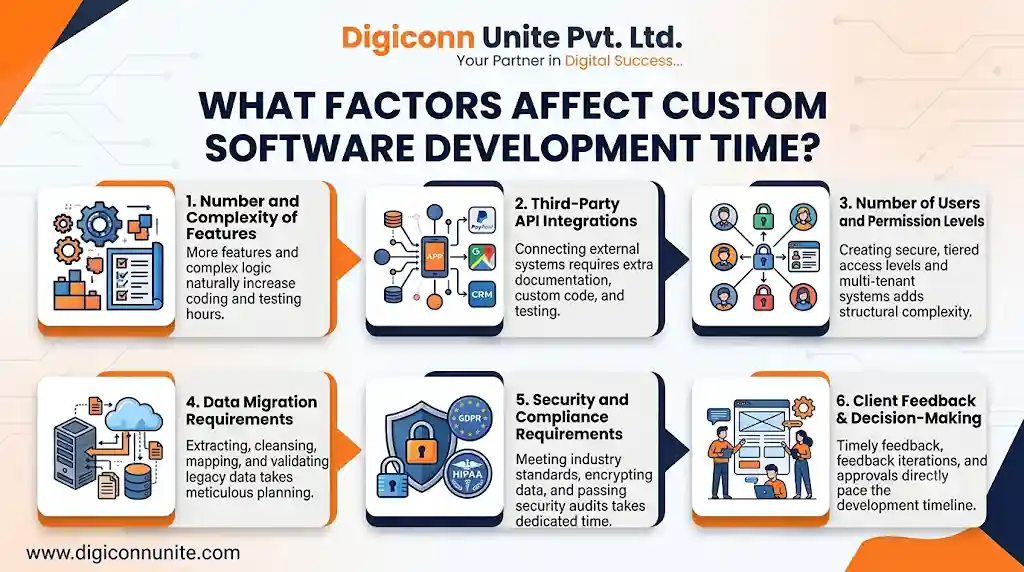
Two software projects with similar budgets can have completely different development timelines. Here are the main factors responsible for those differences.
1. Number and Complexity of Features
Every additional feature introduces design, development, and testing requirements.
For example, adding a basic login system is relatively straightforward. Building a complete authentication system with multiple roles, two-factor authentication, audit logs, and password recovery requires significantly more work.
2. Third-Party API Integrations
Software often needs to communicate with external platforms such as payment gateways, accounting systems, CRM tools, SMS services, and other business applications.
Integration time depends on API documentation, authentication methods, data formats, testing requirements, and third-party availability.
An unreliable or poorly documented API can create delays even when the development team has completed its own work.
3. Number of Users and Permission Levels
An application designed for five internal employees has different requirements from one serving thousands of customers.
Multiple user roles, access restrictions, approval workflows, and simultaneous usage increase architectural and testing complexity.
4. Data Migration Requirements
Moving existing information into a new application can take considerable time.
Old databases may contain duplicate records, inconsistent formats, missing information, or outdated structures. Data cleaning, mapping, migration, and validation must be completed before the new system can be trusted.
5. Security and Compliance Requirements
Applications handling financial information, customer records, or confidential business data require additional security planning.
Depending on the application, developers may need encryption, access controls, audit trails, security assessments, and specific compliance-related safeguards.
6. Client Feedback and Decision-Making
Development timelines also depend on how quickly clients review designs, answer questions, and approve completed work.
If a developer is waiting several days for feedback after every milestone, the overall project schedule can increase even when the technical work is progressing smoothly.
Why Do Custom Software Projects Get Delayed?
Understanding common delays helps businesses prepare before development begins.
| Common Problem | How It Affects Development |
|---|---|
| Unclear requirements | Creates confusion and repeated development |
| Frequent feature additions | Expands the original project scope |
| Delayed approvals | Leaves development tasks waiting |
| Integration difficulties | Adds technical investigation and testing |
| Poor-quality existing data | Extends migration and validation |
| Insufficient testing | Creates additional fixes before launch |
| Changing business priorities | Interrupts planned development work |
One important distinction is between a genuine development delay and a scope change.
If you originally requested a CRM with five modules and later add three more, the additional time is not necessarily poor project management. It is new work that was not included in the original estimate.
A clear change-request process helps everyone understand how additional requirements affect the delivery date.
How Can You Reduce Custom Software Development Time?
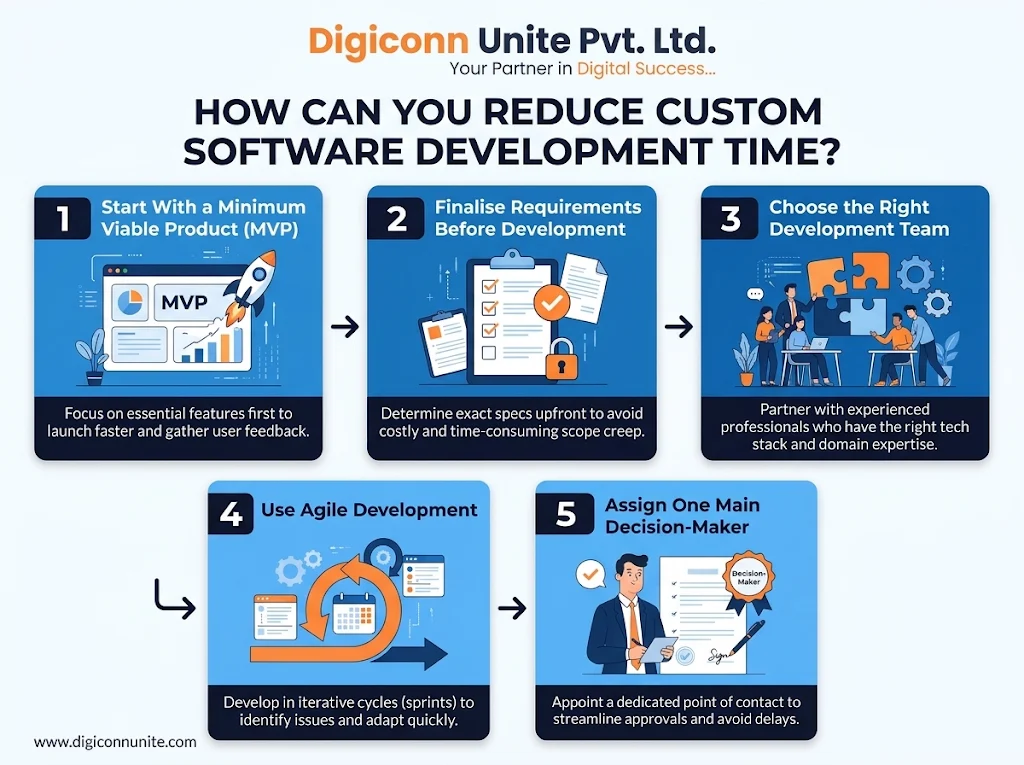
Reducing development time does not mean skipping important stages. It means removing avoidable delays and focusing on the work that delivers the most value.
Start With a Minimum Viable Product (MVP)
Instead of developing every possible feature in the first release, identify the essential functionality required to solve your main business problem.
For example, an initial inventory management application might include:
-
Product management.
-
Stock tracking.
-
Purchase records.
-
Sales records.
-
Basic reporting.
Advanced analytics, automated notifications, and additional integrations can be introduced in later releases.
This approach helps businesses launch a usable product sooner and improve it using actual user feedback.
Finalise Requirements Before Development
Prepare a documented feature list and define what each feature should do.
Make sure the development team understands the expected behaviour, user permissions, and important business rules before coding begins.
Choose the Right Development Team
A capable team should understand your business requirements, technical challenges, and expected delivery schedule.
Look for experience in similar projects, clear communication, proper testing practices, and transparent milestone planning.
Use Agile Development
Agile development allows teams to divide projects into manageable sprints.
Regular demonstrations help identify problems early and give stakeholders opportunities to review progress.
Assign One Main Decision-Maker
Having one authorised person responsible for approvals can reduce conflicting feedback and unnecessary waiting.
It also makes communication between the business and development team more organised.
Custom Software Development Timeline: An Example
Consider a business planning to build a custom CRM application with customer management, lead tracking, employee accounts, reporting, and basic notifications.
A possible development schedule could look like this:
| Development Stage | Estimated Time |
|---|---|
| Requirement gathering | 2 weeks |
| UI/UX design | 3 weeks |
| Architecture and technical planning | 1 week |
| Core development | 10 weeks |
| Testing and final improvements | 3 weeks |
| Deployment | 1 week |
| Total estimated time | 20 weeks |
Some activities can overlap, so the actual calendar duration may be shorter or longer than the sum of individual stage estimates.
This example also shows why asking only how long coding takes does not provide a complete picture of the delivery schedule.
How to Get an Accurate Custom Software Development Estimate
Before requesting a development timeline, prepare the information that helps developers understand the actual project.
Consider these points:
-
Business objective: Explain what problem the software should solve.
-
Target users: Identify who will use the application.
-
Required features: List the essential features for the first release.
-
Existing systems: Mention databases, applications, and external services that need integration.
-
Platform requirements: Specify whether you need web software, desktop software, mobile applications, or multiple platforms.
-
Security requirements: Identify sensitive information and access restrictions.
-
Expected launch date: Share your preferred timeline and any important business deadlines.
A development team can use these details to prepare a more realistic project roadmap, identify technical risks, and estimate delivery milestones.
Avoid accepting a fixed delivery promise before the development team has understood the project scope.
Digiconn Unite helps businesses transform their software ideas into functional, scalable, and business-focused digital solutions. If you are planning a custom software project, start with clearly defined requirements and a development roadmap that matches your business goals. Contact now!
Final Thoughts
So, how long does it take to build custom software? The realistic answer is anywhere from a few weeks for a small application to several months or more for a complex business platform.
The most important factors are not simply the number of developers or the speed of coding. Requirements, feature complexity, integrations, testing, and communication all influence the final delivery date.
Planning the project properly, prioritising essential features, and choosing an experienced development partner can make the entire process more predictable.
Frequently Asked Questions (FAQs)
1. How long does it take to develop custom software from scratch?
Developing custom software from scratch generally takes 2–4 months for a focused business application, 3–6 months for a medium-complexity platform, and 6–12 months or longer for advanced enterprise software. The timeline depends on features, integrations, architecture, testing, and project requirements.
2. Can custom software be developed in 30 days?
Yes, a small and clearly defined application with limited features may be developed within 30 days. However, complex applications involving multiple modules, integrations, advanced security, or extensive testing usually require more time.
3. How long does it take to build custom ERP software?
A single ERP module may take approximately 2–4 months, while a complete ERP system with inventory, finance, HR, sales, purchasing, and reporting can take 6–12 months or longer. Data migration and integration requirements can further extend the timeline.
4. Does custom software development take longer than ready-made software?
Custom software usually takes longer to deliver because it is designed and developed around specific business requirements. Ready-made software can be configured and implemented more quickly, but it may not support every specialised workflow your business needs.
5. What is the fastest way to build custom software?
The most practical approach is to start with an MVP, finalise requirements, use reusable components where appropriate, prioritise essential features, and follow an Agile development process. Quick client approvals and early testing also help reduce avoidable delays.
6. Can developers build custom software in phases?
Yes. Phased development allows businesses to launch essential functionality first and introduce additional modules over time. This approach makes large projects easier to manage and allows businesses to validate features before investing in further development.
7. Does software testing increase the development timeline?
Yes, testing requires dedicated time. However, it helps identify functional errors, security weaknesses, integration problems, and performance issues before users encounter them. Skipping proper testing can create much larger problems after launch.
8. When should a business start custom software development?
A business should start when it has identified a clear operational problem, defined its essential requirements, and determined that existing software cannot adequately support its needs. A discovery and planning stage is a good starting point.
Related Topics
Explore more about software development:
