


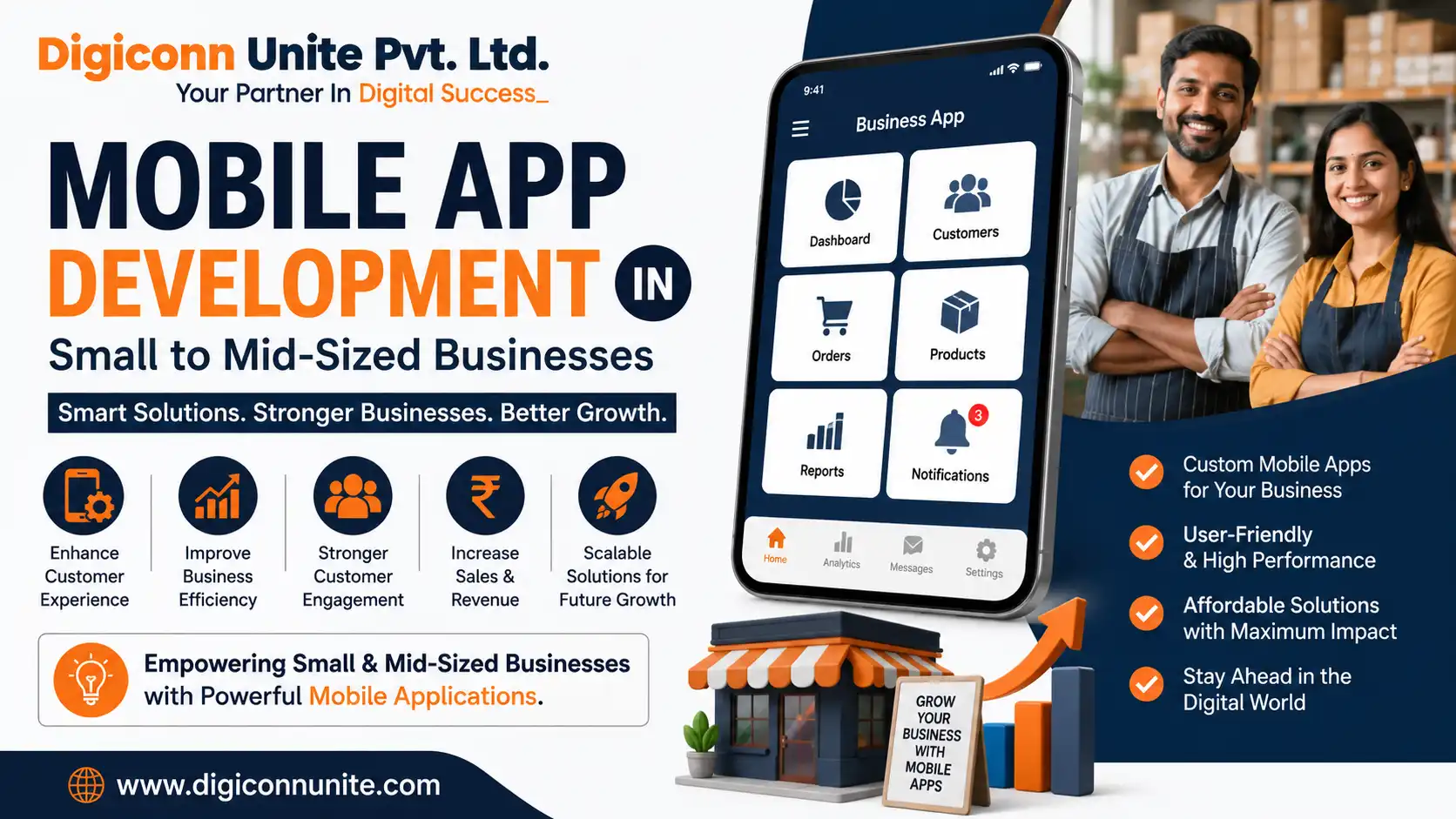
Most small and mid-sized business owners in India ask the same question when they first think about a mobile app: "Is this really for a business like mine, or only for big companies?"
The answer has changed. A few years ago, building a mobile app meant spending several lakhs on development, waiting months for delivery, and then hoping users would download it. Today, the tools, the process, and the cost structure have all shifted — and small businesses across India, from coaching institutes in Agra to grocery stores in Noida, are using mobile apps to serve customers, manage operations, and stay ahead of competitors.
This blog explains what mobile app development actually involves for a small or mid-sized business, when it makes sense to invest in one, what it genuinely costs in Indian rupees, and how to avoid the most common mistakes. If you are a business owner — not a developer — this is written specifically for you.
Why Indian SMEs Are Moving Toward Mobile Apps Faster Than Ever
India has over 750 million smartphone users. The vast majority of them use Android. When your customer opens their phone to search for a product, book a service, or check an order status — they are doing it on a mobile device, not a laptop.
This shift has a direct business impact. A customer who can order from your app at 11 PM does not need to call you the next morning. A field sales team that logs visits on an app gives you real data instead of paper reports. A coaching institute that sends live results and schedule updates through an app retains students better than one sending WhatsApp forwards.
Mobile apps are not about technology for its own sake. They solve specific business problems — and for Indian SMEs in 2026, those problems are real and growing.
Do You Actually Need a Mobile App? An Honest Answer for SME Owners
Not every business needs a custom mobile app right now. Before spending money on development, answer these five questions honestly.
1. Do your customers interact with your business repeatedly? A one-time service business, like a wedding decorator, gets limited value from an app. A business with repeat customers — a coaching institute, a grocery delivery service, a gym, a pharmacy — gets much more value because the app becomes a daily touchpoint.
2. Is there a specific problem the app would solve? "Having an app" is not a business goal. "Reducing manual order calls by 60%" or "sending automated fee reminders to 200 students every month" — those are real problems an app can solve.
3. Would your customers actually use it? If your customers are comfortable on smartphones and interact with other apps regularly, adoption is achievable. If your primary customers are elderly or not tech-comfortable, a mobile-optimised website may serve them better than an app they need to download and learn.
4. Can a mobile-optimised website solve the same problem? For many small businesses, a fast, well-designed website that works perfectly on mobile is sufficient. An app makes more sense when you need push notifications, offline functionality, loyalty programmes, or device-specific features like camera access or GPS.
5. Do you have a plan for maintaining the app after launch? An app that is not updated breaks. Operating systems change. Bugs appear. If there is no plan or budget for ongoing maintenance, even a well-built app deteriorates quickly.
If your answers suggest a strong case for an app, read on. If they do not, a mobile-optimised website and strong digital presence may be a better starting point.
Types of Mobile Apps That Work Well for Small and Mid-Sized Businesses
Understanding which type of app fits your business saves you time and money at the planning stage.
Customer-Facing Apps
These are apps your customers download and use directly. Examples include online ordering apps for restaurants and grocery stores, appointment booking apps for clinics and salons, and loyalty and rewards apps for retailers. The goal is to make it easier for customers to buy from you, stay connected, and keep coming back.
Employee and Field Team Apps
These are internal tools for your team. A field sales management app that logs customer visits, tracks targets, and sends location updates replaces daily manual reporting. An inventory management app for warehouse staff reduces errors and saves hours of paperwork. These apps are often overlooked by small businesses but deliver some of the clearest, most measurable returns on investment.
On-Demand Service Apps
Apps that connect customers to a service in real time — like a cab booking app, a home services app, or a grocery delivery app — follow a model similar to Uber, Swiggy, or Urban Company. These are more complex and more expensive to build, but the business model itself is proven and scalable.
Education and Coaching Apps
For coaching institutes, schools, and online tutors, a dedicated app can handle fee collection, class schedules, live sessions, test results, and parent communication in one place. In a market where students and parents are already spending hours on phones, an app that centralises everything your institute does creates genuine loyalty.
Android vs iOS: Which Platform Should You Build for First?
This is one of the most common questions Indian SME owners ask — and the answer for most Indian businesses is clear: build for Android first.
India's smartphone market is approximately 95% Android by installed base. Unless your specific target audience is premium urban professionals (think high-end financial advisory or luxury retail), starting with Android reaches the widest possible Indian customer base.
If your business needs to serve both platforms eventually, cross-platform development using Flutter or React Native builds one app that runs on both Android and iOS. This approach typically costs 30–40% less than building two separate native apps and is now the recommended path for most Indian SMEs who need both platforms.
You can read a detailed technical breakdown in our comparison of Android vs iOS app development differences to understand which platform suits your specific business scenario.
What Does Mobile App Development Actually Cost in India?
Both competing articles on this topic give US dollar pricing that is not relevant to most Indian SMEs. Here are realistic INR ranges for the Indian market.
| App Type | Estimated Cost (INR) | Timeline |
|---|---|---|
| Basic business app (booking, catalogue, contact) | ₹80,000 – ₹2,50,000 | 6 – 10 weeks |
| Mid-complexity app (e-commerce, coaching, loyalty) | ₹2,50,000 – ₹6,00,000 | 10 – 16 weeks |
| On-demand service app (Uber/Swiggy model) | ₹5,00,000 – ₹12,00,000+ | 16 – 24 weeks |
| Enterprise / ERP mobile module | ₹8,00,000 – ₹20,00,000+ | 20 – 36 weeks |
These figures cover development only. Ongoing maintenance, hosting, and updates typically add 15–20% of the development cost annually.
Several factors push the final cost up or down: the number of user roles in the app, whether you need both Android and iOS, the complexity of backend integration, payment gateway requirements, and whether third-party APIs (like maps, SMS, or video calling) are included.
Always ask for a written, itemised quote before committing. A quote that says "₹3 lakh for a complete app" without specifying features, platforms, and deliverables is not a quote — it is a starting number that grows through the project.
The Development Process: What Actually Happens, Step by Step
Many business owners feel anxious about app development because they don't know what they are paying for at each stage. Here is what a genuine, professional development process looks like.
Step 1 — Requirement discovery. The developer or agency understands your business, your users, your core problem, and your budget. This stage shapes everything that follows. A provider who skips this and jumps straight to quoting is cutting corners.
Step 2 — Wireframes and design. Before a single line of code is written, you see what the app will look like. Screens are mapped out, user flows are defined, and the design is approved. Changes at this stage are cheap. Changes during development are expensive.
Step 3 — Development. The actual build happens in stages, typically with regular check-ins so you can see progress rather than waiting weeks for a finished product. Choosing the right mobile app development partner at this stage determines how smooth this process is.
Step 4 — Testing. The app is tested across different Android devices and operating system versions, since India's diverse device ecosystem means an app that works on a Samsung flagship must also work on a Redmi budget phone.
Step 5 — Launch and App Store submission. Publishing an Android app to the Google Play Store requires a developer account and adherence to Play Store guidelines. This process takes 1–7 days for review.
Step 6 — Post-launch support. Updates, bug fixes, and new feature additions are ongoing. This is not optional — it is how a good app stays useful over time.
Build vs Buy: Should You Use No-Code Tools or Build Custom?
For very simple apps — a basic catalogue, an appointment booking form, a simple loyalty card — no-code platforms like Glide, Bubble, or AppMaster can deliver a working result at a fraction of custom development cost.
The tradeoff is control and scalability. A no-code app is difficult to customise beyond the platform's limits, and you are dependent on the platform's ongoing existence and pricing. For a business that needs a specific workflow, integration with an existing system, or expects significant growth in users, custom development delivers a better long-term return.
Most Indian SMEs start with no-code or a minimal viable product to validate that users will actually use the app, then invest in custom development once the concept is proven. This is a sensible approach that reduces financial risk.
Red Flags When Choosing a Mobile App Development Company
Watch for these warning signs before signing with any development partner. Some of them are covered in detail in our guide on red flags when hiring a mobile app development company in India.
No written contract with clear deliverables. Verbal agreements about features and timelines mean nothing when disagreements arise mid-project.
Full payment demanded upfront. Milestone-based payments protect both parties. A developer asking for 100% payment before starting has no financial incentive to deliver on time.
No portfolio of live, verifiable apps. Ask for Play Store links to apps they have built. If they cannot provide them, the portfolio may be fabricated.
Unrealistically low quotes. An app that would genuinely take 200 hours to build cannot be delivered for ₹40,000. Suspiciously low prices mean corners are being cut — on design, testing, security, or all three.
No mention of post-launch support. An app that is delivered and immediately abandoned when bugs appear is not a finished product.
Mobile App Development Services in Agra for Small and Mid-Sized Businesses
If you are a business owner in Agra or the surrounding region looking for mobile app development services in Agra, the same principles apply — but there is additional value in working with a local or regional team that understands your specific market.
Digiconn Unite provides mobile app development services in Agra for coaching institutes, retail businesses, healthcare providers, on-demand service businesses, and manufacturers looking to build B2B tools for their sales and operations teams. Our development process follows every step outlined in this guide — written strategy before work begins, milestone-based delivery, DPDP-compliant data handling, and post-launch support included.
Whether you need a simple booking app, a multi-vendor marketplace, or a complex on-demand service platform like a safety app, we will walk you through what is realistic for your budget and your business before any development begins.
Final Thoughts
Mobile app development is no longer exclusively for large companies with large budgets. Indian SMEs across retail, education, healthcare, and services are building apps that solve specific, real problems — and the ones doing it well are seeing measurable improvements in customer retention, operational efficiency, and revenue.
The key is to start with a clear problem, choose the right development partner, understand what the process involves, and plan for ongoing support. An app built on a clear foundation delivers value for years. An app built in a hurry to "have an app" creates maintenance headaches and disappoints users.
If you are considering mobile app development for your business and want an honest assessment of what is realistic for your budget and your specific situation, Digiconn Unite offers a free consultation — no obligation and no generic pitch.
Frequently Asked Questions
How much does it cost to build a mobile app for a small business in India?
Realistic costs in India start around ₹80,000 for a basic business app and range to ₹6,00,000 or more for mid-complexity apps with e-commerce, user management, and third-party integrations. On-demand platforms cost significantly more.
Should I build for Android or iOS first?
For most Indian businesses, Android should come first given India's 90%+ Android market share. If budget allows, cross-platform development using Flutter covers both Android and iOS in one build at lower cost than building two separate apps.
How long does mobile app development take for a small business?
A basic app typically takes 6 to 10 weeks from requirement discovery to Play Store launch. Mid-complexity apps take 10 to 16 weeks. Timelines depend heavily on how quickly decisions are made during the design and feedback stages.
What is the difference between a native app and a cross-platform app?
A native app is built specifically for one platform — either Android or iOS — using that platform's tools. A cross-platform app is built once and runs on both. Cross-platform is more cost-effective and is now used by most Indian SMEs who need both platforms.
Do I need to maintain the app after it is launched?
Yes. Operating system updates, security patches, bug fixes, and new feature requirements all require ongoing maintenance. Budget approximately 15–20% of the original development cost annually for maintenance.
How do I know if my app idea is ready to build?
Start by defining the specific problem the app solves, who will use it, how often, and whether your target users are already comfortable using apps. A genuine development partner will help you validate these answers during the requirement discovery phase — not after you have signed a contract.
Contact Digiconn Unite today for a Mobile App Development in Small to Mid-Sized Businesses.
Related Topics
Explore more about mobile app development:
