



Quick Answer
Yes, web app development is available in Agra. Businesses can work with technology companies that provide web application development, custom software development, business portals, booking systems, customer dashboards, and other browser-based solutions.
A web application can help a business automate repetitive tasks, manage customer information, accept online bookings, track orders, and organise business operations. The right solution depends on your requirements, budget, security needs, and plans for future growth.
If you are searching for web app development company in Agra, Digiconn Unite can help you explore web app development solutions based on your business objectives.
Key Takeaways
- Web app development is available through technology providers serving businesses in Agra.
- A web application is different from a basic website because it allows users to perform tasks and interact with data.
- Businesses can use web apps for bookings, customer management, eCommerce, inventory, education, and business automation.
- Technologies such as HTML, CSS, JavaScript, React, Node.js, PHP, Laravel, and databases may be used depending on project requirements.
- Security, mobile responsiveness, performance, maintenance, and scalability should be considered before starting development.
- Choosing a development partner involves checking relevant experience, project scope, ownership terms, communication, and ongoing support.
What Is Web Application Development?
Web application development is the process of planning, designing, building, testing, and maintaining software that users access through a web browser.
Unlike a basic website that mainly displays information, a web application allows users to complete actions and interact with information.
Depending on its purpose, a web application may include:
- User registration and login
- Customer accounts and dashboards
- Online forms and booking systems
- Product catalogues and shopping carts
- Payment gateway integration
- Appointment scheduling
- Inventory and order management
- Reporting and analytics
- Admin panels and user permissions
- Integration with third-party services
For example, a company website might explain a business's services and display its contact details. A web application for the same company could allow customers to sign in, request services, upload documents, track progress, and manage their accounts.
The main objective is to provide useful functionality through an accessible online platform.
Website vs Web Application: What Is the Difference?
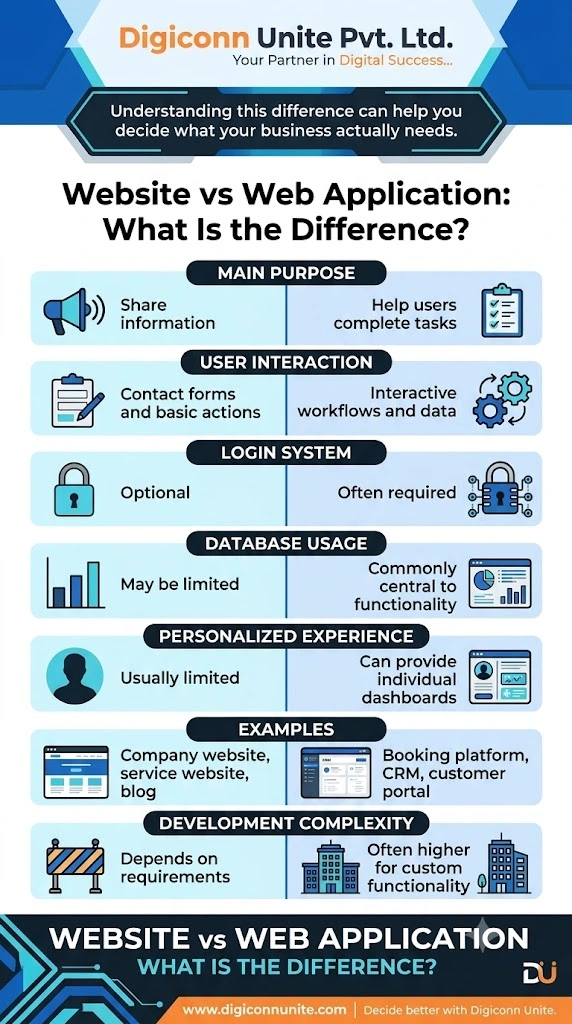
Understanding this difference can help you decide what your business actually needs.
| Feature | Business Website | Web Application |
|---|---|---|
| Main purpose | Share information | Help users complete tasks |
| User interaction | Contact forms and basic actions | Interactive workflows and data |
| Login system | Optional | Often required |
| Database usage | May be limited | Commonly central to functionality |
| Personalised experience | Usually limited | Can provide individual dashboards |
| Examples | Company website, service website, blog | Booking platform, CRM, customer portal |
| Development complexity | Depends on requirements | Often higher for custom functionality |
These categories can overlap. Modern websites may include interactive features, and web applications may also contain public information pages.
A business should choose the solution according to its goals rather than assuming that a more complex application is always better.
If you mainly want to showcase your services and receive enquiries, a professional website may be sufficient. If you need user accounts, data management, automated workflows, or a dedicated online tool, web application development may be more suitable.
Types of Web App Development Services in Agra
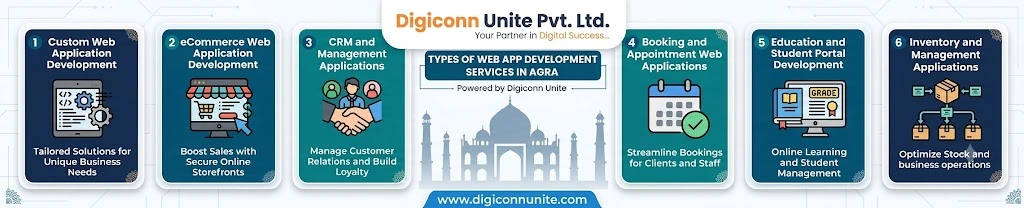
Different businesses require different features. Here are some common types of web applications to consider.
1. Custom Web Application Development
A custom web application is developed around specific business requirements.
It can help organisations manage processes that generic software does not fully support. Features may include customised workflows, role-based access, reports, integrations, and business-specific dashboards.
For example, a manufacturing business may require a system for tracking production stages, managing orders, and monitoring stock.
Custom development is useful when a business needs greater control over its features and workflows.
2. eCommerce Web Application Development
An eCommerce application allows businesses to sell products or services online.
Depending on the business model, it may include:
- Product and category management
- Shopping cart and checkout
- Payment gateway integration
- Customer accounts
- Order tracking
- Inventory management
- Discount and coupon management
- Sales reports
Businesses can also explore marketplace applications that support multiple sellers, product listings, commissions, and order management.
You May Explore It: Cost to Develop an eCommerce Mobile App
3. CRM and Customer Management Applications
A Customer Relationship Management (CRM) application helps businesses organise customer information and sales activities.
A custom CRM may provide lead tracking, contact management, enquiry assignment, follow-up reminders, and sales reports.
For example, a service company can use a CRM to record enquiries, assign leads to team members, and monitor the progress of potential customers.
The required features depend on the company's sales process and reporting needs.
4. Booking and Appointment Web Applications
Booking applications allow customers to schedule services online.
They can be useful for hotels, clinics, consultants, salons, training institutes, and other appointment-based businesses.
Possible features include:
- Available time slots
- Appointment scheduling
- Booking confirmations
- Customer notifications
- Rescheduling and cancellations
- Staff or resource allocation
- Payment integration
A well-planned booking system can reduce manual coordination and make it easier for customers to access services.
5. Education and Student Portal Development
Educational institutions may need web applications to manage students, courses, attendance, assignments, and learning materials.
An education portal could include separate dashboards for students, teachers, and administrators.
Depending on the requirements, it may also support online assessments, fee records, progress reports, and communication tools.
You May Like Also: Custom CRM Software Development for Schools in Agra
6. Inventory and Business Management Applications
Businesses that manage products, orders, employees, or multiple locations may benefit from a centralised application.
Possible features include stock tracking, purchase records, sales reports, invoices, employee permissions, and operational dashboards.
Some projects may require integration with existing accounting software, ERP systems, payment services, or other business tools.
Before development begins, the developer should understand how the new application will exchange information with those systems.
Which Technologies Are Used in Web App Development?
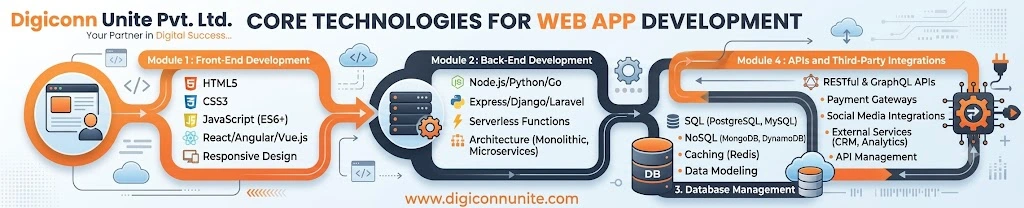
The technology stack depends on the application's complexity, expected traffic, security requirements, and future maintenance needs.
Here are some common technologies and their roles.
Front-End Development
The front end is the part of the application that users see and interact with.
Common technologies include:
- HTML: Structures the content of web pages.
- CSS: Controls layout, colours, typography, and responsive design.
- JavaScript: Adds interactive functionality.
- React: A JavaScript library used to build interactive user interfaces.
- Angular: A framework for building structured web applications.
The right choice depends on the application's interface and development requirements.
Back-End Development
The back end handles application logic, data processing, authentication, and communication with databases or other services.
Common options include:
- Node.js: Runs JavaScript on the server.
- PHP: A server-side language used in many web applications.
- Laravel: A PHP framework that provides tools for structured application development.
- Python: A programming language used for web back ends and other software tasks.
- .NET: A development platform used for web applications and business systems.
Not every project needs every technology. A development team should recommend an appropriate stack rather than selecting tools simply because they are popular.
Database Management
Databases store and organise application information, such as user accounts, orders, products, appointments, and reports.
Common options include MySQL, PostgreSQL, and MongoDB. The choice depends on the type of data, application architecture, and expected workload.
APIs and Third-Party Integrations
An Application Programming Interface (API) allows software systems to communicate with one another.
A web application may use APIs to connect with payment gateways, email services, SMS providers, maps, accounting systems, or an existing CRM.
Integrations should be planned carefully to maintain data accuracy, security, and reliability.
Benefits of Web App Development for Agra Businesses
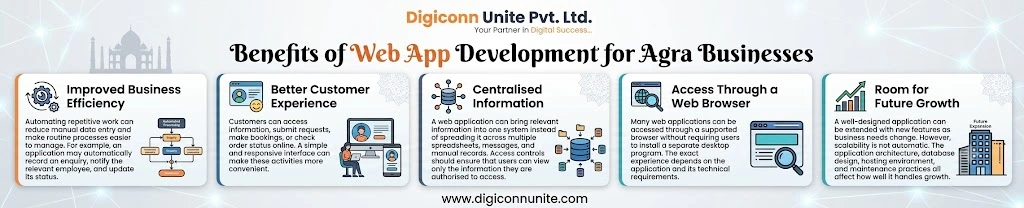
A web application can provide practical advantages when it solves a genuine business problem.
Improved Business Efficiency
Automating repetitive work can reduce manual data entry and make routine processes easier to manage.
For example, an application may automatically record an enquiry, notify the relevant employee, and update its status.
Better Customer Experience
Customers can access information, submit requests, make bookings, or check order status online.
A simple and responsive interface can make these activities more convenient.
Centralised Information
A web application can bring relevant information into one system instead of spreading it across multiple spreadsheets, messages, and manual records.
Access controls should ensure that users can view only the information they are authorised to access.
Access Through a Web Browser
Many web applications can be accessed through a supported browser without requiring users to install a separate desktop program.
The exact experience depends on the application and its technical requirements. Some features may require an internet connection or a compatible device.
Room for Future Growth
A well-designed application can be extended with new features as business needs change.
However, scalability is not automatic. The application architecture, database design, hosting environment, and maintenance practices all affect how well it handles growth.
How Much Does Web App Development Cost in Agra?
The cost of web app development in Agra depends on the features, design, technical complexity, integrations, and level of ongoing support required.
A simple application with a few forms and an administrative dashboard will generally require less work than a multi-user platform with complex permissions, payment processing, reporting, and integrations.
Important cost factors include:
- Project scope: The number and complexity of features.
- UI/UX design: The work required to create a clear, accessible interface.
- Development requirements: The front-end, back-end, database, and architecture.
- Integrations: Payment gateways, APIs, CRM platforms, and other systems.
- Security: Authentication, permissions, data protection, and testing.
- Hosting: Server resources, storage, backups, and related services.
- Maintenance: Bug fixes, security updates, monitoring, and improvements.
For a useful estimate, prepare a list of required features and ask the development company to provide a written proposal with milestones, deliverables, exclusions, and ongoing costs.
Avoid choosing a developer on price alone. A low initial quote may not include important features, testing, deployment, or post-launch support.
You May Look Also: How Much Does Custom Software Development Cost in Agra
How to Choose the Right Web App Development Company in Agra
Choosing the right development partner can influence the quality, usability, and long-term value of your application.
Before making a decision, consider these factors.
1. Review Relevant Experience
Ask to see examples of similar projects. If you need a booking application, for instance, ask whether the team understands scheduling, availability, notifications, and cancellation workflows.
Relevant experience is more useful than a long list of technologies without supporting examples.
2. Discuss Your Requirements First
A reliable development process should begin with questions about your business, users, current workflow, and project goals.
The developer should help define the essential features before recommending a technical solution.
3. Check the Development Process
Ask how the company handles discovery, design, development, testing, deployment, and maintenance.
You should understand what happens at each stage and how progress will be communicated.
4. Ask About Security
Discuss secure authentication, access permissions, data protection, backups, software updates, and testing.
If the application handles personal, financial, or sensitive business information, security requirements should be addressed during planning rather than added at the last minute.
5. Confirm Ownership and Documentation
Before signing an agreement, clarify who will own the source code, design assets, domain, hosting account, and project documentation.
Confirm how you will receive access to the application and its related systems.
6. Understand Support After Launch
Applications need ongoing attention. Ask who will handle bug fixes, updates, monitoring, and future feature requests.
The agreement should explain the support period, response process, and any additional charges.
7. Consider SEO and Performance
If your web application also includes public pages that need to appear in search engines, discuss technical SEO, page speed, mobile usability, indexability, and suitable page architecture.
Not every private dashboard needs to be indexed by Google. In fact, private user areas should be protected appropriately rather than exposed as public search results.
Why Consider Digiconn Unite for Web App Development?
If you are exploring web app development service in Agra, Digiconn Unite is a local digital solutions company offering website development and web application-related solutions.
The right starting point is to explain the problem you want the application to solve. This could mean building a booking platform, creating a customer portal, organising internal workflows, or developing a custom online business tool.
How Digiconn Unite Can Support Your Project
Depending on your project scope, the discussion may cover:
- Requirement planning: Defining the purpose, target users, and essential features.
- Web development: Exploring the front-end and back-end requirements for your application.
- Responsive design: Planning an interface that works across suitable screen sizes.
- Database and integrations: Identifying data requirements and connections with external services.
- Testing and deployment: Establishing how the application will be checked and launched.
- Future improvements: Discussing maintenance and potential feature updates.
Conclusion
Web app development in Agra gives businesses an opportunity to move beyond basic websites and build online tools that support everyday operations.
Whether you need an appointment system, customer dashboard, eCommerce platform, student portal, or custom business application, start by identifying the problem you want to solve. Then evaluate the required features, technology, security, budget, and long-term maintenance needs.
A successful web application is not simply a collection of features. It should be useful for its intended users, reliable in daily operation, and practical to maintain as the business grows.
Frequently Asked Questions
1. Is there web app development in Agra?
Yes. Businesses can find technology providers serving Agra that offer web application development and related software services. Availability, technical expertise, and project suitability should be confirmed directly with each provider.
2. What is the difference between web development and web app development?
Web development is a broad term that includes building websites and web applications. A standard website often focuses on presenting information, while a web application enables users to complete tasks, manage data, or interact with customised features.
3. Which businesses need web application development?
Retailers, educational institutions, hotels, clinics, manufacturers, service providers, and startups may benefit from web applications. The need depends on whether the business requires features such as online bookings, customer accounts, inventory management, reporting, or automated workflows.
4. How long does it take to develop a web application?
The timeline depends on the application's complexity, required features, integrations, testing, and availability of project information. A small application may take considerably less time than a complex multi-user platform. Ask the developer for a timeline based on an agreed project scope.
5. Is a web application mobile-friendly?
It can be. Developers can design responsive interfaces that adapt to different screen sizes. However, mobile responsiveness should be included in the project requirements and tested on suitable devices and browsers.
6. Can a web application connect with existing business software?
Yes, if the relevant systems support suitable integration methods. APIs and other integration approaches can connect a web application with services such as payment gateways, CRM platforms, email tools, and accounting software. Compatibility should be assessed before development.
7. Is custom web application development suitable for small businesses?
It can be suitable when a business has specific requirements that existing tools do not adequately meet. However, a ready-made platform or simpler website may be more cost-effective for some businesses. Compare the total cost, functionality, maintenance, and flexibility before deciding.
8. How do I choose the best web application development company in Agra?
Review relevant project experience, development processes, security practices, pricing clarity, ownership terms, communication, and post-launch support. Ask for a written scope of work and a realistic timeline before committing.
9. Does web application development include maintenance?
Not necessarily. Maintenance may be included in a support agreement or charged separately. Confirm whether the proposal covers bug fixes, security updates, backups, monitoring, hosting, and future improvements.
10. How can I contact Digiconn Unite about web app development?
Visit the Digiconn Unite website to explore its services and contact the team about your project requirements. Share your goals, expected features, and preferred timeline to help the team understand your needs.
Visit Also: How Much Does It Cost to Develop School Management Software
Our Social Links:
Related Topics
Explore more about software development:
